
The Metallurgy of Tip Oxidation: Why It Happens
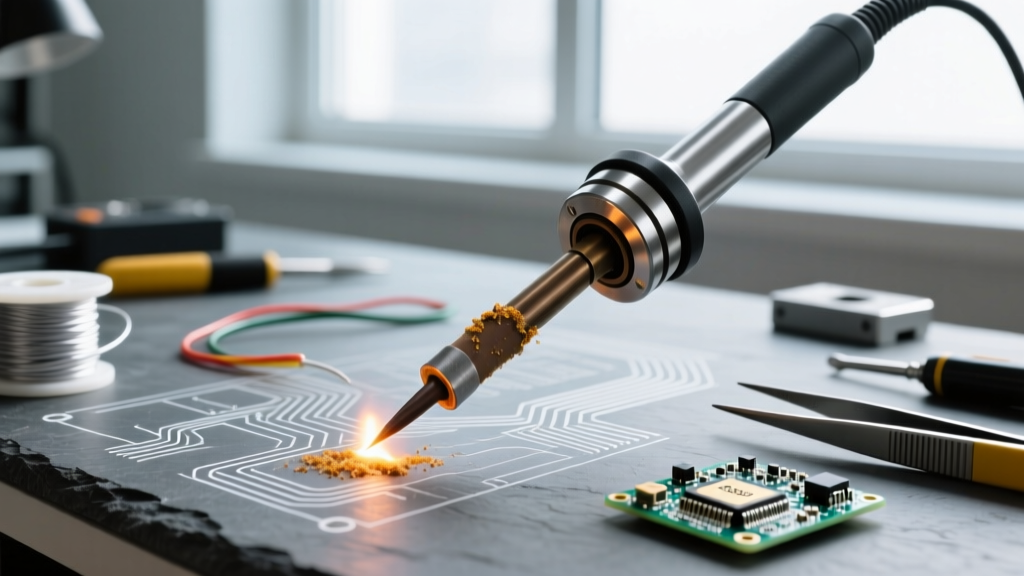
Every modern soldering tip, from a standard Hakko T18 to a high-end Weller RT3, shares a fundamental metallurgical vulnerability. The core is highly conductive copper, but copper dissolves rapidly into molten solder. To prevent this, manufacturers electroplate the copper with a layer of iron, typically between 100 and 150 microns thick. While iron resists solder dissolution, it reacts aggressively with oxygen when heated. When you leave a station powered on at 350°C (662°F) without a protective solder coating, the iron plating reacts with atmospheric oxygen to form iron oxide (Fe2O3 and Fe3O4). This creates a hard, black, non-wetting crust that acts as a severe thermal insulator.
According to industry benchmarks referenced by IPC J-STD-001 standards for soldered electrical and electronic assemblies, a properly wetted tip is critical for forming reliable intermetallic bonds. An oxidized tip fails to transfer heat, leading to cold joints, prolonged dwell times, and eventual thermal damage to sensitive PCB pads and components.
Diagnostic Matrix: Assessing Tip Degradation
Before reaching for abrasives, you must accurately diagnose the oxidation stage. Misidentifying severe oxidation as mild will lead to improper cleaning and permanent tip destruction.
| Oxidation Stage | Visual Indicator | Thermal Conductivity | Restoration Method |
|---|---|---|---|
| Mild | Dull grey / loss of mirror shine | ~85% | Damp cellulose sponge + fresh Sn63/Pb37 solder |
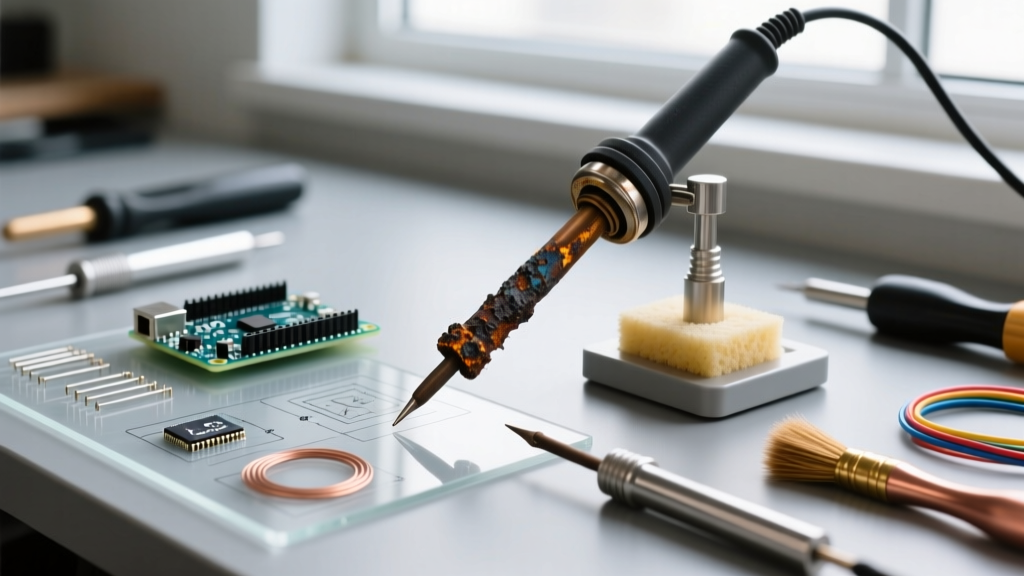
| Moderate | Blue/Purple heat tinting | ~40% | Hakko 599B brass wool + Kester 186 liquid flux |
| Severe | Matte black crust (Fe3O4) | <10% | MG Chemicals 872 Tip Tinner + chemical reduction |
| Terminal | Pitting / Iron plating breach | 0% (Copper dissolves) | Replace tip immediately; copper core is compromised |
The 4-Step Professional Restoration Protocol
If your soldering iron oxidized tip has reached the moderate or severe stage, standard sponges will not work. You must use a combination of chemical reduction and gentle mechanical agitation. This protocol costs less than $25 in consumables and can revive a $12 tip in under three minutes.
Step 1: Chemical Reduction (Tip Tinning)
Power down the station and let the tip cool to around 250°C (482°F). Dip the blackened tip directly into a container of MG Chemicals 872 Tip Tinner (approximately $9.99 for a 20g jar). The tinner contains a highly aggressive rosin-based flux mixed with fine solder powder. The flux chemically strips the iron oxide layer, while the solder powder immediately wets the freshly exposed iron. Swirl the tip for 3 to 5 seconds. Wipe away the black, burnt flux residue.
Step 2: Mechanical Agitation (Brass Wool)
Never use steel wool or abrasive pads. Steel is harder than the iron plating and will scratch it, while copper/brass is softer. Plunge the tip into a Hakko 599B Brass Wool Tip Cleaner ($8.50). Twist the iron in a figure-eight motion 4 to 5 times. The brass shavings scrape away the remaining carbonized flux and microscopic oxide inclusions without breaching the 100-micron iron layer.
Step 3: Flux Activation
Turn the station back on to your standard working temperature (e.g., 315°C for leaded, 350°C for lead-free). While the tip is heating, dip it into a small puddle of Kester 186 RMA (Rosin Mildly Activated) Liquid Flux. As the tip crosses the 180°C threshold, the flux will boil, actively reducing any micro-oxides that formed during the heat-up phase.
Step 4: Protective Tinning
The moment the flux stops boiling and the tip reaches full temperature, immediately apply a generous bead of thick, flux-cored solder (preferably Sn63/Pb37 for tinning, even if you solder with lead-free alloys later). The tip should instantly flash to a bright, mirror-like silver. You have successfully restored the thermal transfer pathway.
CRITICAL WARNING: Never use sandpaper, a metal file, or a Dremel tool on a soldering iron oxidized tip. Abrasives will instantly strip the microscopic iron plating. Once the copper core is exposed, it will dissolve into the solder pool within minutes, creating a pitted, useless crater. As noted in technical bulletins from Hakko, physical abrasion is the number one cause of premature tip failure in DIY and repair environments.
The Lead-Free Oxidation Multiplier
As of 2026, the consumer electronics repair sector has fully transitioned to lead-free solders like SAC305 (Sn96.5/Ag3.0/Cu0.5) for RoHS compliance. However, SAC305 has a melting point of 217°C (423°F), requiring station setpoints of 360°C to 380°C. Oxidation rates do not scale linearly with temperature; they scale exponentially. Operating a tip at 380°C increases the oxidation rate by a factor of 3.5 compared to operating at 315°C with Sn63/Pb37.
If you primarily solder with lead-free alloys, you must adapt your maintenance habits:
- Lower Idle Temperatures: Utilize your station's sleep mode. If you use a Pinecil V2 or a Weller WE1010, configure the auto-sleep to drop the tip to 150°C after just 3 minutes of inactivity.
- Use Larger Tip Geometries: A chisel tip (like the Weller RT4) has higher thermal mass than a micro-pencil (RT1). Higher thermal mass allows you to set the station temperature 20°C lower while still delivering the same joules of heat to the joint, drastically reducing oxidation.
- Tin Before Power-Down: Never turn off your station with a clean tip. Always melt a large blob of cheap, leaded solder onto the tip before switching the power off. This sacrificial blob will oxidize instead of the iron plating while the iron cools down.
Station-Specific Troubleshooting & Edge Cases
Different heating technologies handle oxidation differently. Here is how to manage edge cases across popular 2026 platforms:
1. Cartridge-Style Tips (JBC / Hakko FX-951)
Cartridge tips integrate the heating element directly inside the tip shank. Because they heat up in under 2 seconds, they spend zero time in the "oxidation danger zone" (250°C–300°C) during startup. However, if a cartridge tip oxidizes, the internal sensor may misread the thermal mass and overshoot the temperature, baking the oxide layer harder. Fix: Always use chemical tip tinner first; never rely on the station's rapid heat-up to burn through oxide.
2. High-Frequency Induction Stations (Quick 861DW)
Induction stations use eddy currents to heat the tip directly. If the tip becomes heavily oxidized and pitted, the magnetic coupling efficiency drops. You may notice the station drawing max wattage but failing to reach 350°C. Fix: If chemical restoration does not restore the shiny iron surface, the magnetic skin depth has been altered by pitting. Replace the tip.
3. Portable USB-C Irons (Pinecil V2 / FNIRSI HS-01)
These devices rely on fast PID tuning. An oxidized tip causes erratic PID oscillation because the thermal transfer from the internal heater to the tip surface is choked by the Fe3O4 layer. The screen may show 320°C, but the actual tip surface is only 220°C. Fix: Clean the tip, then perform a PID auto-tune in the device settings menu to recalibrate the thermal algorithm for the restored tip.
Preventative Maintenance Schedule
To ensure your tips last for years rather than weeks, implement this strict maintenance cadence:
- Pre-Session: Inspect the tip for dullness. If dull, apply liquid flux and fresh solder before touching a PCB.
- Mid-Session: Wipe on a damp (not soaking wet) cellulose sponge or brass wool only when excess carbonized flux builds up. Unnecessary wiping strips the protective solder layer and exposes hot iron to air.
- Post-Session: Melt a generous amount of flux-cored solder over the entire working surface of the tip. Leave the blob intact and power off the station.
- Monthly: Inspect the tip shank and the station's heating element bore for oxidized scale. Clean the bore with a cotton swab and isopropyl alcohol to ensure optimal thermal coupling.
By understanding the chemistry of oxidation and utilizing chemical reduction over mechanical abrasion, you can maintain peak thermal performance and achieve the high-reliability solder joints demanded by modern electronics repair. For further reading on professional soldering requirements and workmanship standards, consult the Kester technical data sheets on flux activation and wetting dynamics.