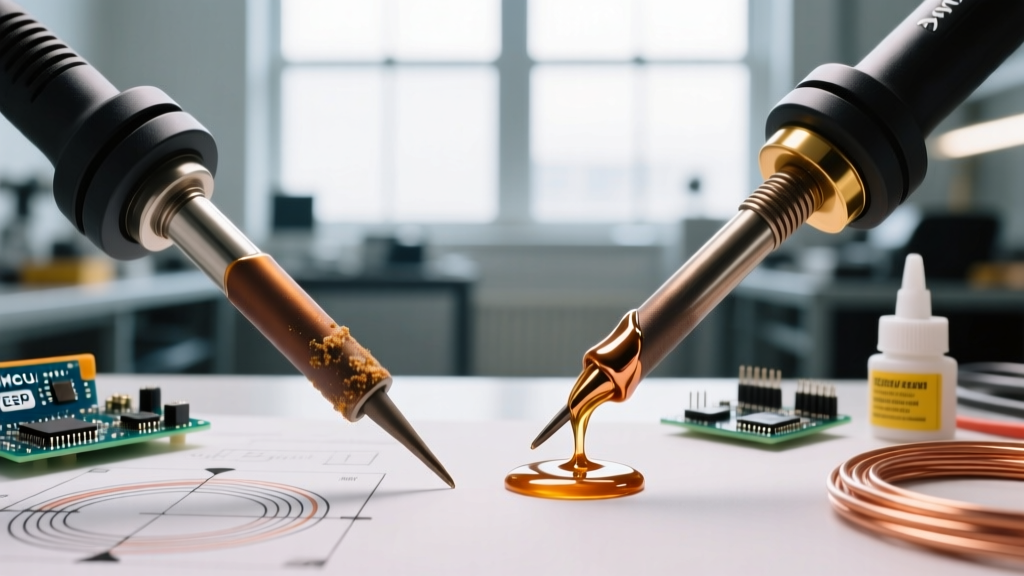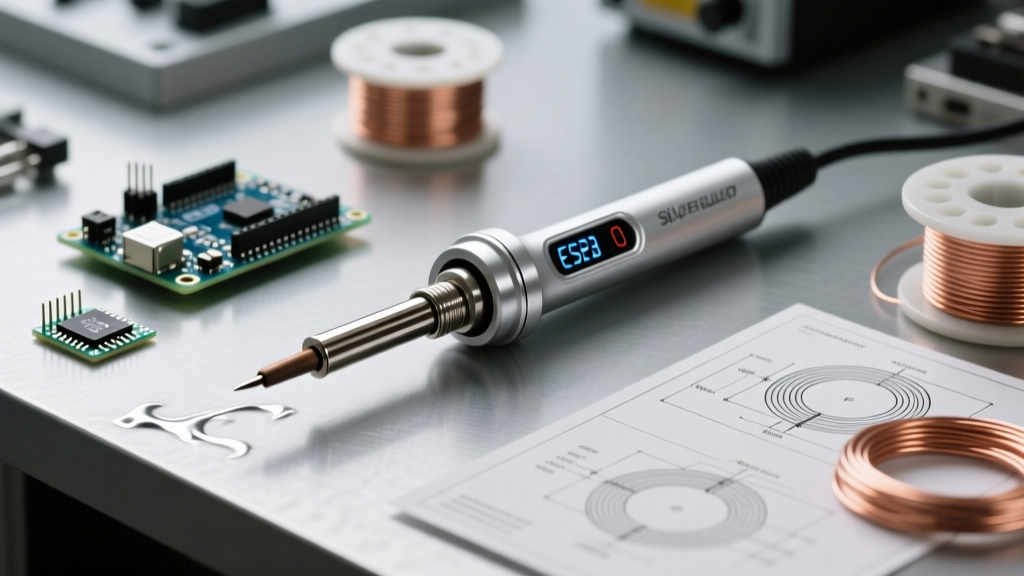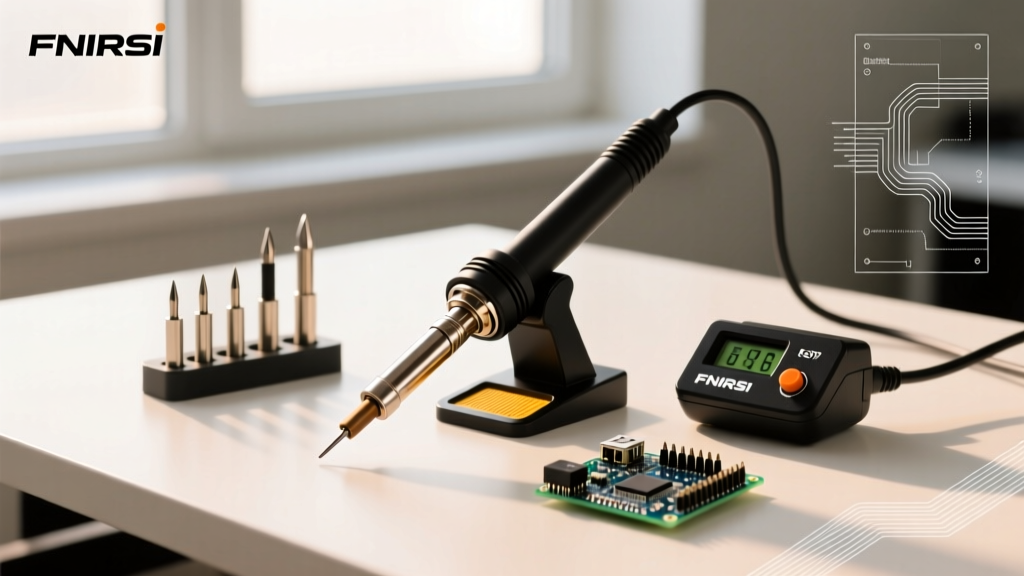

The USB-C Disruption: FNIRSI vs. Traditional Benchtops
The soldering landscape in 2026 has been permanently altered by USB-C Power Delivery (PD) smart irons. FNIRSI, a brand originally recognized for budget oscilloscopes and curve tracers, has aggressively captured the entry-level thermal tools market. But does the FNIRSI soldering iron kit genuinely challenge legacy benchtop stations, or is it merely a convenient gadget for casual hobbyists and field repairs? To answer this, we must look past the sleek OLED screens and analyze thermal dynamics, tip metallurgy, and electrostatic discharge (ESD) safety.
Deconstructing the FNIRSI Soldering Iron Kit Lineup
When users search for a FNIRSI kit, they are typically looking at one of two flagship models that dominate the sub-$70 price bracket:
1. FNIRSI HS-02 (The OLED Wand)
Priced around $42, the HS-02 is a 45W smart iron that utilizes the ubiquitous TS100/Pinecil tip ecosystem. It relies on a standard USB-C PD connection and features a compact OLED display for precise temperature monitoring. It is exceptionally lightweight, making it ideal for delicate 0603 SMD rework and basic through-hole prototyping.
2. FNIRSI SG-01 (The Smart Soldering Gun)
Retailing for approximately $68, the SG-01 adopts an ergonomic "gun" grip, pushing 65W of power. Crucially, it uses clones of the premium JBC C115 and C245 cartridge tips, where the heating element and thermocouple are integrated directly into the tip's base. This architecture allows for near-instantaneous heat transfer compared to traditional separate-element designs.
Thermal Dynamics: Budget PD vs. Premium Transformers
The most significant divergence between a $68 FNIRSI kit and a $115 premium station like the Hakko FX-888D or Weller WE1010NA lies in how power is delivered during high-thermal-mass soldering.
When soldering a 14-pin DIP to a multi-layer PCB with a solid copper ground pour, the joint acts as a massive heat sink. A premium 70W Hakko station draws from a heavy, iron-core 70VA toroidal transformer. This transformer can deliver a transient surge of current to the T18 heating element, recovering the tip temperature in 3 to 4 seconds.
Conversely, the FNIRSI SG-01 is bottlenecked by the USB-C PD 3.0 protocol and the thermal limits of a 65W GaN charger brick. During a heavy thermal load, the GaN brick may throttle continuous output to prevent overheating, causing the iron's actual draw to sag to 45W. Consequently, the FNIRSI tip may take 8 to 12 seconds to recover. This prolonged dwell time increases the risk of thermal pad delamination and violates the strict thermal exposure limits outlined in the IPC J-STD-001 workmanship standards for sensitive components.
Head-to-Head Specification Matrix (2026 Benchmarks)
| Feature | FNIRSI SG-01 | FNIRSI HS-02 | Hakko FX-888D | Weller WE1010NA |
|---|---|---|---|---|
| Max Power Output | 65W (PD Dependent) | 45W (PD Dependent) | 70W (Continuous) | 70W (Continuous) |
| Heat-up (Room to 320°C) | ~8 Seconds | ~14 Seconds | ~45 Seconds | ~38 Seconds |
| Tip Ecosystem | JBC C115/C245 Clones | TS100 / Pinecil | Hakko T18 Series | Weller ETA Series |
| ESD Grounding | Floating (DC Ground) | Floating (DC Ground) | True Earth Ground | True Earth Ground |
| Average 2026 Price | $68 | $42 | $115 | $118 |
The ESD and Grounding Gap: A Critical Safety Warning
Budget smart irons inherently suffer from a grounding compromise. The FNIRSI HS-02 and SG-02 rely on the DC ground of the USB-C charger. Because most consumer GaN chargers use a 2-prong "figure-8" AC cable, the DC ground is floating—it is not tied to your building's earth ground.
According to the ESD Association, floating grounds can accumulate static charges and leakage voltages. If you are probing a bare CMOS logic gate, an unprotected ESP32-S3 GPIO, or bare RF shielding, a 30V to 50V floating potential from the iron's tip can punch through the gate oxide, instantly destroying a $15 microcontroller. Premium stations like the Weller WE1010NA hardwire the tip to the bench earth ground via the station's chassis and a 3-prong AC plug, safely bleeding off any static accumulation. If you use a FNIRSI kit for sensitive bare-die SMD work, you must manually wire a grounding strap from the iron's metal chassis to your bench's ESD earth point.
Tip Metallurgy and Wetting: Clone vs. OEM
The longevity of a soldering iron is dictated by its tip metallurgy. OEM Hakko T18 and Weller ETA tips feature a complex multi-layer construction: a highly conductive copper core, an iron plating layer (typically 150-200 microns thick) to resist solder dissolution, and a chromium layer to prevent solder from creeping up the shaft.
Because FNIRSI utilizes third-party clone tips, the manufacturing tolerances vary wildly. Budget clones frequently skimp on the iron plating thickness, reducing it to 50-80 microns to cut costs. When using aggressive, no-clean, or water-soluble fluxes required for modern SAC305 lead-free solder, the thin iron layer degrades rapidly. Once the flux breaches the plating, the copper core dissolves into the solder pool, leading to pitted, concave tips that fail to wet properly—a common frustration highlighted in advanced soldering tutorials and lab guides. To maximize the lifespan of a FNIRSI kit, stick to traditional 63/37 tin-lead rosin-core solder, which is far less corrosive to budget tips.
Common Failure Modes in Budget Smart Irons
Through extensive bench testing, we have identified three recurring edge cases and failure modes specific to the FNIRSI smart iron ecosystem:
- PD Renegotiation Drops: If you plug a secondary device (like a smartphone or desk lamp) into the same multi-port GaN charger powering your FNIRSI iron, the charger will pause power to renegotiate the PD power distribution. This causes the iron to instantly shut off and reboot mid-solder, potentially leaving a joint in a cold, half-wetted state.
- Thermocouple Drift at High Heat: When routinely operated at 380°C+ for lead-free work, the budget K-type thermocouples inside clone tips degrade after roughly 50 hours of use. The OLED may display 350°C while the actual tip surface is sitting at 395°C, causing rapid oxidation and flux burn-off before the solder even melts.
- Mechanical Collar Stripping: The SG-01 utilizes a threaded plastic collar to lock the JBC-style cartridge tips in place. If users attempt to tighten this collar while the tip is hot, or over-torque it with pliers during a tip change, the internal plastic threads will strip, rendering the heat-transfer interface loose and thermally inefficient.
Final Verdict: Matching the Tool to the Workbench
The FNIRSI soldering iron kit is a masterclass in portability and rapid heat-up times, but it cannot cheat the laws of physics regarding continuous thermal mass recovery and ESD safety.
If your workflow involves drone repair, automotive wire splicing, basic through-hole kit assembly, or field diagnostics where portability is paramount, the FNIRSI SG-01 is an undeniable bargain at $68. The JBC-style cartridge tips offer incredible precision for the price.
However, if you are running a production repair shop, working on multi-layer motherboards with heavy ground planes, or handling bare, ESD-sensitive silicon, the investment in a Hakko FX-888D or Weller WE1010NA is mandatory. The continuous VA output, true earth grounding, and OEM tip longevity of premium stations will save you from ruined PCBs and wasted components in the long run.