
The Problem with Standard Soldering Tips on Polymers
When repairing cracked 3D prints, automotive interior trim, or consumer electronics enclosures, using a standard copper-core or iron-clad soldering tip is a recipe for disaster. Standard tips possess high surface energy, meaning molten polymers like ABS, PETG, and Polypropylene will aggressively adhere to the metal. This results in carbon buildup, polymer degradation (chain scission), and a weak, messy weld joint. As of 2026, with the increasing use of complex engineering polymers in DIY and prosumer electronics, adapting your bench setup is mandatory.
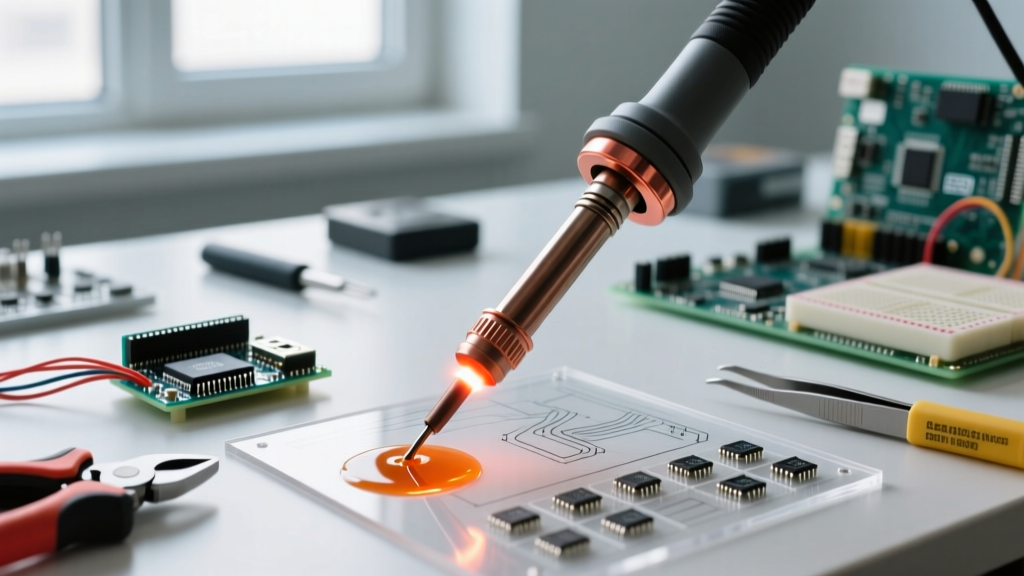
The solution lies in utilizing a specialized plastic welding tip for soldering iron configurations. These tips are coated in PTFE (Polytetrafluoroethylene), commonly known as Teflon. PTFE has one of the lowest coefficients of friction and lowest surface energies of any solid material, allowing molten plastic to glide off the tip without sticking, burning, or leaving residue behind.
Anatomy of a PTFE Plastic Welding Tip
A high-quality plastic welding tip consists of a copper or aluminum alloy core for rapid thermal transfer, encased in a specialized PTFE sleeve or coating. The PTFE layer is typically 0.5mm to 1.0mm thick. It is crucial to understand that PTFE begins to degrade and release toxic fluorocarbon gases at temperatures exceeding 350°C (662°F). Therefore, when using a plastic welding tip for soldering iron stations, you must strictly cap your temperature settings at 300°C to preserve the integrity of the non-stick coating.
Spatula vs. Knife: Choosing the Right Profile
Plastic welding tips generally come in two primary geometries, each serving a distinct structural purpose:
- Wide Spatula (Shoe Tip): Ideal for smoothing, capping, and broad surface melting. The wide thermal mass prevents rapid temperature drops when pressing into thick plastic substrates. Best for cosmetic finishing and embedding reinforcement mesh.
- Angled Knife / Chisel: Designed for cutting, tacking, and precision groove welding. The sharp edge concentrates thermal energy into a small area, allowing you to slice through thick sections or create deep V-grooves for structural joints.
Polymer Temperature Matrix
Dialing in the exact temperature is the difference between a molecular bond and a brittle, degraded mess. Below is the definitive temperature matrix for common repair polymers when using a PTFE-coated plastic welding tip for soldering iron setups. Note that these temperatures reflect the tip setting, not the glass transition temperature of the material.
| Polymer Type | Tip Temperature Range | Melt Characteristics | Common Applications |
|---|---|---|---|
| PLA | 160°C - 180°C | Low viscosity, scorches easily above 200°C | 3D print repairs, cosmetic models |
| ABS | 210°C - 240°C | High tack, excellent melt blending, emits VOCs | Electronics enclosures, auto trim, LEGO |
| PETG | 220°C - 250°C | Stringy, requires higher thermal mass | Waterproof enclosures, drone frames |
| Polypropylene (PP) | 160°C - 170°C | Waxy, low surface energy, difficult to bond | Automotive bumpers, living hinges, tanks |
| Nylon (PA) | 250°C - 280°C | Requires max safe PTFE temps, highly durable | Gears, high-stress mechanical parts |
The Stainless Steel Mesh Reinforcement Technique
A butt joint welded purely with polymer will only achieve roughly 40% to 60% of the tensile strength of the parent material. To achieve structural integrity, you must embed a reinforcement matrix. The industry standard is using 304 Stainless Steel Wire Mesh.
For electronics enclosures and automotive tabs, a 40x40 mesh with a 0.15mm wire diameter provides the optimal balance of flexibility and tensile reinforcement. When pressed into the melt zone, the plastic flows through the microscopic apertures of the mesh. Upon cooling, the mesh acts exactly like rebar in concrete, increasing the joint's shear strength by up to 300%.
Expert Insight: Never use galvanized steel or aluminum mesh. Galvanized coatings vaporize at soldering temperatures, releasing zinc oxide fumes (causing metal fume fever), while aluminum will melt and alloy unpredictably with your soldering iron tip if the PTFE coating is compromised.
Step-by-Step Structural Repair Workflow
Follow this precise methodology for repairing a cracked ABS electronics enclosure or automotive bracket:
- V-Groove Preparation: Use a rotary tool (e.g., Dremel) with a #9901 carbide burr to grind a 60-degree V-groove along the entire length of the crack. This exposes fresh, unoxidized polymer and creates a reservoir for the weld puddle.
- Surface Tacking: Switch to an angled knife plastic welding tip. Set your station to 220°C. Lightly melt the edges of the crack every 2 cm to 'tack' the pieces together, ensuring perfect alignment before full welding.
- Mesh Embedding: Cut your 304 SS mesh slightly narrower than the V-groove. Hold the mesh over the crack. Using a wide spatula PTFE tip set to 230°C, press down firmly. The heat will transfer through the mesh, melting the ABS beneath it. Push the mesh until it sits flush, completely submerged below the surface level of the plastic.
- Capping and Smoothing: Feed a 3mm ABS welding rod into the groove ahead of your spatula tip. Melt the rod into the groove, overfilling slightly. Use the flat back of the spatula to smooth the molten plastic, ensuring a seamless cap over the embedded mesh.
- Post-Processing: Allow the part to cool to room temperature naturally. Do not quench with water, as rapid cooling induces internal thermal stresses and micro-fractures. Once cool, sand flush with 120-grit, then 400-grit sandpaper.
Safety: Mitigating VOCs and Toxic Off-Gassing
Welding polymers is not the same as soldering tin-lead or SAC305 alloys. When ABS reaches its melting and degradation points, it releases Styrene monomers, Butadiene, and potentially Hydrogen Cyanide. According to the U.S. Environmental Protection Agency (EPA), indoor VOC concentrations from heated synthetic materials can be up to ten times higher than outdoors, posing severe respiratory and neurological risks.
Furthermore, the British Plastics Federation notes that while ABS is highly stable in its solid state, thermal degradation during uncontrolled heating requires strict ventilation protocols. In 2026, no professional bench should operate without a dedicated HEPA and Activated Carbon fume extraction system (such as the BOFA AD Qube 3 or a high-static Hakko FA-400 equivalent). Always wear an N95 or P100 respirator equipped with Organic Vapor (OV) cartridges when welding ABS, Nylon, or Polycarbonate.
Troubleshooting Common Failure Modes
1. Plastic Aggressively Sticking to the Tip
- Cause: The PTFE coating has been mechanically scratched (often from using brass wool or steel scrapers) or thermally degraded by exceeding 350°C.
- Solution: Discard the tip immediately. A compromised PTFE layer exposes the copper core, which will instantly oxidize and bond with molten plastic. Clean PTFE tips only with a damp cellulose sponge or a wooden pick.
2. Brittle, Chalky Weld Joints
- Cause: Chain scission due to excessive heat. The polymer chains are breaking down rather than cross-linking, turning the ABS into a brittle, carbonized state.
- Solution: Drop your station temperature by 15°C to 20°C. Increase your physical travel speed, and rely on the thermal mass of the spatula tip rather than raw temperature to maintain the melt pool.
3. Delamination at the Parent Material Boundary
- Cause: Failure to properly prep the surface or welding over oxidized, UV-degraded plastic (common in old automotive parts).
- Solution: Sand the parent material with 80-grit sandpaper and wipe with Isopropyl Alcohol (IPA) before welding. You must expose virgin polymer for a true molecular entanglement to occur.
Final Verdict on Bench Adaptation
Integrating a dedicated plastic welding tip for soldering iron workflows transforms a standard electronics bench into a versatile fabrication and repair station. By respecting the thermal limits of PTFE, utilizing precise temperature matrices, and embedding stainless steel mesh, you can achieve structural repairs that rival or exceed the strength of injection-molded OEM parts. Invest in high-quality, thick-coated PTFE tips, maintain rigorous VOC extraction protocols, and treat polymer chain entanglement with the same scientific respect you apply to metallurgical solder joints.