
The Reality of Soldering Iron Failures in 2026
Most generic guides on how to fix a soldering iron stop at superficial advice like "clean the tip with brass wool" or "re-tin the barrel." But when your iron refuses to heat, throws a digital error code, or trips your workshop GFCI, tip maintenance is entirely irrelevant. True repair requires electrical diagnostics, component-level troubleshooting, and an understanding of your specific station's architecture.
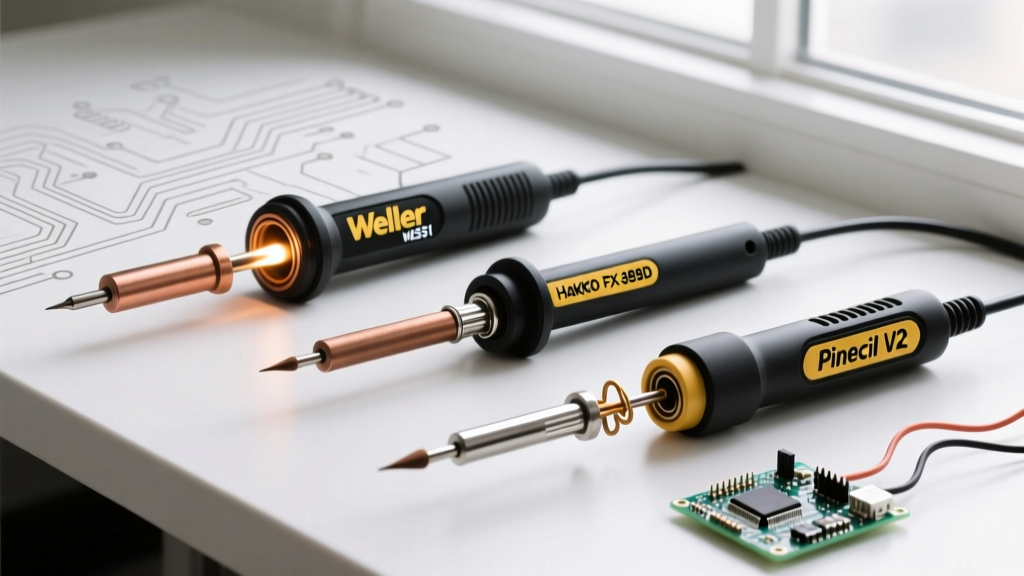
In this tool comparison, we break down the repairability, common failure modes, and exact diagnostic steps for three dominant classes of soldering irons: the analog Weller WES51, the digital Hakko FX-888D, and the open-source smart iron, Pinecil V2. We will compare the cost of component-level repair versus full wand replacement, giving you a precise decision framework for your workbench.
Diagnostic Tool Comparison: What Do You Need to Fix It?
Before opening a chassis, you need the right diagnostic tools. Relying on a $5 multimeter will lead to misdiagnosing low-resistance heating elements. Here is how the standard diagnostic tools compare for soldering station repair:
| Diagnostic Tool | Best Used For | Accuracy Requirement | Estimated Cost (2026) |
|---|---|---|---|
| True-RMS DMM (e.g., Fluke 115) | Measuring heater element resistance and thermocouple continuity. | Must resolve down to 0.1Ω for Hakko T18 heaters. | $180 - $220 |
| Smart DMM (e.g., Uni-T UT61E+) | High-resolution resistance and AC/DC voltage tracking on base stations. | High precision, excellent for PCB-level tracing. | $75 - $95 |
| Infrared Thermal Camera | Identifying shorted triacs, blown MOSFETs, and thermal runaway. | Spot heat anomalies without physical probing. | $250 - $400 |
How to Fix a Soldering Iron: 3-Brand Comparison Matrix
Different architectures dictate entirely different repair strategies. Let us compare the internal failure modes and repair pathways for the three most common station types.
1. Weller WES51 (Analog Workhorse)
The Weller WES51 utilizes the PES51 iron wand. It is an analog system relying on a zero-crossing triac circuit on the main PCB to pulse 24V AC to the heating element.
- Common Failure Mode: The iron light turns on, but the tip remains stone cold.
- Diagnostic Step: Unplug the wand. Set your DMM to Ohms (Ω). Measure across Pins 1 and 2 on the 5-pin DIN connector. A healthy PES51 heating element should read approximately 14.0Ω. If it reads infinite (OL), the internal heater wire is snapped, and the wand must be replaced (~$65).
- Component-Level Fix: If the heater reads 14Ω, the wand is fine. The failure is in the base station. Open the chassis (after waiting 15 minutes for capacitors to discharge) and test the main triac (often a BTA12 or similar). A shorted or open triac costs about $2 to replace from DigiKey, but requires through-hole desoldering skills.
2. Hakko FX-888D (Digital Standard)
The Hakko FX-888D uses the FX-8801 wand and T18 tips. Unlike older irons where the tip was the heater, the T18 is just a thermal mass; the ceramic heater and thermocouple are built into the wand itself.
- Common Failure Mode: The digital display flashes H-E (Heater Error) or L-E (Low Temperature Error).
- Diagnostic Step: According to the Hakko USA FAQs, an H-E code indicates an open circuit in the heater or sensor. Measure the 5-pin connector. Pins 1-2 (Heater) should read ~2.5Ω. Pins 3-4 (Sensor) should read ~2.0Ω.
- Component-Level Fix: If the wand tests fine, the solid-state relay (SSR) or the op-amp on the base station PCB has failed. Replacing the SSR (typically a Toshiba TLP-series) costs under $3. However, because the FX-8801 wand is relatively inexpensive (~$38), most technicians opt to replace the wand rather than perform board-level SMD rework.
3. Pinecil V2 (Open-Source Smart Iron)
The Pinecil V2 is a radically different beast. It runs on a BL702 microcontroller, uses a FUSB302B chip for USB-C Power Delivery (PD) negotiation, and drives a low-voltage MOSFET to heat the tip.
- Common Failure Mode: The screen turns on, but the iron refuses to heat, or it fails to negotiate 20V from a USB-C PD power supply.
- Diagnostic Step: The Pine64 Wiki details the V2 schematic. If PD negotiation fails, the FUSB302B chip or the P-Channel MOSFET protecting the power rail has likely burned out due to a non-compliant USB-C cable injecting incorrect voltage.
- Component-Level Fix: While a micro-soldering expert could replace the FUSB302B chip (cost: $1.50), the pitch is 0.5mm and requires a hot air rework station and microscope. Because a complete replacement Pinecil V2 board costs only $26 in 2026, component-level repair is rarely economical unless you are doing it for the educational experience.
CRITICAL SAFETY WARNING: Before opening the base station of any Weller or Hakko iron, unplug the unit and wait at least 15 minutes. The mains rectification capacitors can hold a lethal charge of 170V DC even when disconnected from the wall. Always verify zero voltage across the primary capacitors with a DMM before touching the PCB.
Step-by-Step Diagnostic Flowchart
When an iron fails, follow this strict sequence to isolate the fault without wasting money on unnecessary replacement parts:
- Visual Inspection: Check the power cord for fraying and the wand connector for bent pins or carbon tracking (black burn marks).
- Cold Resistance Test: Measure the heater element resistance at the wand plug. Compare against the manufacturer's spec (e.g., 14Ω for Weller, 2.5Ω for Hakko).
- Sensor Continuity Test: Measure the thermocouple pins. An open circuit here means the station cannot read temperature and will shut down to prevent thermal runaway.
- Base Station Output Test: If the wand is healthy, plug it in, turn the station on, and carefully measure the AC voltage at the wand receptacle on the base station. (Use extreme caution around mains voltage). If no voltage is present, the fault is in the base station's switching circuit.
- Thermal Verification: After repair, verify the tip temperature using a dedicated tip thermometer (e.g., Hakko FG-100). According to the IPC J-STD-001 Standard for soldered electrical assemblies, equipment must maintain strict thermal recovery profiles; a repaired iron that sags more than 5°C under a standard test load must be recalibrated.
Repair vs. Replace: The Cost-Benefit Breakdown
Is it worth fixing, or should you just buy a new wand? This matrix compares the economics of repair in 2026.
| Brand / Model | Component Fix Cost | Wand Replacement Cost | Skill Level Required | Time to Fix |
|---|---|---|---|---|
| Weller WES51 | $2 (Triac) / $14 (Heater) | $65 (PES51 Wand) | Advanced (Through-Hole) | 45 mins |
| Hakko FX-888D | $1 (Fuse) / $3 (SSR) | $38 (FX-8801 Wand) | Intermediate (SMD) | 30 mins |
| Pinecil V2 | $26 (Full Board Swap) | $10 (Replacement Tip) | Expert (Micro-SMD BGA) | 15 mins (Swap) |
Calibration After Repair
Fixing the hardware is only half the battle. If you replace a heating element or a base station thermocouple amplifier, the iron's temperature reading will drift.
- Analog (Weller): Requires opening the base station and turning a small trimpot on the PCB while monitoring the tip with a FG-100 thermometer until the dial matches the actual tip temperature.
- Digital (Hakko): Uses a button-combination sequence on the front panel to enter "Calibration Mode," allowing you to input an offset value (+/- degrees) to match your external thermometer.
- Smart (Pinecil): Navigate to the Advanced Settings menu, select Calibrate Temperature, and input the offset directly via the digital interface. The V2's internal PID controller will adjust the PWM duty cycle automatically.
Frequently Asked Questions
Why does my soldering iron tip turn black and stop working?
This is oxidation, not an electrical failure. Leaving an iron at 400°C+ without a protective layer of solder burns the flux core and oxidizes the iron plating. Fix this by applying a specialized tip tinner (a mix of aggressive flux and solder powder) while the iron is at 250°C, then wiping it on damp cellulose. Never use sandpaper or files, as they will destroy the microscopic iron plating.
Can I use a generic replacement wand for a Weller or Hakko station?
While third-party wands exist on marketplaces for $15-$20, they often use inferior thermocouple alloys. This causes the station's PID controller to miscalculate thermal mass, leading to severe temperature overshoot that can instantly destroy sensitive surface-mount ICs. Always use OEM wands for professional PCB rework.
How do I know if my USB-C power supply is killing my Pinecil?
If your Pinecil V2 displays a "DC 55" error or refuses to negotiate past 12V, your power supply may lack proper E-Marker chips or have floating ground issues. Always use high-quality, USB-IF certified 100W PD power supplies (like those from Anker or UGREEN) to prevent the FUSB302B negotiation chip from burning out.