
The Legacy of the Hakko FX-888D in Modern Electronics
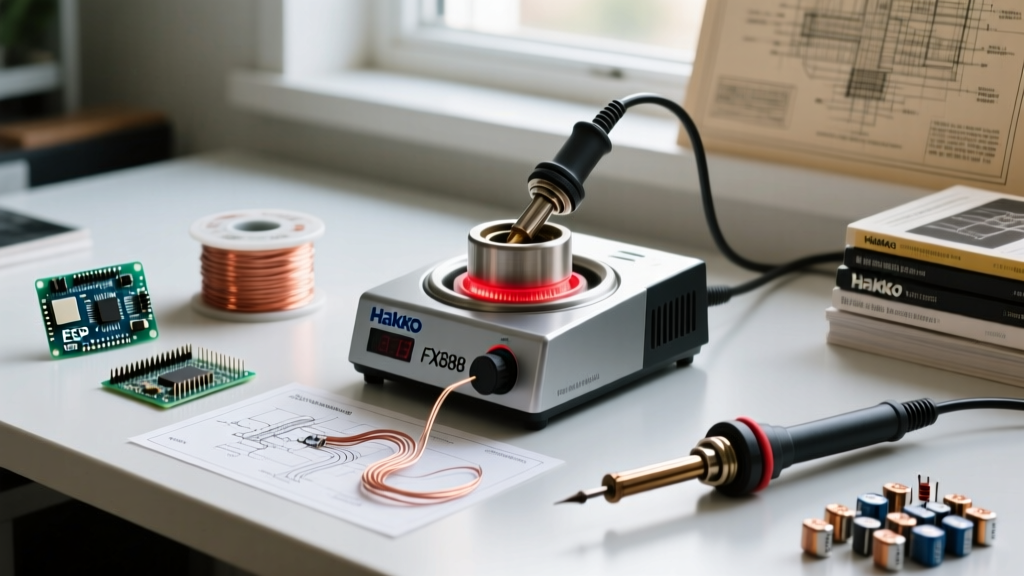
For over a decade, the Hakko FX888 soldering station has been the undisputed gold standard for hobbyists, makers, and professional repair technicians. However, the electronics landscape in 2026 looks vastly different. With the rise of high-power USB-C direct-drive irons and smart PID-controlled portable stations, many engineers are asking if this 70W bench staple still deserves a spot on the workbench. To provide a definitive answer, we must look past the marketing and examine the thermal physics, long-term reliability, and real-world failure modes of the Hakko FX-888D (the digital successor to the original analog FX-888).
Analog Roots, Digital Evolution
It is crucial to clarify that if you are purchasing a new unit today, you are buying the Hakko FX-888D. The original analog FX-888 was discontinued years ago. The 'D' variant introduced a digital PID controller, a push-button interface, and a password lock feature. While a 70W ceramic heater might seem underpowered compared to modern 120W or 200W smart stations, the FX-888D relies on high thermal mass and efficient heat transfer rather than brute wattage. This makes it exceptionally reliable for 95% of standard printed circuit board (PCB) rework tasks, provided you understand its thermal limitations.
Core Specifications and Thermal Recovery Physics
The heart of the Hakko FX888 soldering station is the T18 tip series and the B3100 ceramic heating element. Unlike direct-drive USB-C irons that integrate the heater directly into the tip cartridge (like the Pinecil or TS100), the FX-888D uses a traditional slip-on tip over a ceramic core. This design creates a slight thermal lag compared to cartridge-based systems, but it offers vastly superior mechanical durability and lower replacement costs. A standard T18 tip costs around $8 to $12, whereas integrated cartridge tips often exceed $25.
| Specification | Hakko FX-888D | Typical USB-C Smart Iron |
|---|---|---|
| Power Output | 70 Watts | 65W - 100W (PD dependent) |
| Temperature Range | 120°F - 899°F (50°C - 480°C) | 212°F - 842°F (100°C - 450°C) |
| Heater Type | Ceramic (B3100) | Integrated Cartridge |
| Tip Series | T18 (Slip-on) | Proprietary Cartridge |
| Tip Replacement Cost | ~$9.00 USD | ~$25.00+ USD |
Hakko FX888 Soldering Station vs. 2026 Market Alternatives
When evaluating the Hakko FX888 soldering station against modern competitors like the Weller WE1010NA or the Pinecil V2, the decision matrix shifts from pure performance to use-case environment. The FX-888D is a dedicated bench tool. It requires a standard AC wall outlet and occupies a fixed footprint. In contrast, USB-C irons offer unparalleled portability for field repairs and drone technicians. However, the FX-888D's heavy, grounded base station and robust 5-pin DIN connector provide a level of physical stability and ESD safety that lightweight portable irons simply cannot match.
| Feature | Hakko FX-888D | Weller WE1010NA | Pinecil V2 |
|---|---|---|---|
| Price Range (2026) | $115 - $135 | $140 - $160 | $26 - $35 |
| Thermal Mass | High (T18 Tips) | Medium (ET Tips) | Low (Integrated) |
| ESD Safe Design | Yes (Grounded) | Yes (Grounded) | No (Floating) |
| Best Use Case | Dedicated Bench / Rework | Production / Heavy Duty | Field Repair / Travel |
Optimizing T18 Tip Geometry for Surface Mount
A common mistake among beginners using the Hakko FX888 soldering station is relying on the default T18-B conical tip. Conical tips possess terrible thermal transfer characteristics for anything other than fine-pitch SOIC pins. To maximize the 70W output of the FX-888D, you must match the tip geometry to the thermal mass of the joint.
- T18-D24 (Chisel): The absolute workhorse. The flat 2.4mm face maximizes surface area contact, allowing for rapid heat transfer into ground planes and thick through-hole leads. Keep this on your station for 80% of your tasks.
- T18-K (Knife): Essential for drag-soldering TQFP and LQFP microcontrollers. The angled blade allows you to flow solder across 50+ pins in seconds without bridging, provided you use a high-quality mild RMA flux like Kester 186.
- T18-C4 (Bevel): Ideal for pre-tinning heavy gauge wires (14 AWG to 10 AWG). The cup-like bevel holds molten solder, enveloping the wire strands for a uniform capillary action.
Real-World Failure Modes and Bench Troubleshooting
Despite its legendary reliability, the FX-888D is not immune to user error. Based on repair shop data, here are the most common failure modes and how to diagnose them using a standard digital multimeter (DMM):
- Heater Element Burnout: If the station displays an 'H-E' error code or fails to heat, unplug the unit and disconnect the handpiece. Set your DMM to measure resistance (Ohms). Measure across pins 1 and 2 on the handpiece connector. A healthy B3100 heater should read between 13 and 15 ohms at room temperature. If it reads 'OL' (open loop), the ceramic element has fractured and requires a $25 replacement.
- Sensor Failure: Measure across pins 3 and 4. You should see a very low resistance, typically around 2 ohms. A higher reading indicates a corroded or broken thermocouple wire inside the handpiece cord.
- 5-Pin DIN Connector Damage: The handpiece connection is a known weak point. Forcing the plug in without aligning the keyway will bend the internal pins, causing intermittent heating or total failure. Always grip the hard plastic collar, never the rubber strain relief, when unplugging.
ESD Compliance and IPC J-STD-001 Alignment
For professionals working on sensitive RF modules or CMOS logic, Electrostatic Discharge (ESD) safety is non-negotiable. According to the IPC J-STD-001 requirements for soldered electrical and electronic assemblies, soldering equipment must maintain a strict equipotential bond to prevent static buildup from damaging component gates. The Hakko FX-888D features a dedicated grounding terminal on the front panel. By connecting this terminal to your bench's common ESD ground point, the tip of the iron is kept at a near-zero millivolt potential relative to the PCB ground plane. Portable USB-C irons lack this hard-ground capability, making the FX-888D vastly superior for compliant, high-reliability aerospace or medical device rework.
Pro-Tip: To verify your ESD ground is functioning, set your multimeter to AC millivolts. Place the black probe on a known earth ground and touch the red probe to the soldering iron tip. A properly grounded Hakko FX-888D will read less than 2mV AC. Anything higher indicates a faulty ground wire or a compromised internal grounding spring.
The Counterfeit Warning
As of 2026, the market remains flooded with counterfeit Hakko stations, particularly on third-party marketplace storefronts. Fake units often use ungrounded transformers, inaccurate thermocouples that can overheat and destroy PCB pads, and toxic leaded internal wiring. A genuine Hakko FX-888D purchased from an authorized distributor will typically cost between $115 and $135 USD. If you see a 'new' unit priced at $45, it is unequivocally a clone. Always verify the holographic security sticker on the packaging and check the build quality of the blue or black plastic enclosure.
Final Verdict: Who Should Buy the FX-888D Today?
Is the Hakko FX888 soldering station still worth it in 2026? The answer depends entirely on your workflow. If you are a field technician who needs to solder a connector inside a tight enclosure or on a rooftop, buy a Pinecil V2 or an FNIRSI HS-01. However, if you are building a dedicated home lab, running a repair shop, or assembling prototype PCBs where ESD safety, tip longevity, and physical stability are paramount, the Hakko FX-888D remains an unbeatable investment. Its low cost of ownership, massive aftermarket tip ecosystem, and proven 15-year track record ensure it will remain a workbench staple for years to come.