
The Evolution of the Express Soldering Iron
When technicians and hobbyists search for an express soldering iron, they are typically looking for one specific characteristic: rapid thermal recovery and sub-10-second heat-up times. Historically, this meant reaching for a heavy, transformer-based trigger iron. However, the landscape of rapid-heat soldering tools has shifted dramatically by 2026. Smart, USB-C-powered irons equipped with RISC-V microcontrollers now challenge legacy AC-powered models, offering express heating without the massive thermal mass that damages sensitive printed circuit boards (PCBs).
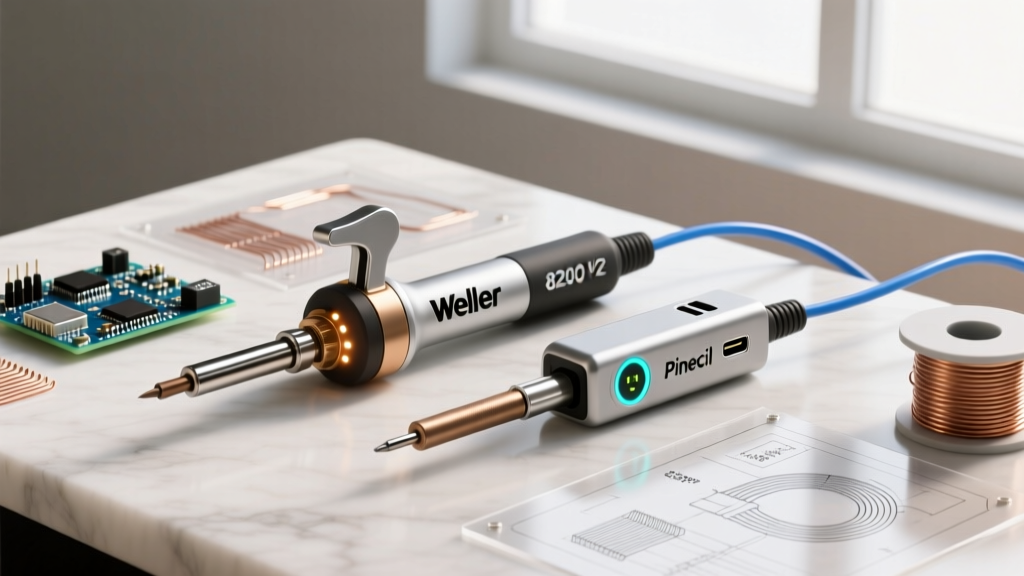
In this deep-dive comparison, we pit the undisputed legacy champion of rapid heat—the Weller 8200PK Dual Range Soldering Gun—against the modern open-source disruptor, the Pine64 Pinecil V2. We will also include the Hakko FX-601 as a ceramic middle-ground baseline. Our goal is to determine which express soldering iron architecture actually delivers the best joint integrity, tip longevity, and user experience for modern electronics work.
Contender Profiles: Transformer vs. Smart Ceramic
Weller 8200PK (The Transformer Trigger)
The Weller 8200PK is a 120V AC, dual-range (100W/140W) soldering gun that has been a staple in electrical toolboxes for decades. It operates on a simple but effective principle: a step-down transformer delivers massive current directly to the copper tip loop. When you pull the trigger, the tip reaches solder-melting temperatures (around 315°C / 600°F) in approximately 6 seconds. The 'high' trigger position pushes 140W, while the 'low' position drops to 100W for slightly more delicate work. However, its 1.5-pound weight and massive physical footprint make it a brute-force instrument.
Pine64 Pinecil V2 (The USB-C Smart Iron)
The Pinecil V2 represents the cutting edge of portable, rapid-heat technology. Powered by a Bouffalo Lab BL706 RISC-V SoC, it negotiates USB-C Power Delivery (PD 3.1) to pull up to 65W from a compatible charger. Despite a lower peak wattage than the Weller, its low-thermal-mass ceramic heater and ultra-thin mini-blade tips allow it to reach 320°C in just 6 to 9 seconds. Weighing a mere 28 grams, it offers PID-controlled temperature stability that legacy irons simply cannot match.
Hakko FX-601 (The Ceramic Middle-Ground)
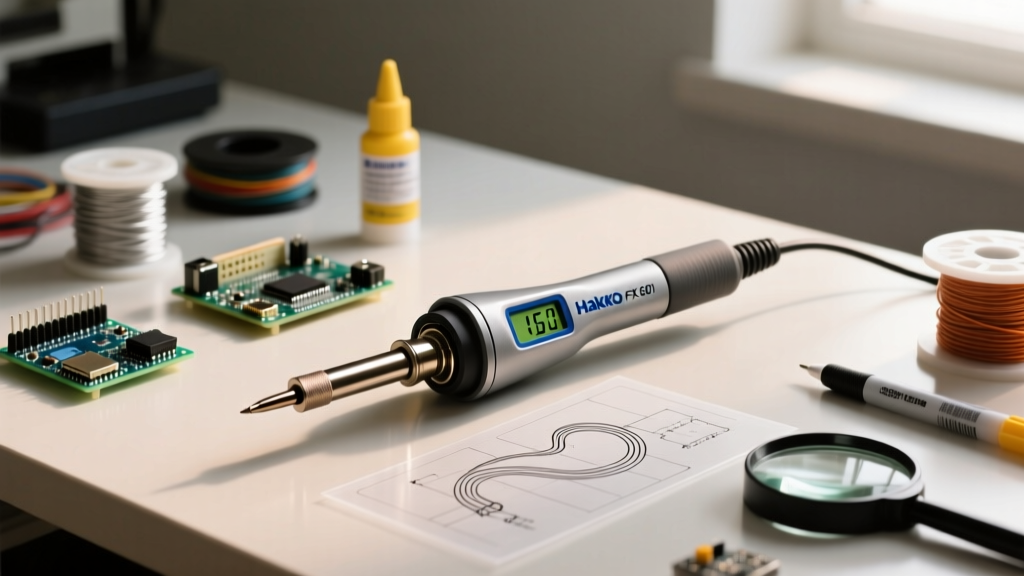
For context, the Hakko FX-601 is a 67W adjustable ceramic iron. While it features a highly efficient ceramic heating element, it lacks the 'instant-on' trigger mechanism of the Weller or the aggressive PD negotiation of the Pinecil. It takes roughly 20 seconds to reach operating temperature, serving as our baseline for traditional station-quality heat-up times.
Head-to-Head Matrix: Speed, Cost, and Precision
| Specification | Weller 8200PK | Pine64 Pinecil V2 | Hakko FX-601 |
|---|---|---|---|
| Peak Power | 140W (AC Transformer) | 65W (USB-C PD 3.1) | 67W (AC Ceramic) |
| Heat-Up Time (to 320°C) | ~6 Seconds | ~8 Seconds | ~22 Seconds |
| Temperature Control | Binary (Trigger High/Low) | PID Algorithm (50-450°C) | Analog Dial (200-500°C) |
| Weight (Handpiece) | 680g (1.5 lbs) | 28g (0.06 lbs) | 180g (0.4 lbs) |
| Tip Ecosystem | CT Series (Thick Loop) | TS100/101 Mini-Blade | T19 Series (Ceramic) |
| 2026 Street Price | $45 - $55 | $26 (Iron only) | $75 - $85 |
Thermal Dynamics and Joint Integrity
To understand why the definition of an express soldering iron is changing, we must look at thermal mass and recovery rate. The Weller 8200 relies on raw wattage and high thermal mass. When the thick copper tip touches a large ground plane, it dumps heat rapidly. This makes it exceptional for 10 AWG wire, XT90 connectors, and basic plumbing. However, this brute-force approach is highly detrimental to modern PCBs.
According to the IPC-J-STD-001 standard for soldered electrical and electronic assemblies, thermal dwell time on a joint should be strictly managed to prevent pad delamination, thermal shock to components, and flux burnout. The IPC guidelines emphasize that excessive heat application degrades the intermetallic compound (IMC) layer, leading to brittle, unreliable joints. The Weller's inability to precisely regulate temperature means the tip often overshoots 400°C during idle moments or heavy trigger pulls, risking severe PCB damage on anything smaller than a 1206 SMD component.
Conversely, the Pinecil V2 uses a closed-loop PID controller. As noted in the official Pine64 Pinecil documentation, the BL706 chip samples the thermocouple hundreds of times per second. When you touch a large ground plane, the Pinecil detects the temperature drop instantly and ramps the PWM signal to the ceramic heater to recover heat. While its 65W ceiling means it will struggle with massive RC battery connectors compared to the 140W Weller, its thermal recovery on standard 2-layer and 4-layer PCBs is remarkably stable, keeping dwell times well within IPC safe zones.
Known Failure Modes & Maintenance Edge Cases
Every express heating architecture has distinct failure points. Understanding these is critical for long-term tool ownership.
Weller 8200PK Failure Modes
- Trigger Switch Arcing: The internal mechanical switch handles high AC current. Over time, carbon buildup and arcing cause the trigger to stick or fail to deliver full wattage.
- Tip Oxidation and Burnout: Because the iron lacks a standby temperature, users often hold the trigger down continuously. This superheats the CT series tip past 450°C, causing rapid iron plating degradation and permanent oxidation.
- Transformer Hum and Heat: The internal laminated transformer generates a loud 60Hz hum and transfers significant ambient heat to the user's hand during extended sessions.
Pinecil V2 Failure Modes
- PD Negotiation Drops: If paired with a substandard USB-C cable lacking proper E-marking or a power brick that doesn't fully support PD 3.1, the Pinecil may default to 5V/3A (15W), resulting in abysmal heat-up times and thermal stalling.
- Mini-Blade Tip Plating Wear: The TS100-compatible tips have very low thermal mass. Running them at 400°C+ to compensate for poor power delivery will crack the iron plating within weeks.
- Thermocouple Drift: After hundreds of hours at high temperatures, the internal K-type thermocouple can drift, requiring software recalibration via the device's hidden menu.
Which Express Soldering Iron Should You Choose?
The decision between these tools is not about which is universally 'better,' but rather which architecture fits your specific workflow.
Choose the Weller 8200PK If:
Your primary work involves heavy-gauge electrical wiring, automotive harnesses, drone power systems (soldering 8 AWG to 10 AWG silicone wire), or basic copper plumbing. The 140W transformer output provides the raw thermal inertia required to flood large mechanical joints with 63/37 rosin-core solder without the joint cooling prematurely. It is also the superior choice for field technicians who do not have access to USB-C PD power banks or wall outlets, relying instead on standard AC extension cords.
Choose the Pine64 Pinecil V2 If:
Your work revolves around modern electronics repair, micro-soldering, SMD rework, and custom PCB assembly. The express heat-up time of the Pinecil V2 is more than fast enough for daily use, but its real advantage is the precision of that heat. Being able to lock the tip at exactly 340°C ensures that delicate 0402 resistors and QFN ICs are not subjected to thermal shock. Furthermore, its portability makes it the ultimate mobile repair tool, easily powered by a 65W laptop charger or a high-output PD power bank.
Final Verdict
The term 'express soldering iron' has successfully transitioned from describing heavy, trigger-activated transformer guns to encompassing smart, algorithmically controlled ceramic heaters. While the Weller 8200PK remains an undefeated titan for heavy-duty wire tinning and mechanical joints, the Pine64 Pinecil V2 is the undisputed champion for 90% of modern electronics work. By leveraging USB-C PD technology and rapid PID sampling, the Pinecil delivers express heating without sacrificing the joint integrity demanded by modern IPC standards.