
The Thermal Paradox of Stained Glass Soldering
Soldering stained glass is fundamentally different from soldering printed circuit boards. While electronics soldering requires precision and low thermal mass to protect delicate microchips, stained glass demands high thermal retention and rapid heat recovery. Glass itself is a thermal insulator, but the copper foil tape or lead came wrapping your pieces acts as a massive heat sink. If your iron lacks the wattage or tip mass to push through this thermal barrier, the solder cools prematurely, resulting in dull, lumpy, and structurally weak seams.
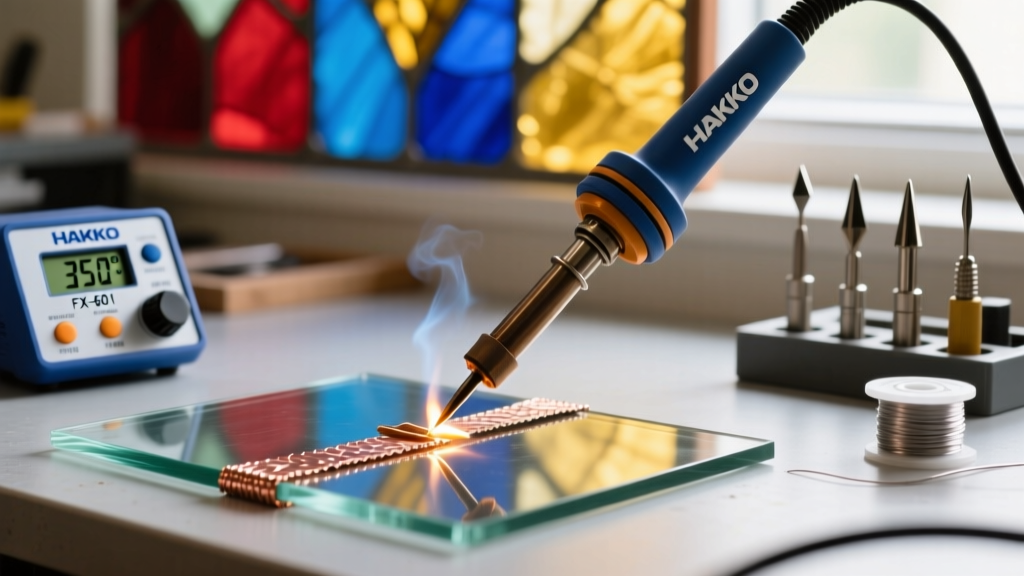
Enter the Hakko FX-601. Retailing between $85 and $95 in 2026, this 67-watt adjustable temperature iron is a staple in the stained glass community. However, out of the box, the FX-601 is configured for electronics. To harness its full potential for glass art, you must reconfigure the tip ecosystem, calibrate the ceramic heater, and master the specific feed techniques required for molten tin-lead alloys on glass.
Why the Hakko FX-601 Excels (When Configured Correctly)
Many beginners mistakenly purchase cheap 100W or 150W irons from hardware stores, assuming higher wattage equals better glass soldering. These unregulated irons frequently overshoot their target temperatures, oxidizing the solder instantly and risking thermal shock to the glass. The FX-601 utilizes a high-efficiency ceramic heating element with closed-loop temperature control. This means when the cold copper foil leaches heat from the tip, the FX-601's internal sensor detects the drop and surges power to recover the heat in milliseconds, maintaining a stable liquidus state in your solder puddle.
Expert Insight: Glass has a relatively high coefficient of thermal expansion. Holding an unregulated 150W iron at 450°C in one spot on cold art glass can induce micro-fractures or catastrophic cracking. The FX-601's precise dial allows you to hover exactly 30°C above your solder's melting point, protecting the glass while keeping the alloy fluid.
The T19 Tip Ecosystem for Glass Artists
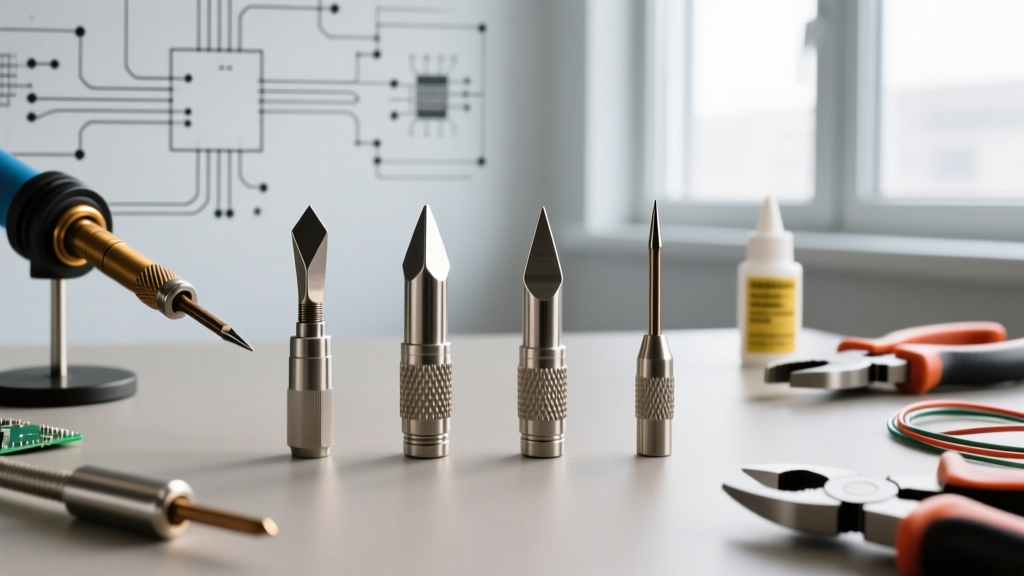
The FX-601 uses the Hakko T19 series tips. The standard conical tip (T19-B) included in some electronics kits is entirely useless for stained glass; it lacks the surface area to transfer heat to wide copper foil lines. You must upgrade to high-mass chisel tips. According to Hakko USA's official specifications, the following T19 tips are mandatory for glass work:
- T19-D6 (6.0mm Chisel): The workhorse for 7/32-inch and 1/4-inch copper foil. The wide, flat face maximizes thermal transfer and allows you to 'iron' the solder into a smooth, convex bead.
- T19-D24 (Bent Chisel): Essential for soldering deep inside the corners of geometric panels or 3D boxes (like Tiffany-style lampshades) where a straight iron shaft would hit adjacent glass pieces.
- T19-D65 (6.5mm Heavy Chisel): Best reserved for heavy lead came (H-profile or U-channel) restoration work, where the thermal mass of the lead requires maximum heat injection.
Temperature Calibration & Alloy Matching
Stained glass artists primarily use two types of tin-lead solder, plus emerging lead-free alternatives. Each requires a distinct temperature profile on the FX-601's dial. Setting the iron too low causes 'cold joints' (solder that sticks to the foil but doesn't melt into a cohesive puddle). Setting it too high burns the flux, leaving a sticky, oxidized residue that prevents the solder from flowing.
| Solder Alloy | Primary Application | FX-601 Target Temp (°C) | FX-601 Target Temp (°F) | Optimal Dwell Time |
|---|---|---|---|---|
| 60/40 (Sn/Pb) | Copper Foil (Flat & 3D) | 360°C - 380°C | 680°F - 715°F | 1.5 - 2.0 sec/inch |
| 50/50 (Sn/Pb) | Lead Came Joints | 315°C - 340°C | 600°F - 645°F | 2.0 - 3.0 sec/inch |
| Lead-Free (Sn/Cu) | Eco / Public Installations | 390°C - 410°C | 735°F - 770°F | 2.5 - 3.5 sec/inch |
Note: The 60/40 alloy has a tighter 'plastic range' (the temperature gap between solidus and liquidus states) than 50/50. This allows 60/40 to cool faster and hold a high, round bead on copper foil, whereas 50/50 stays semi-molten longer, making it ideal for wiping smooth joints on lead came.
Step-by-Step Copper Foil Seaming Technique
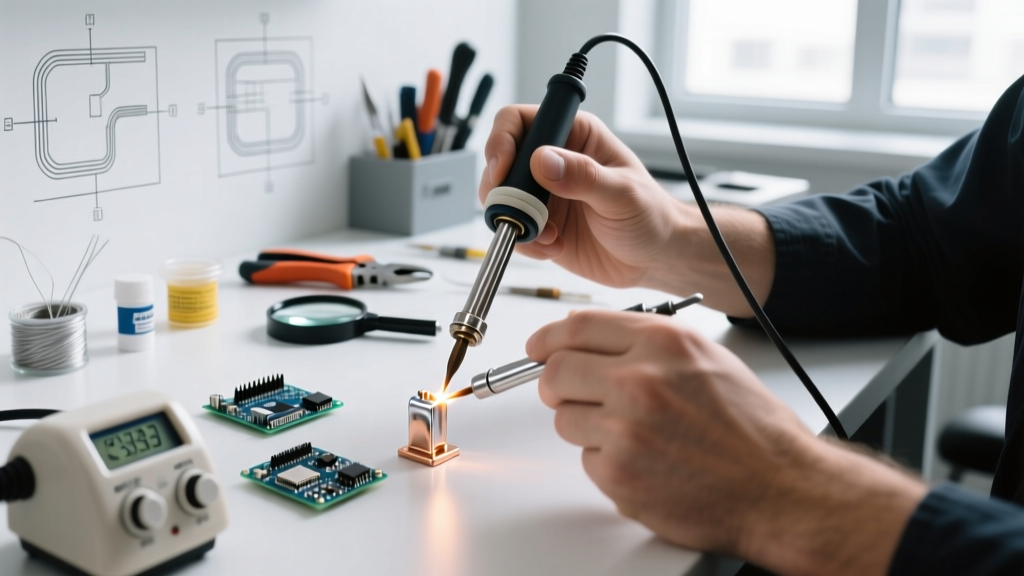
Achieving the coveted 'beaded' seam—where the solder forms a perfect half-cylinder over the copper foil—requires a synchronized two-handed technique. The FX-601 is lightweight (approx. 2.2 oz without the cord), which reduces wrist fatigue during long panel sessions, but you must maintain strict pacing.
- Flux Application: Apply a thin, even coat of gel flux (oleic acid or petroleum-based) to the copper foil. Do not over-apply; excess flux will boil under the iron, creating pinholes in your solder bead.
- Tack Soldering: Before running a continuous bead, 'tack' the intersections where foil lines meet. Dab a small drop of 60/40 solder at every joint. This locks the glass pieces in place and prevents them from shifting when the iron's weight pushes against them.
- The Iron-Feed Method: Hold the FX-601 like a thick pen, resting the side of your hand on the workbench for stability. Angle the T19-D6 tip at 45 degrees to the foil.
- Synchronized Feed: Touch the hot tip to the foil, and simultaneously feed 1/8-inch or 3/16-inch diameter solder wire into the leading edge of the tip (not directly between the tip and the glass). The iron should melt the solder, not the glass.
- Pacing the Bead: Move the iron at a steady pace of about 1.5 inches per second. If the bead flattens out, you are moving too fast or your temperature is too low. If the solder spills over the edges of the foil onto the glass, you are moving too slow or feeding too much wire.
Troubleshooting the FX-601 on Glass Projects
Even with precision equipment, environmental variables and technique flaws can cause defects. Here is how to diagnose and fix common issues when using the FX-601 for glass art.
1. Pitting and Pinholes in the Solder Bead
Cause: Boiling flux or moisture trapped under the copper foil. When the FX-601 hits a wet spot, the liquid instantly vaporizes, blowing tiny craters into the molten solder.
Fix: Ensure your glass is completely dry after grinding and washing. Use a high-quality gel flux rather than liquid flux for copper foil, as gels do not trap water and evaporate more predictably under heat.
2. Dull, Grainy, or 'Frosted' Solder Lines
Cause: The solder is oxidizing because the FX-601 temperature is set too high, or you are lingering in one spot for more than 3 seconds.
Fix: Drop the dial by 15°C. Keep the iron moving. If the damage is already done, apply fresh flux and do a quick 'wipe' pass with a clean, tinned tip to re-melt the surface layer and restore the shine.
3. Solder Sticking to the T19 Tip
Cause: The tip has oxidized and lost its wetting ability, often caused by leaving the FX-601 on at 400°C while not actively soldering.
Fix: Never leave the iron on high when resting. Turn the dial down to 200°C when taking a break. To clean an oxidized T19 tip, use a damp cellulose sponge or brass wire wool—never use abrasive sandpaper or steel files, which will strip the iron plating off the tip and ruin it permanently.
Flux Corrosion and Heater Maintenance
Stained glass environments are incredibly harsh on soldering equipment. The acidic vapors from stained glass fluxes can creep up the shaft of the iron and corrode the stainless steel sleeve that houses the ceramic heater. According to glass manufacturing guidelines from Oceanside Glasstyle, proper tool maintenance is just as critical as glass handling.
To prevent the tip from seizing inside the FX-601:
- Once a week, allow the iron to cool completely.
- Unscrew the tip locking nut and remove the T19 tip and sleeve.
- Wipe the ceramic heating element with a dry, lint-free cloth to remove any sublimated flux residue.
- Apply a microscopic amount of high-temperature anti-seize compound or pure beeswax to the outside of the ceramic element before reassembling. This ensures the tip slides off easily for future replacements.
By treating the Hakko FX-601 not just as an electronics tool, but as a specialized thermal instrument for glass art, you can achieve museum-quality seams, reduce tip replacement costs, and protect your fragile glass pieces from thermal shock.