
The Real Cost of Cheap Heat: Why Airflow Stability Matters
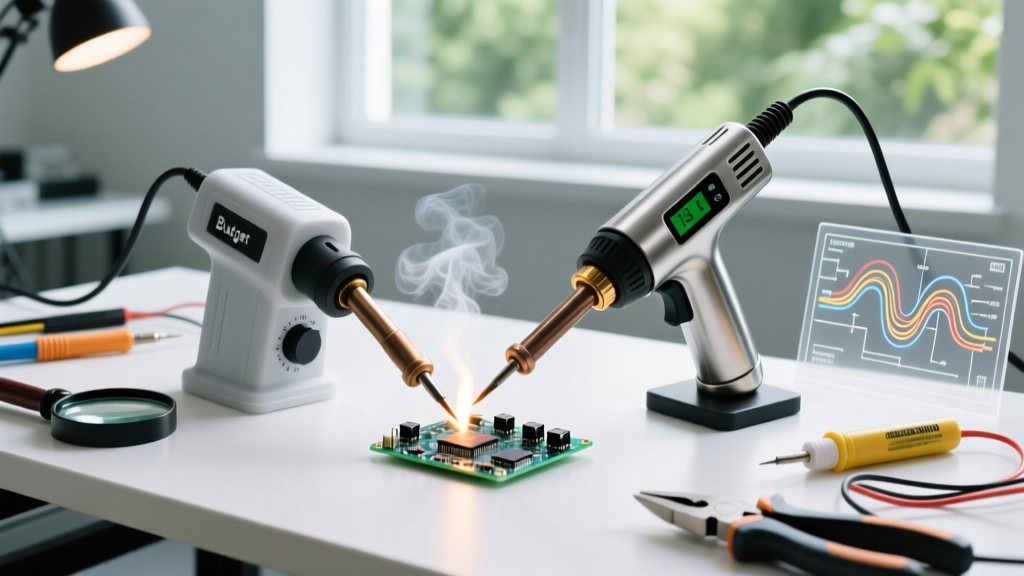
When selecting a hot air gun for soldering surface-mount components, the market presents a stark dichotomy. On one end, you have the ubiquitous $50 clone stations flooding online marketplaces; on the other, precision-engineered $600+ bench tools used in aerospace and medical device manufacturing. As we navigate the 2026 electronics repair landscape, the gap between these tiers is no longer just about brand prestige—it is about physics, closed-loop thermodynamics, and electrostatic safety.
Reflowing a 0.5mm pitch QFP (Quad Flat Package) or reballing a BGA (Ball Grid Array) requires more than just hot air. It demands precise volumetric airflow, rapid thermal recovery, and strict adherence to IPC J-STD-001 soldering standards. This analysis dissects the engineering realities of budget versus premium hot air rework stations, helping you decide where to invest your capital.
Budget Contenders ($40–$90): The 858D Ecosystem
The '858D' designation has become a generic catch-all for entry-level hot air stations from brands like Yihua, WEP, and various unbranded OEM clones. Priced between $40 and $90 in 2026, these units are the undisputed kings of hobbyist workbenches. However, understanding their internal architecture reveals significant limitations.
The Diaphragm Pump and Backpressure Problem
Most budget stations utilize a rudimentary diaphragm pump or a low-grade brushed DC motor housed in the base unit. Air is pushed through a long, corrugated silicone hose to the handpiece. This design creates a massive vulnerability: backpressure. When you attach a small 2mm or 3mm nozzle for targeted IC work, the restricted airflow causes internal pressure to spike. Because the heating element's power output remains static while air volume drops, the air exiting the nozzle can easily overshoot the dialed temperature by 40°C to 60°C.
Hidden Failure Modes in Budget Stations
- Thermal Lag: Budget heating elements lack the thermal mass to recover quickly. When reflowing a component connected to a heavy ground plane, the temperature drops, forcing the operator to hold the gun in place for 45+ seconds. This prolonged dwell time frequently causes FR4 pad delamination.
- Acoustic and Vibration Issues: The internal pumps generate significant vibration, which can literally 'walk' the handpiece across your desk if not secured, and the noise level often exceeds 65dB, causing fatigue during long rework sessions.
- Zero ESD Protection: Cheap stations rarely feature static-dissipative plastics or grounded heating elements. Blowing un-ionized, high-velocity air across a plastic nozzle generates a triboelectric charge that can easily exceed 2,000 volts—enough to gate-punch a sensitive MOSFET or corrupt flash memory.
Premium Powerhouses ($250–$700+): Hakko, Weller, and JBC
Stepping into the premium tier means paying for closed-loop PID (Proportional-Integral-Derivative) control, zero-crossing switching, and rigorous ESD compliance. Stations like the Hakko FR-830, Weller WTHA1, and JBC JTSE are engineered to meet the stringent requirements of the ESD Association's ANSI/ESD S20.20 standard.
Closed-Loop Precision and Zero-Crossing Safety
In a premium station, the thermocouple is embedded millimeters from the nozzle tip, providing real-time, closed-loop feedback to a microprocessor. If the sensor detects a 5°C drop when hitting a copper pour, the station instantaneously pulses the heating element to compensate. Furthermore, premium stations utilize zero-crossing solid-state relays (SSRs). By only switching the AC power on when the sine wave crosses zero volts, these stations eliminate the high-frequency electromagnetic interference (EMI) and voltage spikes that plague cheaper triac-based controllers.
Ergonomics and Airflow Dynamics
Premium handpieces feature brushless micro-motors located directly inside the wand or utilize highly engineered base blowers with rigid, low-resistance PTFE tubing. This ensures that the CFM (Cubic Feet per Minute) rating remains stable regardless of the nozzle attached. The result is a smooth, laminar airflow that prevents the 'blowing away' of tiny 0201 resistors and 0402 capacitors during reflow.
The Mid-Tier Bridge: Quick 861DW Analysis
No 2026 analysis is complete without addressing the Quick 861DW. Priced around $175, it occupies a unique 'value-premium' space. It bridges the gap by offering a 1000W heating element, a digital brushless fan, and 100 programmable temperature profiles. While it lacks the ultra-fast thermal response of a JBC or the nitrogen-compatibility of a high-end Hakko, its ESD-safe construction and stable airflow make it the default choice for independent micro-soldering and board repair shops worldwide.
Head-to-Head Matrix: 2026 Market Breakdown
| Model | Tier | Est. Price (2026) | Max Power | Airflow Mechanism | ESD Safe | Temp Accuracy |
|---|---|---|---|---|---|---|
| Generic 858D Clone | Budget | $55 | 700W | Base Diaphragm / Brushed | No | ± 15°C |
| Quick 861DW | Mid-Tier | $175 | 1000W | Base Brushless Digital | Yes | ± 5°C |
| Weller WTHA1 | Premium | $580 | 900W | Base Brushless / Zero-Cross | Yes | ± 2°C |
| Hakko FR-830 | Premium | $650+ | 1000W | Base Brushless / N2 Ready | Yes | ± 1°C |
Application-Specific Buying Framework
Choosing the right hot air gun for soldering depends entirely on your failure tolerance and the components you handle.
When to Buy Budget (858D Clones)
Stick to budget stations if you are strictly working on through-hole desoldering, shrinking heat tubing, or reworking non-sensitive, high-thermal-mass consumer electronics (e.g., replacing barrel jacks or large DIP ICs on single-layer boards). Do not use these for automotive ECUs or telecommunications hardware.
When to Buy Mid-Tier (Quick 861DW)
This is the sweet spot for smartphone repair, HDMI port replacements, and general SMD rework. The 1000W heater ensures you can reflow large shielded RF cans without preheating the entire board, and the ESD safety protects modern smartphone PMICs (Power Management ICs).
When to Buy Premium (Hakko / Weller / JBC)
Invest in premium gear if you are performing BGA reballing, working on multi-layer aerospace PCBs, or handling ultra-sensitive GaN (Gallium Nitride) transistors. The precision airflow and strict thermal profiles prevent the 'popcorning' effect caused by trapped moisture in IC packages.
Expert Insight: Never attempt to reflow a BGA chip using a budget station without a dedicated PCB preheater. The top-down thermal gradient required to reflow the center balls of a BGA without scorching the outer edges is physically impossible with a 700W open-loop diaphragm pump.
Pro-Tips for Maximizing Any Hot Air Station
Regardless of your budget, technique dictates success. Implement these professional workflows to elevate your results:
- Flux is Non-Negotiable: Always apply a high-quality tacky flux like Amtech NC-559-V2-TF or Chip Quik TS391AX before applying heat. Flux reduces surface tension, allowing solder to wick evenly and preventing bridging on fine-pitch pins.
- Match the Nozzle to the IC: Use a nozzle that is exactly 1mm to 2mm larger than the IC body. A nozzle that is too small creates a Venturi effect, accelerating the air and blowing components off the pads. A nozzle that is too large dissipates heat into surrounding components.
- The 'Hover and Orbit' Technique: Never hold the nozzle static. Keep the gun 5mm to 10mm above the board and move in slow, continuous circles. This creates a convective heat envelope, ensuring uniform reflow without localized scorching.
- Leverage Preheating: For any 4-layer board or thicker, use a bottom-side preheater set to 100°C–120°C. This reduces the thermal delta your hot air gun must overcome, cutting reflow time in half and saving your pads from thermal shock.
Ultimately, a hot air gun for soldering is an investment in yield rate. While budget stations offer an accessible entry point, the hidden costs of damaged ICs and lifted pads quickly eclipse the savings. Evaluate your 2026 project pipeline, respect the physics of thermal dynamics, and choose the tier that guarantees your rework success.