
The Thermal Challenge of Inline Wire Splices
Learning exactly how to solder wire to wire is a foundational skill in electronics, automotive harness repair, and aerospace prototyping. Unlike soldering a component to a rigid PCB pad, wire-to-wire splicing—whether you are executing a Western Union (Lineman's) splice, a pigtail twist, or a parallel lap joint—presents a unique thermal challenge. Stranded copper wire acts as a massive heat sink, drawing thermal energy away from the soldering iron tip and into the length of the cable. If your solder alloy's melting point is too high, or your flux's activation temperature is mismatched, you will end up with a brittle, high-resistance cold joint or melted PVC insulation.
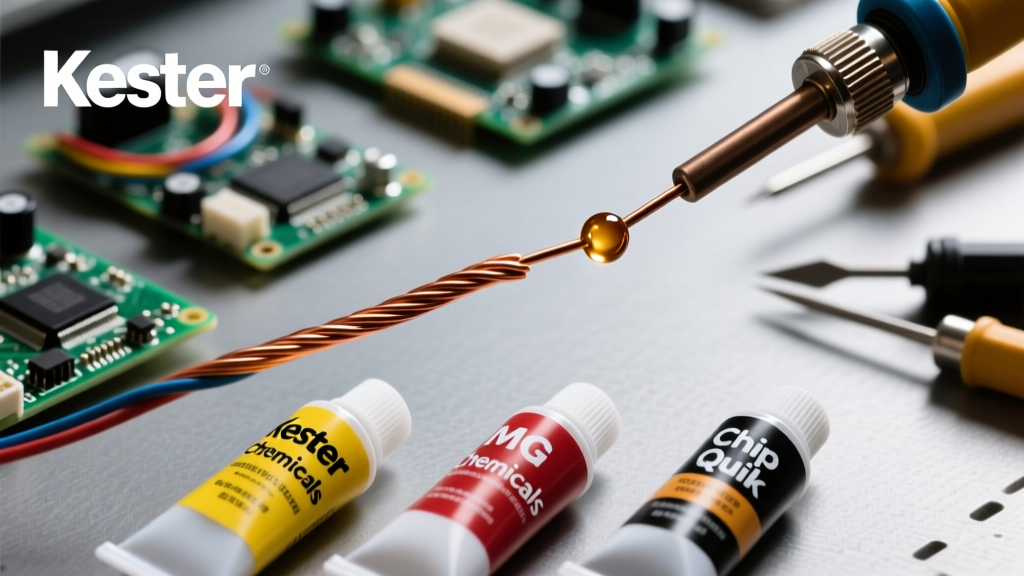
To achieve a metallurgically sound inline splice, the consumables you choose are just as critical as your soldering iron's wattage. In this guide, we bypass generic advice and dive deep into a brand comparison of the industry's leading solder wires and liquid fluxes—specifically pitting Kester, MG Chemicals, and Chip Quik against each other across various wire gauges and environmental requirements.
Solder Alloy Showdown: Kester vs. MG Chemicals vs. Chip Quik
The alloy composition of your solder wire dictates its melting point, wetting characteristics, and long-term mechanical strength. When splicing wires that will be subjected to vibration or thermal cycling, choosing the right brand and alloy is non-negotiable.
Kester 44 (Sn63/Pb37): The Eutectic Benchmark
For decades, Kester 44 has been the undisputed champion of general-purpose wire splicing. As a eutectic alloy (63% Tin, 37% Lead), it transitions directly from solid to liquid at a precise 183°C (361°F) without passing through a plastic (semi-solid) state. This is critical when learning how to solder wire to wire, as any movement during the plastic phase causes a disturbed joint. Kester's proprietary RMA (Rosin Mildly Activated) flux core activates rapidly at 120°C, stripping light oxidation from stranded copper before the solder even melts, ensuring rapid capillary action into the wire strands.
MG Chemicals 4895 (SAC305): The Lead-Free Contender
When RoHS compliance or environmental regulations forbid lead, MG Chemicals' SAC305 (96.5% Sn, 3.0% Ag, 0.5% Cu) is a premier choice. However, SAC305 melts at 217°C (423°F). When splicing heavier gauge wires (14 AWG to 10 AWG), this higher melting point requires a high-thermal-mass iron (minimum 60W) to prevent dwell times that melt wire insulation. MG Chemicals pairs this alloy with a highly active no-clean flux core that compensates for the poorer wetting characteristics inherent to lead-free alloys.
Chip Quik SMD291AX (Sn62/Pb36/Ag2): The Vibration Specialist
For automotive, marine, and aerospace wire harnesses, vibration is the enemy of standard tin-lead joints. Chip Quik's Sn62 alloy introduces 2% Silver into the mix. While it is slightly off-eutectic (melting range 179°C–183°C), the silver addition dramatically increases the joint's resistance to thermal fatigue and mechanical shock. If you are splicing wires in an engine bay or drone frame, Chip Quik's silver-bearing solder provides a measurable increase in tensile strength and vibration resistance.
Flux Chemistry: Liquid Pens vs. Tacky Pastes for Splicing
Even the best flux-cored solder wire struggles to penetrate tightly twisted 24 AWG stranded wire. Supplemental flux is often required to guarantee a watertight, electrically conductive splice.
Taming Stranded Wire with Chip Quik Tacky Flux
One of the greatest frustrations in wire splicing is keeping the twisted strands together while applying heat. Chip Quik's TACKY Flux (SMD295AX) is a viscous, rosin-based paste that acts as a temporary adhesive. By dabbing a small amount onto a pigtail splice before applying heat, the flux physically holds the frayed strands together while simultaneously lowering the surface tension of the molten solder. It is a game-changer for micro-splices in RC electronics and drone wiring.
MG Chemicals 8341 for No-Clean Harnesses
When building complex wire harnesses that will be wrapped in braided sleeving or heat shrink, cleaning flux residue is nearly impossible. MG Chemicals' 8341 No-Clean Liquid Flux Pen dispenses a halogen-free, alcohol-based flux that leaves behind a negligible, non-conductive, and non-corrosive residue. Unlike water-soluble fluxes that must be cleaned to prevent catastrophic dendritic growth and corrosion, 8341 is safe to leave inside sealed automotive connectors.
Comprehensive Wire-to-Wire Consumables Matrix
The following matrix breaks down the optimal consumable pairings based on specific wire-to-wire splicing scenarios.
| Application Scenario | Recommended Solder Brand/Alloy | Supplemental Flux | Target Iron Temp | Key Advantage |
|---|---|---|---|---|
| Standard PCB Repair (22-28 AWG) | Kester 44 (Sn63/Pb37) | None (Core is sufficient) | 310°C | Instant wetting, zero disturbed joints |
| Automotive Harness (12-16 AWG) | Chip Quik Sn62 (2% Ag) | Chip Quik Tacky Paste | 330°C | High vibration & thermal shock resistance |
| RoHS / Consumer Electronics | MG Chemicals SAC305 | MG Chemicals 8341 Pen | 360°C | Lead-free compliance, strong copper wetting |
| High-Temp Environments | Chip Quik Sn96.5 (Sn/Ag/Cu) | Kester 186 RMA Liquid | 380°C | High melting point prevents joint reflow |
Real-World Failure Modes and Brand-Specific Diagnostics
Even experienced technicians encounter failures when splicing wires. Here is how to diagnose them based on your consumable choices.
The 'Grainy' Cold Joint on Thick Gauge Wire
Symptom: The solder looks dull, lumpy, and crystalline. The wire pulls apart with minimal force.
Cause: Attempting to use a lead-free alloy (like MG Chemicals SAC305) on a 12 AWG wire with a standard 40W soldering iron. The wire acts as a heat sink, dropping the temperature below the alloy's liquidus point before the joint is fully wetted.
Fix: Switch to Kester Sn63/Pb37 for better thermal transfer, or use a heavy-duty chisel tip with a minimum 60W station to maintain thermal equilibrium.
Insulation Meltback and Solder Creep
Symptom: Solder wicks far up the stranded wire, under the PVC insulation, making the wire rigid and prone to snapping at the stress relief point.
Cause: Using a highly active, low-viscosity liquid flux (like water-soluble Oatey or generic plumbing flux) combined with excessive dwell time. Never use plumbing acid flux on electrical wires.
Fix: Use a rosin-based tacky flux (Chip Quik SMD295AX) which stays localized and only activates at higher temperatures, combined with proper heat-shrink tubing application post-solder.
According to the NASA Electronic Parts and Packaging (NEPP) Workmanship Standards, a proper soldered wire connection must exhibit a smooth, bright, concave fillet with visible wire contours. The solder must wet the entire circumference of the splice without obscuring the underlying wire geometry, a feat heavily dependent on the activation temperature of the chosen flux.
Final Verdict: Building Your Wire Splicing Kit
Mastering how to solder wire to wire requires moving beyond the generic solder wire that came with your cheap iron kit. For a versatile, professional-grade splicing kit, stock your bench with Kester 44 (0.031" diameter) for 90% of your daily signal and power wire splicing. Keep a spool of Chip Quik Sn62 on hand specifically for automotive and marine projects where vibration will destroy standard tin-lead joints. Finally, invest in a MG Chemicals 8341 No-Clean Flux Pen to rescue oxidized vintage wiring and ensure flawless wetting on stubborn, high-strand-count silicone wires. By matching the metallurgical properties of your solder to the thermal demands of the wire gauge, you will eliminate cold joints and build harnesses that last a lifetime.