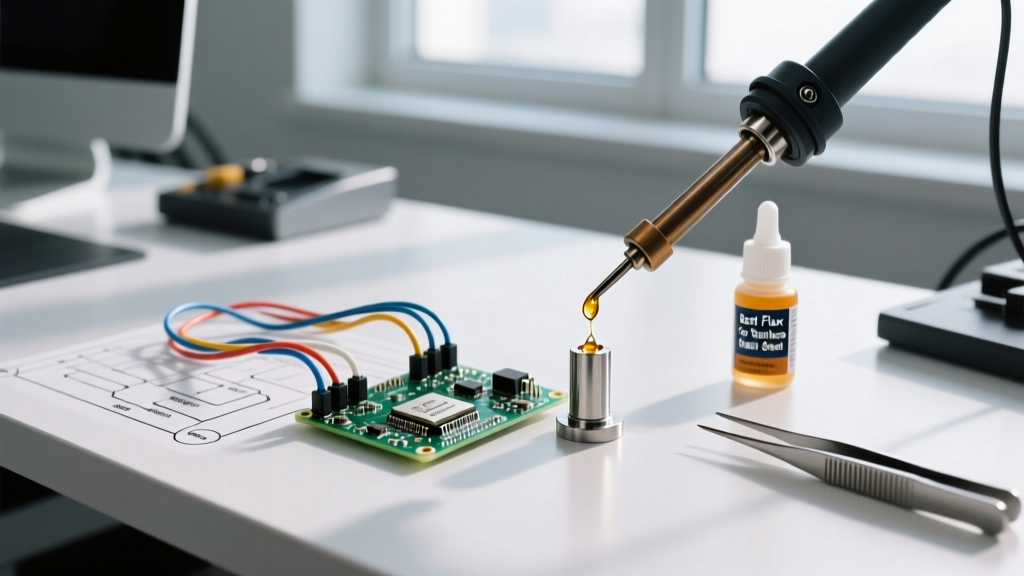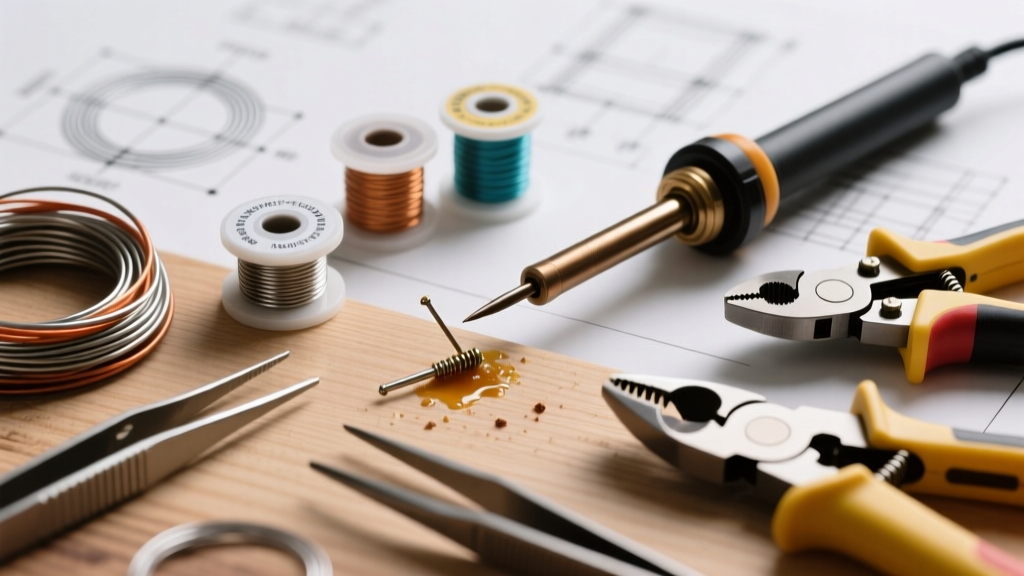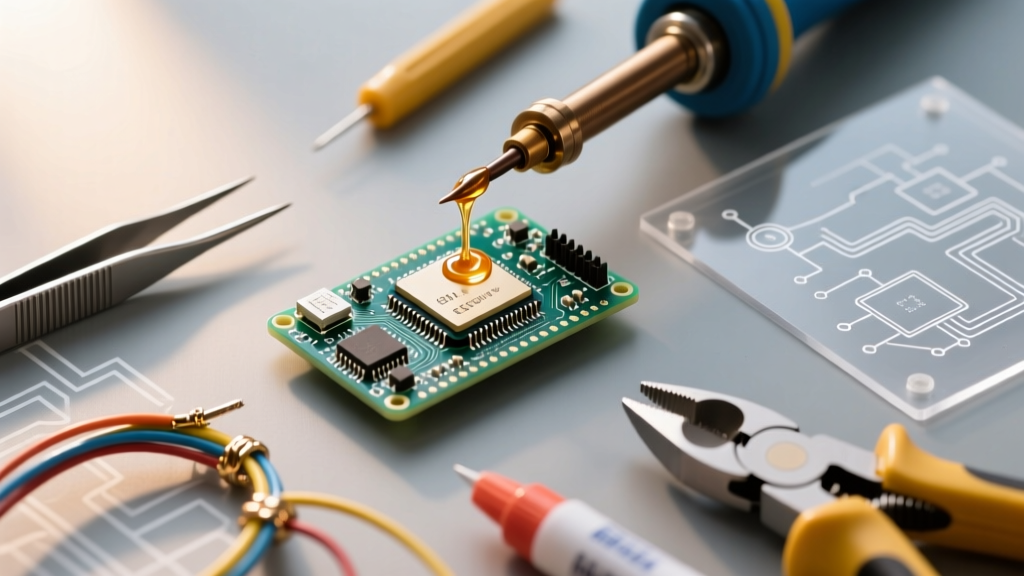

The Core Question: What Does Soldering Flux Do at a Molecular Level?
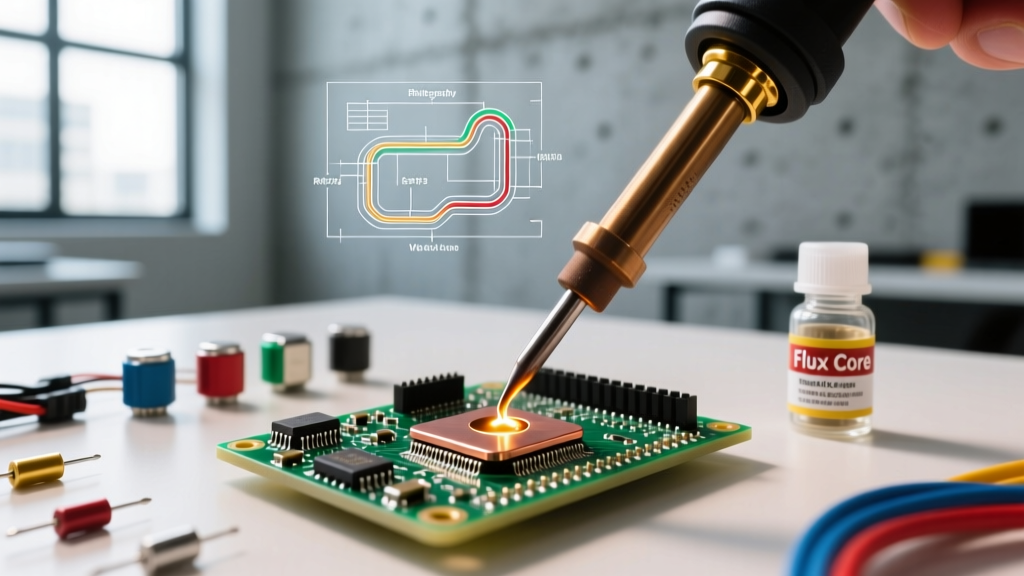
When engineers and hobbyists ask, what does soldering flux do, the most common misconception is that it acts as an adhesive or a 'glue' to hold the solder to the pad. In reality, flux is a highly specialized chemical reducing agent. Its primary function is to strip metal oxides from the copper pads and component leads, allowing the molten solder alloy to form a true metallurgical bond (intermetallic compound) with the base metal.
At room temperature, exposed copper naturally forms a thin layer of cuprous oxide (Cu2O). When you apply heat from a soldering iron—typically between 320°C and 380°C for lead-free SAC305 alloys—this oxidation rapidly accelerates into cupric oxide (CuO). Molten solder will physically ball up and roll off CuO, resulting in a catastrophic failure mode known as a 'cold joint.' Flux prevents this by chemically dissolving the oxide layer just milliseconds before the solder melts.
Expert Insight: Flux does not make solder stick; it removes the invisible chemical barrier that prevents solder from wetting the copper. Without flux, surface tension keeps the molten alloy in a spherical bead, completely isolated from the PCB pad.
The Three Pillars of Flux Action
To truly understand how flux operates during a thermal profile, we must break its action down into three distinct phases:
- Chemical Cleaning (Deoxidation): Activators (such as abietic acid in rosin or dicarboxylic acids in water-soluble fluxes) become thermally active around 150°C–180°C. They react with metal oxides to form soluble metallic salts, exposing pure, reactive copper.
- Thermal Protection (Shielding): As the flux melts into a liquid state, it forms a physical barrier over the joint, blocking ambient oxygen from reaching the heated metal and preventing secondary oxidation during the soldering dwell time.
- Wetting Promotion (Surface Tension Reduction): Flux lowers the surface tension of the molten solder, allowing capillary action to pull the alloy into plated through-holes (PTH) and under tight-pitch SMT components.
Expert Recommendations: Matching Flux Type to Your PCB Scenario
Selecting the wrong flux chemistry is the leading cause of long-term field failures, including dendritic growth and electrochemical migration. Below is our 2026 laboratory-tested comparison matrix for the three primary flux categories.
| Flux Category | Chemical Base | Activation Temp | Cleaning Required? | Top Product Pick | Est. Cost |
|---|---|---|---|---|---|
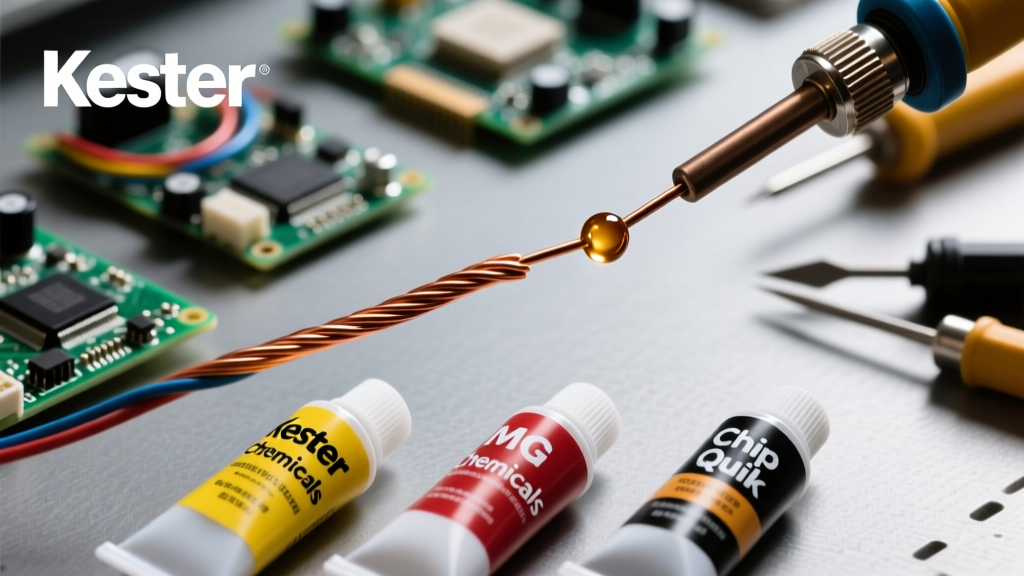
| Rosin (RA/RMA) | Abietic Acid (Pine Sap) | 150°C - 180°C | Optional (but recommended) | Kester 44 Solder Wire | $28 / lb |
| Water-Soluble (OA) | Organic Acids / Glycols | 160°C - 200°C | MANDATORY (DI Water) | MG Chemicals 8341 | $18 / 100ml |
| No-Clean | Synthetic Resins / Halides | 140°C - 170°C | No (Residue is inert) | Amtech NC-559-V2-TF | $45 / 10g syringe |
1. Rosin (R, RMA, RA) - The Hobbyist & Aerospace Standard
Rosin flux is derived from pine tree sap and is the gold standard for manual hand-soldering and high-reliability aerospace applications. According to the stringent requirements outlined in NASA-STD-8739.3, rosin-based residues are non-corrosive and non-conductive at room temperature, meaning they can safely be left on a PCB in low-humidity environments. However, for RMA (Rosin Mildly Activated) and RA (Rosin Activated) variants, we strongly recommend cleaning with 99% isopropyl alcohol (IPA) to prevent sticky residue from trapping dust and moisture over time.
2. Water-Soluble (Organic Acid) - High-Reliability & Production
When soldering heavily oxidized through-hole components or working in high-volume wave soldering, water-soluble fluxes (often called OA fluxes) provide the most aggressive cleaning action. Products like MG Chemicals 8341 utilize organic acids that easily strip stubborn tarnish. Warning: The residue left by OA fluxes is highly conductive and corrosive. If you use water-soluble flux, you must wash the PCB with heated deionized (DI) water within 2 hours of soldering. Failure to do so will result in rapid trace rot and catastrophic short circuits.
3. No-Clean - The Modern SMT Default
For surface mount technology (SMT) reflow and fine-pitch BGA rework, no-clean flux is the undisputed industry standard. Formulations like Amtech NC-559-V2-TF are engineered to completely consume their activators during the reflow thermal profile, leaving behind a hard, transparent, and electrically inert residue. This eliminates the costly and time-consuming washing step. However, no-clean flux is less forgiving during manual hand-soldering; if your iron temperature is too low and the flux does not reach full activation, the unreacted activators can remain corrosive.
Failure Modes: What Happens When You Skip or Misuse Flux?
In our failure analysis lab, we frequently evaluate PCBs returned from the field. Misunderstanding what soldering flux does—and how to apply it—leads to highly specific, identifiable failure modes:
- Tombstoning (Drawbridging): Occurs in SMT reflow when flux on one side of a component pad exhausts its activators before the other side. The uneven surface tension pulls the component upright, breaking the connection on the opposite pad.
- Dendritic Growth (Electromigration): When uncleaned water-soluble flux residues are exposed to humidity and a DC bias, metallic dendrites grow between traces, eventually causing a dead short. This is a primary concern governed by IPC-J-STD-004B flux testing standards.
- Icicle Formation & Bridging: In wave or selective soldering, insufficient flux pre-heating prevents the solvents from evaporating. When the board hits the solder wave, the rapid boiling of trapped flux solvents causes solder to splash and bridge adjacent pins.
- Corrosion from Plumbing Flux: A fatal beginner error is using zinc-chloride plumbing paste on electronics. Plumbing flux is designed for copper pipes, not PCBs. It will eat through the thin copper traces and destroy the board within weeks.
Pro-Tips for Application and Thermal Profiling
To maximize the efficacy of your flux and ensure perfect wetting, implement these expert techniques in your workflow:
The 'Tack and Flood' Technique for SMT
When hand-soldering 0402 or 0603 SMT components, do not rely solely on the flux core inside your solder wire. Apply a microscopic drop of liquid no-clean flux (like Chip Quik SMD291AX in a precision syringe) to the pad first. Tack one corner with a clean iron, then use the iron to heat the tack joint while feeding your rosin-core wire. The dual-flux approach guarantees zero oxidation and perfect fillet formation.
Managing Flux Exhaustion
Flux has a finite thermal lifespan. If you are struggling to solder a large ground plane that acts as a heatsink, the flux will boil off and oxidize before the copper reaches the alloy's melting point (e.g., 217°C for SAC305). Solution: Use a chisel tip to maximize thermal transfer, apply the iron, and immediately introduce fresh flux-cored solder to the joint to replenish the chemical shield. Never hold the iron on a dry, flux-exhausted pad for more than 3 seconds.
Frequently Asked Questions
Can I use too much flux?
Yes. While excess rosin or no-clean flux is generally harmless (just messy), excessive water-soluble flux that is not properly rinsed will leave thick, conductive acid deposits that will short-circuit high-impedance analog circuits and RF traces.
Does soldering flux expire?
Liquid and paste fluxes typically have a shelf life of 6 to 12 months. Over time, the solvents evaporate, altering the viscosity and causing the activators to precipitate out of the solution. Always store syringe fluxes in a cool, dark environment and check the manufacturer's date code.
Understanding the precise chemical role of flux transforms your soldering from a frustrating guessing game into a predictable, repeatable science. By matching the correct flux chemistry to your specific alloy and thermal profile, you guarantee long-term electrical reliability and mechanical strength in every joint you create.