
The Core Chemistry: What Is Flux Used For Soldering?
When assembling printed circuit boards (PCBs), splicing high-current wiring, or performing micro-BGA rework, the solder alloy is only half the metallurgical equation. To answer the fundamental question—what is flux used for soldering?—we must examine surface chemistry at a microscopic level. Flux is a chemical cleaning agent specifically engineered to remove metal oxides, prevent re-oxidation during the heating cycle, and reduce the surface tension of molten solder to promote 'wetting'.
The Oxide Barrier: Copper and silver begin to oxidize instantly when exposed to standard soldering temperatures (250°C to 350°C). Molten solder will physically refuse to bond to an oxidized surface, beading up and resulting in a weak, high-resistance mechanical joint. Flux dissolves this oxide layer, exposing pure metal to allow the tin in the solder to form a true intermetallic compound (IMC) layer.
According to the IPC Standards body, flux selection is not merely a preference; it dictates the long-term reliability, cleaning requirements, and electrical safety of the final assembly. Below, we break down the exact chemistries, form factors, and selection frameworks required for professional electronics work in 2026.
The IPC J-STD-004 Classification Matrix
The electronics industry categorizes flux under the IPC J-STD-004 standard, which classifies materials by their base composition, activity level, and halide content. Understanding this matrix is critical for passing IPC-A-610 Class 2 and Class 3 inspections.
| IPC Classification | Base Material | Activity Level | Halide Content | Cleaning Required? |
|---|---|---|---|---|
| ROL0 / ROL1 | Rosin (Natural) | Low | 0 (None) / 1 (<2%) | Optional (L0) / Recommended (L1) |
| ORM0 / ORH1 | Organic Acid | Medium to High | 0 / 1 (>2%) | Mandatory (DI Water) |
| REL0 / REL1 | Resin (Synthetic) | Low | 0 (None) / 1 (<2%) | No (No-Clean) / Optional |
Deep Dive: Selecting the Right Flux Chemistry
1. Rosin-Based Fluxes (R, RMA, RA)
Derived from pine tree sap, rosin flux relies on abietic acid to dissolve oxides when heated. It is the oldest and most trusted chemistry for general-purpose electronics.
- R (Non-Activated): Pure rosin. Extremely mild, leaves a hard, non-conductive, and non-corrosive residue. Used almost exclusively in aerospace and military applications where cleaning is impossible.
- RMA (Rosin Mildly Activated): The industry standard for decades. Contains mild activators to handle slightly oxidized pads. Leaves a sticky residue that traps dust but is generally safe to leave on the board.
- RA (Rosin Activated): Contains aggressive halide activators. Excellent for heavily tarnished through-hole leads and thick copper wires. Warning: The residue is highly corrosive and must be cleaned with isopropyl alcohol (IPA) or a dedicated saponifier within 4 hours of soldering.
2. Water-Soluble / Organic Acid (OA) Fluxes
Water-soluble fluxes utilize glycol bases and organic acids (like lactic or stearic acid) to provide extremely high activity. According to Indium Corporation's technical guidelines, OA fluxes are mandatory for soldering difficult surfaces like nickel, oxidized brass, or bare copper without pre-tinning.
The Catch: OA flux residue is highly conductive and aggressively corrosive. It must be cleaned. However, you cannot use standard tap water or IPA. Cleaning requires heated (60°C / 140°F) deionized (DI) water with a resistivity of >1 Megohm-cm, often followed by an ultrasonic bath to dislodge residue from under low-clearance SMD components. Shelf life is also notably short, typically degrading after 6 to 12 months.
3. No-Clean Fluxes
Dominating modern SMT (Surface Mount Technology) assembly, no-clean fluxes use synthetic resins and mild organic acids. They are designed to completely volatilize (burn off) or leave behind a hard, glass-like, electrically inert residue that does not interfere with automated optical inspection (AOI) or bed-of-nails testing.
Expert Caveat: 'No-clean' does not mean 'no-cleaning-ever'. In high-impedance analog circuits, RF applications, or environments with high humidity and voltage bias, the microscopic residue can absorb moisture and cause electrochemical migration (dendritic growth). For Class 3 medical or automotive PCBs, cleaning no-clean residue with an engineered solvent like Kyzen E5611 is increasingly becoming the standard in 2026.
Form Factor Selection: Pen, Paste, or Liquid?
Once you select the chemistry, you must match the physical form factor to your specific workflow. Kester Technical Resources highlights that improper form factor application is a leading cause of solder defects.
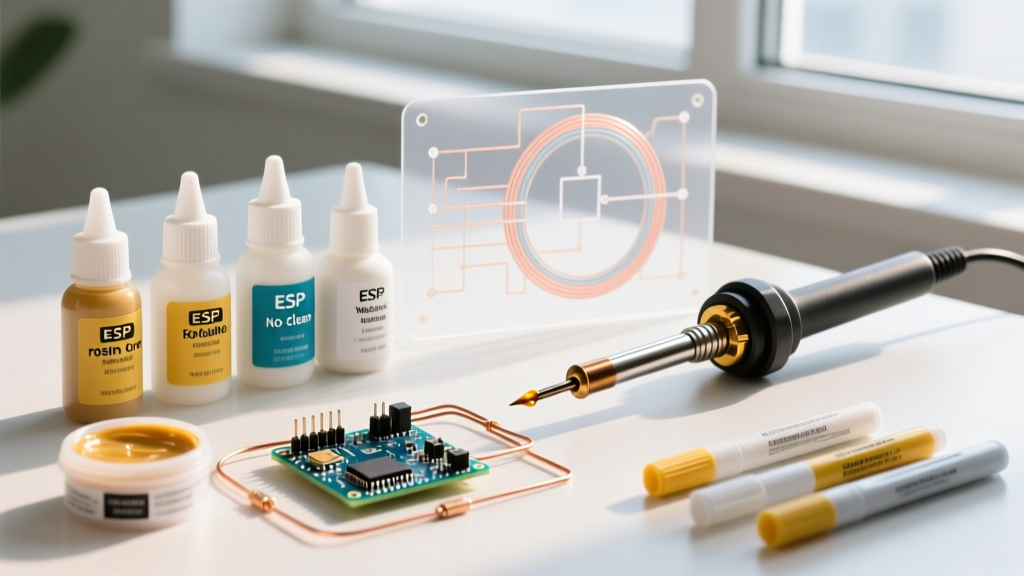
- Liquid Flux (e.g., Kester 951): Best for through-hole components, DIP switches, and large wire splicing. Applied via brush or spray. It flows easily under components via capillary action but can run into unintended vias if over-applied.
- Tacky / Gel Flux (e.g., Amtech NC-559-V2-TF): The undisputed king of BGA rework and 0201 SMD components. It is highly viscous, holding tiny components in place via surface tension while providing localized, long-lasting activation. Typically sold in 10cc syringes for $30-$45.
- Flux Pens (e.g., MG Chemicals 8341): Ideal for quick touch-ups and field repairs. The felt tip allows for targeted application without flooding the board. Ensure the pen is stored horizontally to prevent the internal valve from drying out.
Troubleshooting: When Flux Fails
Even with premium consumables, improper thermal profiles or expired shelf-life can cause catastrophic flux failure. Here are the most common edge cases and their solutions:
- Solder Balling and Spattering: Caused by rapid heating. The solvent in the flux boils instantly, exploding microscopic droplets of molten solder across the PCB, potentially causing micro-shorts. Solution: Implement a 60-second preheat ramp to 150°C using a hot air station or preheater before applying full iron heat.
- Dry, Grainy Joints (Burnout): If a 60W iron is left on a large ground plane joint for more than 4-5 seconds, the flux boils off completely. The exposed solder instantly oxidizes, creating a cold, high-resistance joint. Solution: Use a higher-thermal-mass chisel tip, apply fresh liquid flux, or switch to a higher-activity RA flux.
- Wicking and Tombstoning: In SMT reflow, if flux activates unevenly across a small capacitor, the unequal surface tension will pull the component upright (tombstoning). Solution: Ensure your reflow profile includes a proper 'soak' zone (150°C to 175°C for 60-90 seconds) to allow the flux to activate uniformly across the entire board before the solder melts.
Expert Selection Framework
To streamline your consumable purchasing, use this decision matrix based on your primary application:
- Prototyping & General DIY: Use ROL1 (RMA) rosin-core solder wire. It provides excellent wetting, forgiving activation temperatures, and the residue is benign enough to leave on the board for short-term testing.
- High-Volume SMT Assembly: Use REL0 No-Clean liquid or tacky flux. It eliminates the costly and time-consuming post-assembly washing stage while maintaining high electrical resistance.
- Heavy-Duty Wiring & Automotive: Use ORH1 Water-Soluble paste or aggressive RA liquid flux. The high activity cuts through heavy oxidation on thick gauge wires, provided you commit to a rigorous DI water cleaning protocol afterward.
Ultimately, understanding what is flux used for soldering transforms it from a messy afterthought into a precision chemical tool. By matching the IPC classification to your thermal profile and cleaning capabilities, you guarantee robust, long-lasting metallurgical bonds in every project.