
The Unique Thermal and Chemical Demands of Stained Glass
Unlike printed circuit board (PCB) assembly, stained glass soldering involves joining heavy copper foil or lead came to create continuous, structural beads. This requires massive thermal transfer and aggressive oxide removal. In 2026, the market for stained glass fluxes remains divided between traditional inorganic acids and modern organic alternatives, each demanding specific temperature profiles and cleanup protocols.
Choosing the best flux for stained glass soldering is not a one-size-fits-all decision. A flux that yields a mirror-smooth bead on copper foil might cause severe pitting on lead came, while a gel formula perfect for vertical domes will struggle to flow across flat sun catchers. This guide breaks down the exact chemistries, pricing, and failure modes of the top stained glass flux brands available today.
The Chemistry: Inorganic vs. Organic Fluxes
Before comparing brands, you must understand the two primary chemical bases used in glass art:
- Zinc Chloride (Inorganic): Highly aggressive and water-soluble. It strips heavy oxidation instantly, making it ideal for lead came and heavily tarnished copper. However, it is highly corrosive and must be neutralized post-soldering to prevent long-term degradation of the metal.
- Oleic / Stearic Acid (Organic): Milder and heat-activated. These fluxes require higher soldering iron temperatures (typically 700°F to 800°F at the tip) to break down oxides. They leave a protective, wax-like residue that is friendly to chemical patinas but can cause 'skipping' if your iron lacks the thermal mass to activate the chemistry.
According to the IPC J-STD-004 Flux Requirements, organic fluxes (like rosin and oleic blends) are classified by their activity levels and residue tackiness, which directly translates to how a stained glass flux behaves under a 100W iron.
2026 Brand Comparison Matrix
| Brand & Model | Base Chemistry | Form | Best Application | Avg. Price (8oz) | Fume Level |
|---|---|---|---|---|---|
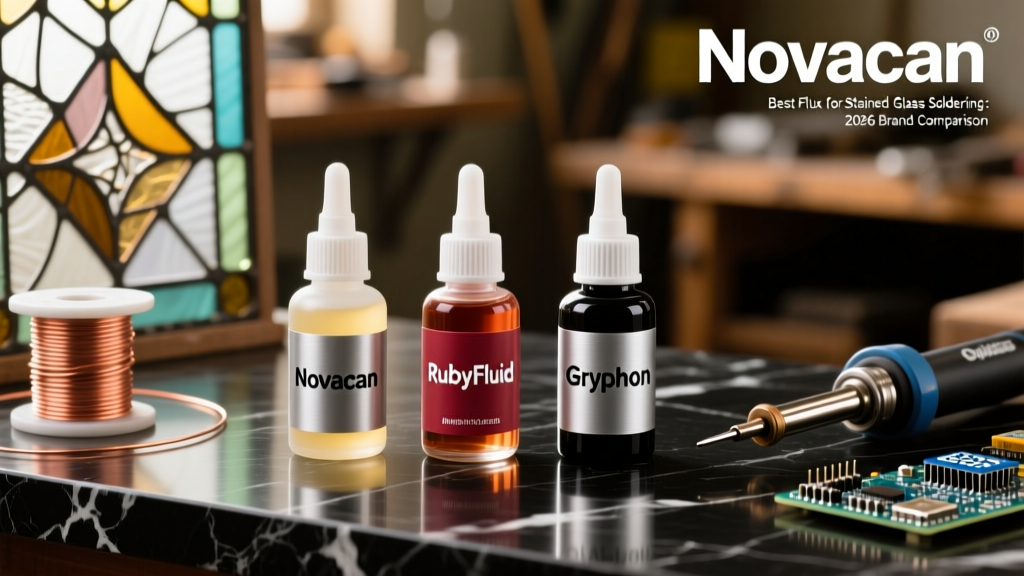
| Novacan Super Pro | Zinc Chloride | Liquid | Lead Came / Heavy Oxidation | $11 - $14 | High |
| RubyFluid Stained Glass | Oleic Acid Blend | Liquid | Copper Foil / Patina Prep | $16 - $19 | Low |
| Gryphon Flux | Organic/Gel | Gel | Vertical Seams / 3D Domes | $13 - $15 | Medium |
| Worden's Flux | Zinc Chloride | Liquid | General Purpose / Traditional | $10 - $12 | High |
Deep Dive: Top Brands Analyzed
1. Novacan Super Pro (The Heavy-Duty Standard)
Novacan Super Pro is an inorganic, zinc chloride-based liquid flux that has been a studio staple for decades. It is exceptionally effective at cutting through the thick oxidation that naturally forms on lead came and aged copper foil.
- Pros: Instant wetting; requires lower iron temperatures (600°F - 650°F) to activate; extremely cost-effective.
- Cons: High fume output; highly corrosive if not cleaned properly.
- Failure Mode Edge Case: If Novacan is left on copper foil overnight without neutralization, it will eat through the copper adhesive and cause 'black line' pitting under the patina. Always neutralize immediately.
2. RubyFluid Stained Glass Flux (The Patina Protector)
RubyFluid utilizes an oleic acid base, making it an organic flux. It is widely considered the premium choice for copper foil projects where a flawless, mirror-like bead and subsequent chemical patina (like Novacan Black Patina) are desired.
- Pros: Low fume output; leaves a protective barrier that prevents premature oxidation before patina application; does not eat copper adhesives.
- Cons: Premium pricing; requires a high-thermal-mass iron (80W to 100W, such as the Hakko FX-601 or Weller 100PG).
- Failure Mode Edge Case: 'Skipping' or 'beading up.' If your soldering iron tip drops below 700°F (370°C) during a long seam, the oleic acid fails to activate, resulting in the solder refusing to stick to the copper. Upgrading to a 1/4-inch bevel tip solves this thermal bottleneck.
3. Gryphon Flux (The Vertical Specialist)
Gryphon's gel-based formula is engineered for high-viscosity applications. When building 3D lamp shades or jewelry boxes, liquid fluxes run down the glass, pooling at the bottom and leaving the top seams dry. Gryphon stays exactly where you brush it.
- Pros: Excellent vertical adhesion; precise application with a brush; reduced splatter.
- Cons: Gel residue is thicker and requires warm water and a soft brush to remove completely from textured glass (like Waterglass or Artique).
4. Worden's Flux (The Traditionalist)
Worden's is a straightforward, no-nonsense zinc chloride liquid. It performs similarly to Novacan but with a slightly thinner viscosity, making it ideal for artists who prefer to spray their flux rather than brush it.
- Pros: Very affordable; excellent capillary action into tight foil seams.
- Cons: Splatters easily when hit with a hot iron; strong chemical odor requiring robust ventilation.
Application-Specific Selection Framework
To maximize your success rate, match the flux to your specific project architecture:
- Copper Foil Sun Catchers (Flat): Use RubyFluid. The flat surface allows the liquid to spread evenly, and the oleic acid ensures the copper is perfectly prepped for black or copper patina.
- Lead Came Borders & Framing: Use Novacan Super Pro. Lead oxidizes heavily and requires the aggressive bite of zinc chloride to ensure the 60/40 solder bonds structurally to the came.
- 3D Lampshades & Domes: Use Gryphon Gel. The viscosity prevents the flux from running down the glass and onto your workbench, ensuring continuous wetting on sloped seams.
Expert Tip: Never mix flux chemistries on the same project. Applying an oleic acid flux over a zinc chloride residue will create a gummy, un-solderable paste that requires stripping the piece with white vinegar and starting over.
Safety, Fumes, and Cleanup Protocols
Soldering stained glass generates hazardous fumes, particularly when using zinc chloride fluxes. The CDC NIOSH Pocket Guide to Chemical Hazards notes that zinc chloride fumes can cause severe respiratory irritation and metal fume fever if inhaled in poorly ventilated spaces. Always use an inline HEPA/Carbon fume extractor positioned within 6 inches of your workpiece.
The Neutralization Step (Crucial for Zinc Chloride)
Water alone will not stop the corrosive action of zinc chloride. You must chemically neutralize it:
- The Ratio: Mix 1 tablespoon of baking soda (sodium bicarbonate) per 1 pint of warm water.
- The Process: Brush the solution over all soldered lines. You will see it fizz as it neutralizes the acid.
- The Rinse: Wipe down with clean water and dry immediately to prevent water spots on the glass.
For organic fluxes like RubyFluid, a simple wipe-down with a damp cloth and a drop of dish soap is sufficient, as the oleic acid is non-corrosive once cooled. For more advanced glass preparation techniques, the Delphi Glass Learning Center offers excellent visual guides on post-solder cleanup and patina sealing.
Frequently Asked Questions
Can I use electronic PCB flux for stained glass?
No. PCB fluxes (like Amtech or MG Chemicals rosin pastes) are designed for microscopic surface-mount components and low-heat alloys (SAC305). They lack the aggressive oxide-removal power needed for heavy copper foil and will carbonize instantly under the 800°F tip required for stained glass, leaving a hard, black crust that ruins your solder bead.
Why is my solder beading up and rolling off the copper foil?
This is almost always a thermal or chemistry mismatch. If you are using an organic flux (RubyFluid) with a low-wattage iron (40W-60W), the flux is not reaching its activation temperature. Upgrade to an 80W+ iron with a thick chisel or bevel tip to maintain thermal mass across the copper.
How long does an 8oz bottle of flux last?
For a hobbyist building 2-3 medium-sized sun catchers a month, an 8oz bottle of liquid flux will typically last 6 to 8 months. Gel fluxes tend to dehydrate if the lid is not sealed tightly, reducing their shelf life to about 4 months once opened.