
The Great Flux Showdown: Finding the Best Soldering Flux for Your Workbench
When diagnosing poor solder joints, cold connections, or bridged SMD pins, hobbyists and professionals alike often blame their soldering iron or the solder wire itself. However, the true unsung hero of electronics assembly is the flux. Flux chemically removes metal oxides, reduces surface tension, and enables the molten alloy to wet the copper pads. Without it, even the most expensive JBC or Weller station will struggle to form a reliable metallurgical bond.
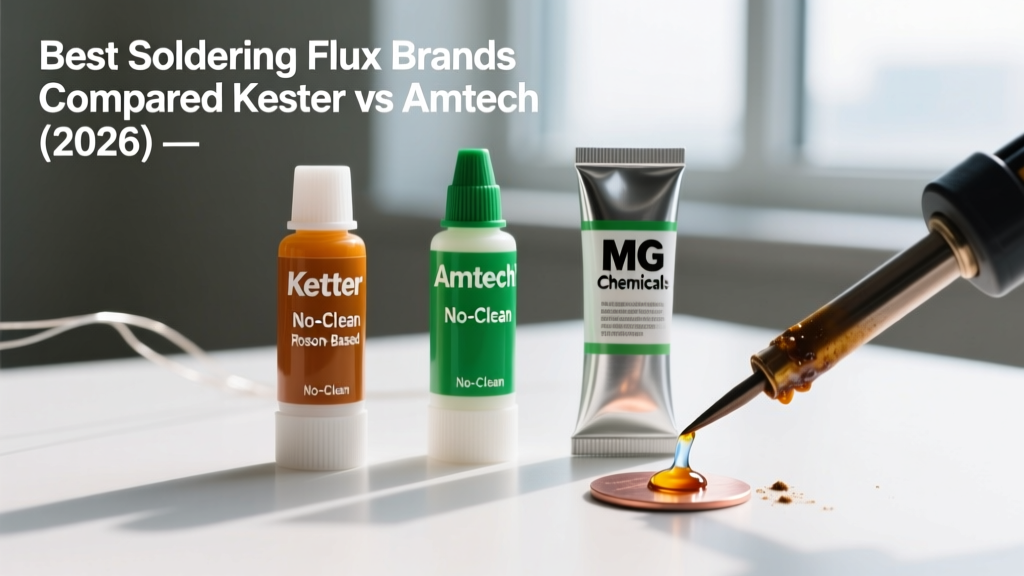
But with dozens of formulations on the market, which one actually delivers? To determine the best soldering flux for various applications, we put four industry-leading brands head-to-head: Kester, Amtech, MG Chemicals, and Chip Quik. This 2026 brand comparison evaluates their flagship products based on wetting speed, residue reliability, IPC compliance, and real-world rework performance.
The Contenders: Brand Profiles and Flagship Models
1. Kester: The Industrial Standard
Kester (now part of MacDermid Alpha) has been the benchmark for soldering consumables for over a century. Their formulations are heavily referenced in IPC standards documentation and military-grade assembly guidelines.
- Flagship Model: Kester 186 RMA (Rosin Mildly Activated) & Kester 951 No-Clean.
- Chemistry & Performance: Kester 186 contains roughly 2% chloride-based activators, giving it aggressive oxide removal capabilities. It excels on slightly tarnished through-hole components and older PCBs. However, it leaves a sticky, amber residue that requires cleaning with isopropyl alcohol (IPA) or a dedicated saponifier to prevent long-term corrosion.
- Pricing (2026): ~$14.00 for a 2 oz bottle of 186; ~$18.00 for a 10ml pen of 951.
- Best For: Through-hole assembly, repairing vintage electronics, and heavy-duty wire tinning where aggressive wetting is required.
2. Amtech: The SMD and BGA Rework King
Amtech (Indium Corporation) dominates the surface-mount technology (SMT) and micro-BGA rework space. If you are replacing a modern QFN chip or reballing a BGA, Amtech is usually the default choice among board-level repair technicians.
- Flagship Model: Amtech NC-559-V2-TF (Tack Flux).
- Chemistry & Performance: This is a Type 4, halide-free, no-clean tack flux. Its high viscosity (tackiness) is specifically engineered to hold tiny 0201 and 0402 SMD components in place before the solder melts. It is optimized for the higher thermal profiles of lead-free SAC305 alloys (240°C+), resisting charring and spitting during prolonged hot-air rework.
- Pricing (2026): ~$32.00 for a 10cc syringe.
- Best For: Precision SMD rework, BGA reballing, and drag-soldering fine-pitch QFP chips.
3. MG Chemicals: The Accessible All-Rounder
MG Chemicals bridges the gap between industrial manufacturing and the DIY hobbyist. Their products are widely available, reasonably priced, and packaged in user-friendly applicators.
- Flagship Model: MG Chemicals 8341 No-Clean Pen & 8342 Rosin Paste.
- Chemistry & Performance: The 8341 pen uses a low-solids (<5%) synthetic resin base. It flows beautifully when heated and leaves a practically invisible, non-conductive residue. The built-in brush pen makes it incredibly easy to apply a controlled amount of flux to a specific IC pin without flooding the board.
- Pricing (2026): ~$12.00 per 10ml pen.
- Best For: Quick SMD touch-ups, Arduino prototyping, and educational environments where messy cleanup is a concern.
4. Chip Quik: The Drag-Soldering Specialist
Chip Quik is famous for its low-temperature desoldering alloys, but their flux line is equally impressive, particularly for manual drag-soldering techniques.
- Flagship Model: Chip Quik SMD291AX (Tack Flux in Syringe).
- Chemistry & Performance: Formulated with a proprietary rosin ester base, SMD291AX offers a longer tack time than Amtech. It doesn't dry out as quickly when exposed to air during lengthy rework sessions. It provides excellent thermal transfer, protecting delicate plastic IC packages from heat damage during prolonged iron contact.
- Pricing (2026): ~$22.00 for a 10g jar or 10cc syringe.
- Best For: Drag-soldering LQFP-144 microcontrollers and extended hot-air rework sessions.
Head-to-Head Comparison Matrix
| Brand / Model | Flux Type | IPC J-STD-004 Class | Residue / Cleaning | Viscosity | Ideal Application |
|---|---|---|---|---|---|
| Kester 186 | RMA (Rosin Mildly Activated) | RO1 (Type 3) | Amber, Sticky / Must Clean | Low (Liquid) | Through-hole, Vintage Repair |
| Kester 951 | No-Clean | OR0 (Type 4) | Clear, Hard / Optional | Low (Liquid) | General Purpose, Wire Tinning |
| Amtech NC-559-V2 | No-Clean Tack | OR0 (Type 4) | Clear, Tacky / Optional | High (Gel) | BGA Rework, 0201 SMD |
| MG 8341 Pen | No-Clean | OR0 (Type 4) | Invisible / No Clean | Low (Liquid) | Prototyping, Quick Touch-ups |
| Chip Quik SMD291 | Rosin Tack | RO1 (Type 4) | Amber, Tacky / Recommended | Very High (Gel) | Drag Soldering, QFP Chips |
Deep Dive: Flux Chemistry and Failure Modes
Choosing the best soldering flux isn't just about brand loyalty; it requires understanding the chemistry and how it interacts with your specific thermal profile. According to high-reliability guidelines outlined in the NASA Electronic Parts and Packaging (NEPP) program and standard IPC classifications, mismatching your flux to your environment can lead to catastrophic field failures.
The Danger of Electrochemical Migration (ECM)
A common misconception in 2026 is that "No-Clean" means you never have to clean the board. While no-clean fluxes (like Amtech NC-559 and MG 8341) use synthetic resins that encapsulate the activators upon cooling, this encapsulation can be compromised. If a no-clean flux is heated excessively (charring the resin) or if the board operates in a high-humidity, high-bias environment, the unencapsulated activators can dissolve in ambient moisture. This triggers Electrochemical Migration (ECM), where metallic dendrites grow between fine-pitch traces, eventually causing a short circuit.
Expert Rule of Thumb: If you are building a device that will operate outdoors, in a bathroom, or under high voltage bias, always clean your no-clean flux residues with 99% IPA and a soft brush, or switch to a water-soluble (OA) flux and use a deionized water wash.
Rosin Charring on Lead-Free Alloys
Traditional RMA fluxes like Kester 186 were designed for Tin/Lead (Sn63/Pb37) solder, which melts at 183°C. Modern lead-free alloys like SAC305 require tip temperatures of 350°C to 380°C to achieve proper wetting. When traditional rosin flux is exposed to these extreme temperatures, the abietic acid boils off and carbonizes, turning into a hard, black, glass-like crust. This charred flux is nearly impossible to clean and acts as a thermal insulator, preventing the solder from flowing. Solution: When working with lead-free solder, always use a high-temperature synthetic no-clean gel (Amtech) or a specialized lead-free liquid flux (Kester 952).
Application Techniques: Maximizing Flux Performance
Even the most expensive Amtech syringe will fail if applied incorrectly. Here is how to optimize your technique based on the format:
1. Liquid Flux (Pens and Bottles)
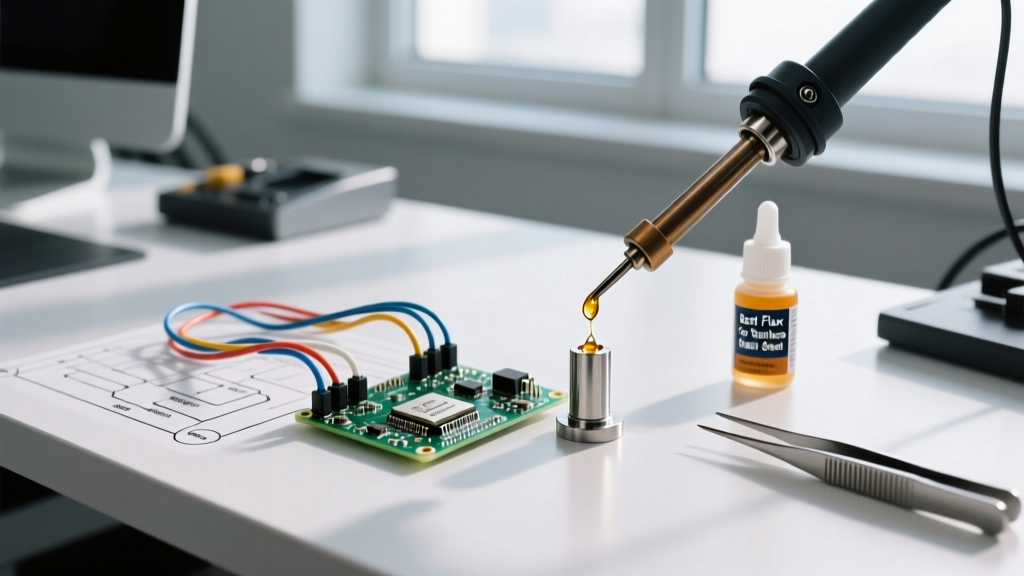
Liquid fluxes rely on volatile solvents (like glycol ethers or alcohols) to carry the activators. Do not apply liquid flux and immediately touch it with a 350°C iron. The rapid boiling of the solvent will cause the flux to splatter, leaving you with dry pads and flux sprayed across your workbench. Apply the flux, wait 3 to 5 seconds for the solvent to flash off slightly, and then apply heat.
2. Tack Flux (Syringes and Jars)
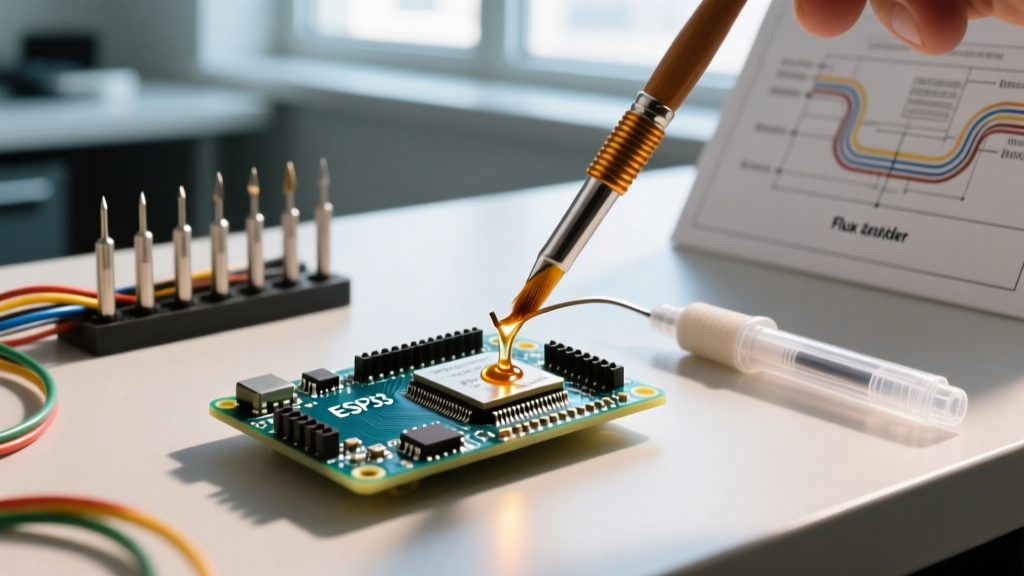
Tack fluxes are thixotropic—they become less viscous when agitated or heated. When dispensing Amtech or Chip Quik from a syringe, use a blunt-tip needle (20-gauge or 22-gauge). Apply a microscopic dot to the corner pads of a QFP chip. The surface tension of the molten solder will naturally pull the flux (and the solder) under the IC pins via capillary action. Over-applying tack flux will result in a messy residue that traps heat and makes post-rework inspection difficult.
Final Verdict: Which Brand Should You Buy?
There is no single "best" soldering flux; there is only the best flux for your specific task. Here is our 2026 purchasing recommendation:
- Buy Kester 186 if you are restoring vintage audio equipment, building tube amplifiers, or doing heavy through-hole wiring where aggressive oxide removal is paramount.
- Buy Amtech NC-559-V2-TF if you are a professional repair technician working on modern smartphones, laptops, or doing micro-BGA rework. It is the undisputed champion of high-heat SMD rework.
- Buy MG Chemicals 8341 Pens if you are a hobbyist, student, or maker who wants a clean, easy-to-use flux for everyday Arduino and Raspberry Pi HAT assembly without the mess of syringes.
- Buy Chip Quik SMD291AX if you frequently drag-solder fine-pitch microcontrollers and need a gel that won't dry out during long, meticulous soldering sessions.
By matching the flux chemistry to your alloy and thermal profile, you will instantly elevate the quality of your solder joints, turning dull, grainy connections into bright, concave, and reliable metallurgical bonds. For further reading on high-reliability soldering requirements and flux residue tolerances, consult the Kester technical data sheets and your local IPC training guidelines.