
The Hidden Role of Flux in Wire-to-Wire and Wire-to-Board Joints
When soldering wires, the metallurgical challenges differ significantly from flat PCB pads. Stranded wires possess a vastly higher surface area than solid core wires or copper traces, meaning they harbor more oxidation and trap contaminants deep within the interstitial spaces between individual strands. Selecting the correct flux for wire soldering is not merely about preventing oxidation; it is about reducing surface tension to enable capillary wicking deep into the wire bundle, ensuring a robust intermetallic compound (IMC) layer forms across every single strand.
Using the wrong flux chemistry can lead to catastrophic failure modes, including dry joints hidden inside heat-shrink tubing, galvanic corrosion from trapped activators, and wicking failures that leave high-resistance connections. This guide breaks down the exact chemistries, form factors, and application-specific frameworks you need to select the optimal flux for your wiring projects in 2026.
Decoding Flux Chemistries for Wire Soldering
The IPC J-STD-004B standard categorizes soldering fluxes by their base material and activity level. Understanding these classifications is critical for wire applications, where post-soldering cleaning is often physically restricted by insulation and heat shrink.
1. Rosin-Based Fluxes (RO)
Derived from pine tree sap, rosin fluxes are the traditional workhorses of electronics wiring. They are available in three activity levels:
- RO-L (Pure Rosin): Non-activated. Extremely safe but lacks the chemical punch to cut through heavily oxidized automotive or aerospace wiring. Best for pristine, freshly stripped hook-up wire.
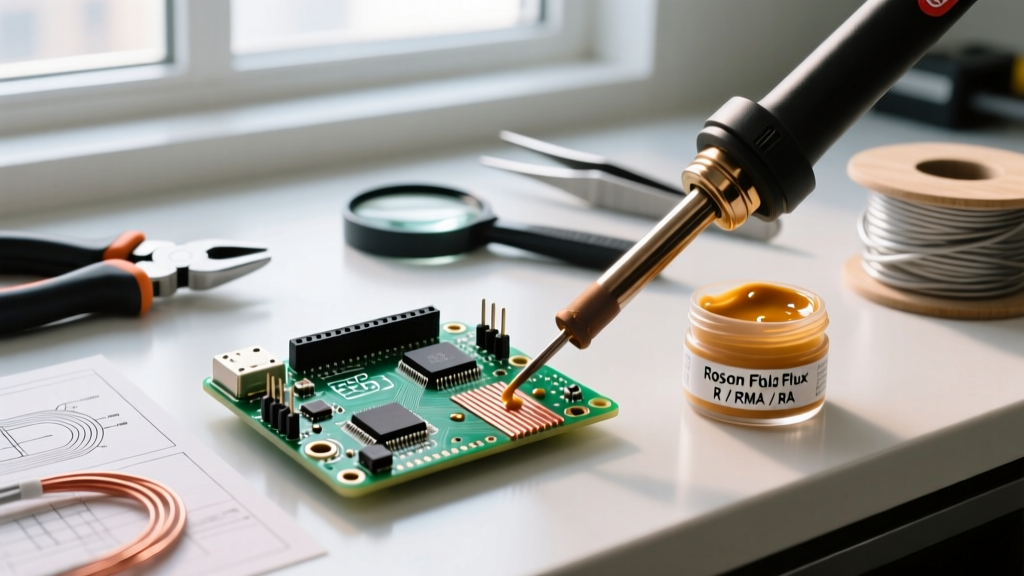
- RO-M (RMA - Rosin Mildly Activated): The industry standard for general wire soldering. Products like Kester 186 (~$14 for 2 oz) use mild activators to clean moderate oxidation while leaving a benign, hard residue that is non-corrosive if left uncleaned.
- RO-H (RA - Rosin Activated): Contains aggressive activators (like diethylamine hydrochloride) designed for heavily tarnished wires. Warning: RA flux residues are highly corrosive and must be cleaned with 99% isopropyl alcohol or specialized solvents before applying heat shrink.
2. Water-Soluble Fluxes (OA - Organic Acid)
Water-soluble fluxes use organic acids (such as adipic or glutaric acid) to provide aggressive oxide removal. They are exceptional for soldering thick-gauge battery cables or heavily oxidized grounding straps. However, their residues are highly conductive and corrosive. If you are soldering a wire to a tight-pitch PCB connector, capillary action can draw the corrosive residue under the component, leading to dendritic growth and short circuits. Products like MG Chemicals 8341 (~$18 for 50ml) require thorough cleaning with warm water or specialized saponifiers, not just alcohol.
3. No-Clean Fluxes (IN/RE)
No-clean fluxes utilize synthetic resins and mild activators that completely volatilize or encapsulate upon reaching soldering temperatures. They are the undisputed champions for wire splicing where heat-shrink tubing will be applied immediately after soldering. Because you cannot clean a wire joint once the heat shrink is sealed, a no-clean flux (like Kester 245 or Indium NC-559) ensures no corrosive residues are trapped against the copper.
Flux Chemistry Comparison Matrix
| Flux Type | IPC Code | Oxide Removal Power | Residue Conductivity | Cleaning Required? | Best Wire Application |
|---|---|---|---|---|---|
| Pure Rosin | RO-L | Low | Non-Conductive | Optional | Pristine audio / RF cables |
| Mildly Activated | RO-M | Medium | Non-Conductive | Recommended | General PCB jumpers, harnesses |
| Activated | RO-H | High | Corrosive | Mandatory | Tarnished automotive wiring |
| Water-Soluble | OA | Very High | Highly Conductive | Mandatory (Water) | Heavy gauge battery cables |
| No-Clean | IN/RE | Medium-Low | Non-Conductive | No | Wire splices under heat-shrink |
Form Factors: Matching Delivery to Wire Gauge
The physical delivery method of your flux is just as critical as its chemical composition. Applying a high-viscosity gel to a 30 AWG stranded wire will result in a messy joint, while a thin liquid will instantly boil off a massive 8 AWG power cable before the core reaches melting temperature.
Flux-Cored Solder Wire
For 80% of standard wire-to-board and wire-to-wire soldering, flux-cored solder is sufficient. However, pay attention to the core fill percentage. Standard electronics solder features a 2% to 3% flux core. When soldering multi-strand wires, the flux often depletes before the thermal mass of the wire is fully saturated. For heavy wiring, seek out 3.3% to 4% core fill solders (e.g., Kester 245 3.3% core) to ensure adequate wetting.
Liquid Flux Pens
Ideal for AWG 22 to AWG 30 wires. A quick swipe of a no-clean flux pen (like the Kester 951 Flux Pen, ~$9) pre-wets the strands, allowing the solder to wick instantly upon iron contact without needing a third hand to apply paste.
Tacky / Thixotropic Gel Flux
Gel fluxes (dispensed via 10cc syringes, typically $15-$25) are highly viscous and thixotropic—meaning they flow under pressure but stay put when static. They are perfect for pre-tinning thick stranded wires (AWG 10 to AWG 2) before they are inserted into screw terminals or XT60 connectors. The gel clings to the vertical wire strands and prevents the flux from boiling away prematurely under high-heat soldering irons (400°C+).
Application-Specific Selection Framework
Pro-Tip: The Heat-Shrink Rule
If your wire joint will be covered by adhesive-lined heat shrink tubing, never use water-soluble or RA (Activated) rosin flux. The heat from the shrink process will reactivate trapped corrosive residues, eating through the copper strands over months or years. Always use No-Clean or thoroughly clean RMA residues before shrinking.
Aerospace and High-Vibration Wiring
In aerospace and motorsport applications, wires are subject to intense vibration. The goal is maximum mechanical strength and complete strand penetration. Use a Rosin Activated (RA) liquid flux to aggressively clean the strands, follow with a 63/37 Sn/Pb eutectic solder for optimal crystalline structure, and mandatory ultrasonic cleaning in an isopropyl bath before sealing. For lead-free requirements, Sn96.5/SAC305 alloys paired with a high-activity no-clean gel (like Indium Corporation's specialized wire fluxes) provide the necessary wetting force.
Audiophile and RF Signal Wiring
When soldering silver-bearing wires or delicate Litz wire for audio and radio frequencies, signal integrity is paramount. Aggressive acid fluxes can alter the dielectric properties of the surrounding PTFE or Kapton insulation. Stick to Pure Rosin (RO-L) or ultra-low residue No-Clean pastes. Furthermore, Litz wire is coated in enamel. Standard flux will not remove polyimide (Kapton) enamel; you must mechanically strip it or use a specialized high-temperature solder pot to burn off polyurethane enamels before applying flux and finishing the joint.
Troubleshooting Flux Failure Modes in Wire Joints
Even experienced technicians encounter flux-related failures when working with wires. Here is how to diagnose and correct them:
- The 'Icicle' or Non-Wetting Joint: The solder balls up on the outside of the stranded wire but doesn't wick inside. Cause: Insufficient flux volume or flux boiling off before the wire reaches 183°C (for Sn/Pb). Fix: Pre-tin the wire with liquid flux and a lower iron temperature (320°C), let it wick, then apply the final solder joint.
- Charred, Black Residue: The flux turns into a hard, black crust that refuses to dissolve in alcohol. Cause: Thermal degradation. Your soldering iron is set too high (400°C+), burning the rosin base into carbon. Fix: Lower the iron temperature to 350°C and use a gel flux, which has a higher thermal mass and resists burning longer than thin liquids.
- Green Corrosion (Copper Chloride): Appears weeks after soldering, usually near the edge of heat shrink. Cause: Trapped RA or Water-Soluble flux residues reacting with ambient humidity. Fix: Cut the joint, clean with a specialized saponifier, and re-solder using a verified No-Clean chemistry.
Final Verdict: Building Your Wire Soldering Kit
To handle the vast majority of electrical and electronics wiring tasks in 2026, your bench should be equipped with three specific flux consumables: a No-Clean flux pen for quick PCB jumper wires, a 3.3% core RMA solder for general wire-to-terminal splicing, and a Water-Soluble gel in a syringe for heavy-gauge battery and automotive cables where aggressive cleaning is possible. By matching the flux chemistry and delivery method to the specific thermal mass and environmental requirements of your wire, you eliminate cold joints and ensure decades of electrical reliability.