
The Chemistry of Connection: Why Application Dictates Your Flux
Selecting the correct flux in soldering is not a one-size-fits-all decision; it is a precise chemical calculation based on your specific application, thermal profile, and post-assembly cleaning capabilities. At its core, flux serves two primary functions: it chemically reduces metal oxides on the pad and component lead, and it lowers the surface tension of the molten solder to promote capillary wetting. However, the activators used to achieve this—ranging from mild rosin derivatives to aggressive organic acids—dictate the reliability of the final joint.
According to the IPC J-STD-004B standard, fluxes are classified by composition (Rosin, Resin, Organic, Inorganic) and activity level (Low, Medium, High), combined with a halide indicator (0 or 1). Misaligning your flux chemistry with your application can lead to catastrophic field failures, including electrochemical migration (dendrite growth) and hidden corrosion under bottom-terminated components.
Application 1: Through-Hole & Heavy Wire Splicing (Rosin Mildly Activated)
For general-purpose through-hole technology (THT), heavy-gauge wire splicing, and basic electromechanical assembly, Rosin Mildly Activated (RMA) flux remains the industry workhorse. The rosin base (derived from pine sap) becomes active only at soldering temperatures (typically above 150°C), providing a safe, mildly aggressive cleaning action that protects the joint from re-oxidation during cooling.
Product Spotlight: Kester 44 (RMA)
Kester 44 is the benchmark RMA flux, frequently cored inside Sn63/Pb37 and SAC305 (Sn96.3/Ag3.0/Cu0.7) wire solders. As of early 2026, a 1lb spool of 0.031-inch Kester 44 cored SAC305 wire retails for approximately $42 to $48, reflecting recent stabilization in silver and tin commodity markets.
- Best For: Hand soldering of through-hole capacitors, connectors, and heavy-gauge (12 AWG to 4 AWG) wire lugs.
- Failure Mode Edge Case: While RMA residues are generally considered non-corrosive and can be left on the board, leaving thick pools of unactivated rosin under high-impedance analog circuits can cause parasitic capacitance and signal leakage.
- Cleaning Protocol: Optional, but if required for aesthetic or conformal coating adhesion, use an isopropyl alcohol (IPA) based solvent or a dedicated rosin cleaner like MG Chemicals 413B.
Application 2: High-Density SMD & BGA Rework (No-Clean / Tacky)
When dealing with high-density surface mount devices (SMD), particularly Ball Grid Arrays (BGAs) and Quad Flat No-leads (QFNs), post-soldering cleaning is physically impossible. The standoff height of a BGA is typically between 0.2mm and 0.4mm, preventing solvents from flushing out residues. Therefore, a true No-Clean flux with an ROL0 (Rosin, Low activity, 0 halides) classification is mandatory.
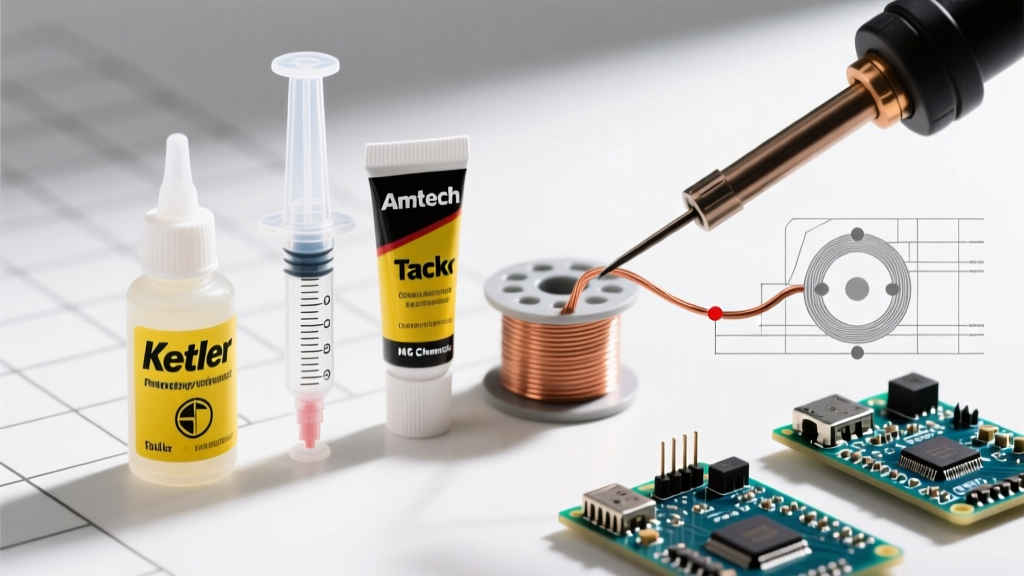
Product Spotlight: Amtech NC-559-V2-TF
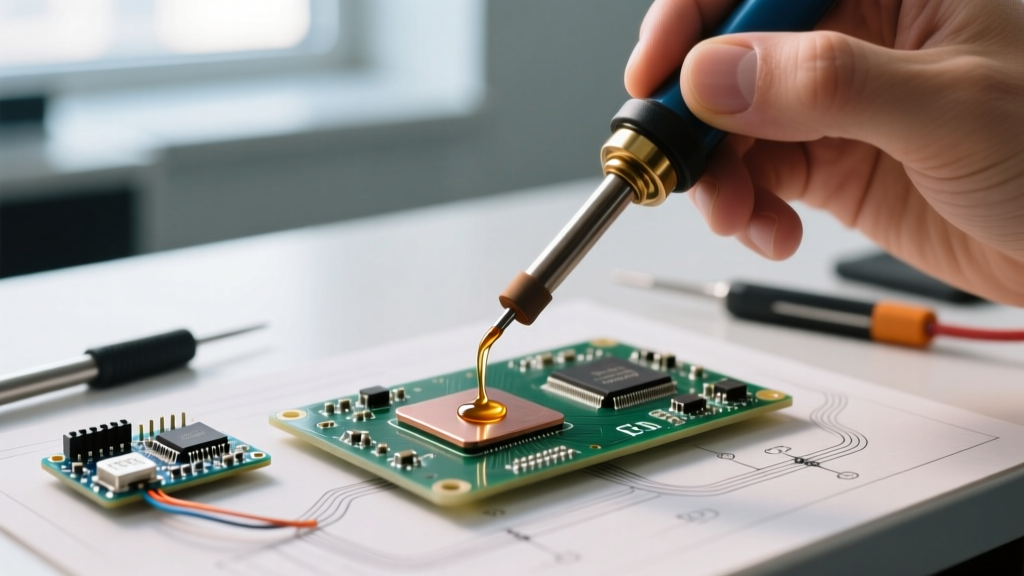
Amtech NC-559-V2-TF is a halogen-free, no-clean tacky flux specifically engineered for BGA reballing and SMD rework. It exhibits high tackiness to hold components in place prior to reflow and leaves a clear, hard residue that passes IPC-TM-650 surface insulation resistance (SIR) testing.
Expert Insight: When dispensing tacky flux for BGA rework, volume control is critical. Over-dispensing NC-559-V2-TF can cause the flux to boil violently during the reflow profile's peak temperature (245°C for SAC305), resulting in micro-solder balling under the BGA package. Use a precision pneumatic dispenser with a 20-gauge needle and aim for a 0.5mm bead height.
Pricing for a 35g syringe of Amtech NC-559-V2-TF sits around $45 to $52 in 2026. Always store this flux between 2°C and 8°C to prevent the solvents from evaporating and altering the rheology, which directly impacts stencil printing performance.
Application 3: High-Reliability & Aerospace (Water-Soluble / Organic Acid)
In aerospace, medical, and automotive applications where zero-defect reliability is mandated, water-soluble (Organic Acid or OA) fluxes are preferred. These fluxes contain aggressive activators that easily strip heavy oxides from challenging surfaces like oxidized copper or nickel-palladium-gold (NiPdAu) finishes. However, the resulting residues are highly conductive and corrosive, necessitating rigorous post-solder cleaning.
NASA's Electronic Parts and Packaging (NEPP) workmanship standards strictly govern the use and removal of these fluxes in mission-critical hardware. Any ionic residue left behind will absorb ambient moisture and rapidly cause dendritic shorting.
Product Spotlight: Kester 331 Organic Acid Flux
Kester 331 is a liquid, water-soluble flux designed for wave and selective soldering of high-reliability boards. A 1-pint container costs approximately $32 to $38.
- Best For: Selective soldering of heavy ground planes, RF shielding cans, and components with highly oxidized legacy leads.
- Cleaning Protocol (Strict): Must be cleaned within 2 to 4 hours of soldering. Use heated deionized (DI) water (minimum 60°C) with a resistivity of >10 MΩ·cm. For complex geometries, a saponifier (like Kyzen E5611) at a 5% concentration is required to break down the organic acid salts.
Application-Specific Flux Selection Matrix
| Flux Category | IPC Classification | Activity Level | Cleaning Required? | Ideal Application | Shelf Life (Unopened) |
|---|---|---|---|---|---|
| Rosin (RMA) | ROM1 | Medium | Optional (Recommended for coatings) | THT, Wire Splicing, General Repair | 24 Months |
| No-Clean (Tacky) | ROL0 | Low | No (Do not clean) | BGA Rework, 0402 SMD, QFN | 6-12 Months (Refrigerated) |
| Water-Soluble (OA) | ORH1 | High | Yes (Mandatory DI Water) | Aerospace, Medical, Heavy Oxides | 12 Months |
| Inorganic Acid | IN1 | Very High | Yes (Neutralization required) | Plumbing, Heavy Sheet Metal (Never PCBs) | 24 Months |
Edge Cases & Troubleshooting: When the Right Flux Fails
Even when you select the correct flux in soldering for your application, process variables can induce defects. Understanding these failure modes separates novice technicians from process engineers.
1. Tombstoning in 0402 and 0201 Passives
Tombstoning occurs when a small passive component stands on one end during reflow. While often blamed on the flux, the root cause is usually flux exhaustion combined with uneven thermal mass. If the flux activators burn off before the solder paste on the opposite pad reaches its liquidus temperature (217°C for SAC305), the wetting force becomes unbalanced. Solution: Extend the soak zone of your reflow profile (150°C to 180°C) by 15-20 seconds to allow the flux to maintain its protective blanket until both pads reflow simultaneously.
2. Electrochemical Migration (Dendrite Growth)
If you use a No-Clean flux but subsequently clean the board with an incompatible solvent (like low-grade IPA), you may not remove the flux. Instead, you dissolve the rosin matrix and spread the ionic activators across the board surface. When exposed to humidity and voltage bias, these ions form conductive dendrites, causing micro-shorts. Solution: If you must clean a No-Clean residue, use a high-flashpoint, engineered solvent (e.g., Techspray Ecoline) followed by a DI water rinse, or simply leave the board entirely untouched.
3. Solder Balling and Splatter
Aggressive spitting of solder during hand soldering is rarely a flux chemistry issue; it is a moisture issue. If your cored solder wire or tacky flux has absorbed ambient humidity, the water turns to steam instantly upon contact with the 350°C iron tip, exploding the flux core outward. Solution: Always allow refrigerated flux syringes to acclimate to room temperature for at least 2 hours before opening. Never store cored solder wire in high-humidity environments; use desiccant packs in your consumable storage cabinets.
Final Recommendations for the Modern Workbench
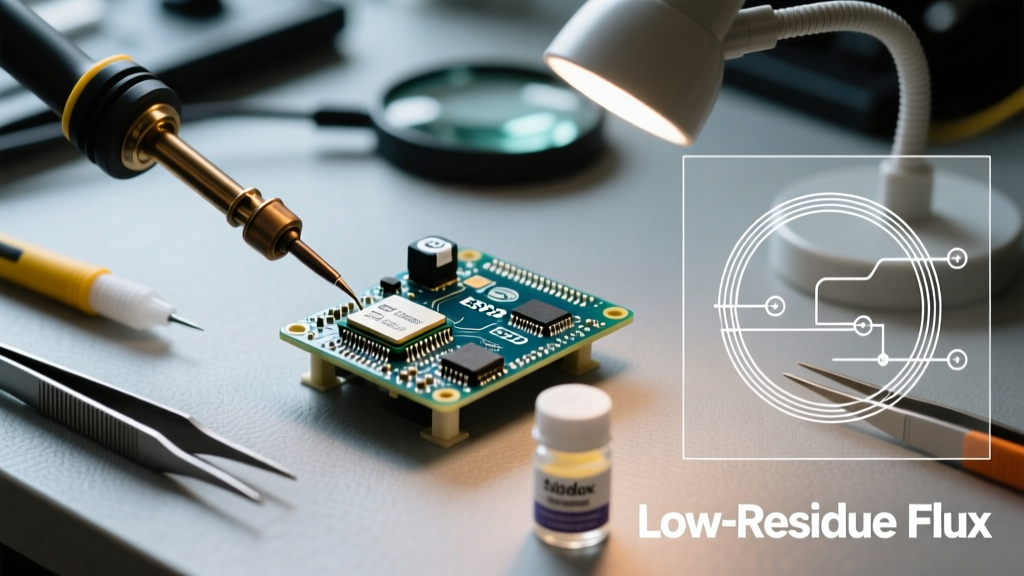
The landscape of electronics assembly continues to evolve, with component miniaturization pushing the limits of flux chemistry. For a well-equipped 2026 workbench, stock a high-quality RMA cored wire (like Kester 44) for mechanical joints, a precision ROL0 tacky flux (like Amtech NC-559-V2-TF) for micro-SMD rework, and reserve water-soluble chemistries strictly for environments where automated, high-pressure DI water cleaning is available. By aligning your flux selection with the specific thermal and environmental demands of your application, you ensure long-term electrical reliability and mechanical integrity.
For further reading on advanced reliability testing, consult the technical documentation available through the IPC standards library and review the latest material safety data sheets provided by your consumable manufacturers.