
The Critical Role of Flux in Metallurgical Bonding
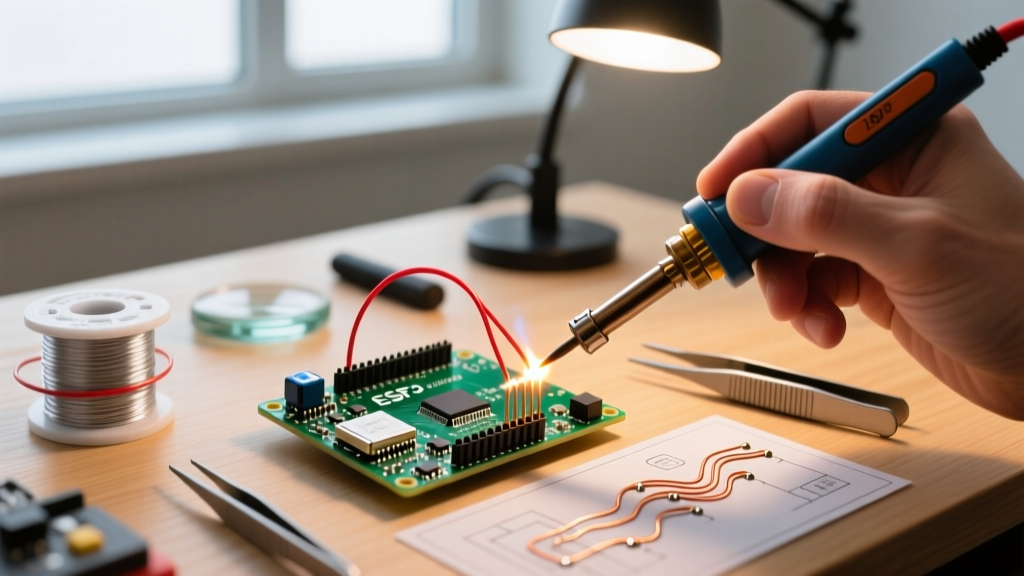
In electronics manufacturing and DIY prototyping, soldering fluxes are the unsung heroes of reliable metallurgical bonds. While solder wire provides the physical and electrical connection, flux is the chemical agent that makes the connection possible. By definition, flux removes metal oxides from the base metal and the solder alloy, prevents re-oxidation during heating, and reduces the surface tension of the molten solder to promote wetting.
According to the Association Connecting Electronics Industries (IPC), specifically under the IPC-J-STD-004B standard, fluxes are rigorously categorized by their base material (Rosin, Resin, Organic, Inorganic) and their activity level (Low, Moderate, High). Choosing the incorrect flux for your specific application is one of the most common causes of latent field failures, electrochemical migration (ECM), and cold solder joints.
The Chemistry: What is Actually Inside Your Flux?
Modern soldering fluxes are complex chemical formulations, but they generally consist of three primary components:
- Vehicles (Base): The bulk material that carries the active ingredients and provides a thermal barrier. Common vehicles include natural rosin (abietic acid), synthetic resins, and water-soluble glycols.
- Activators: The chemicals that actually dissolve the metal oxides. These range from mild organic acids (like adipic or succinic acid) to highly aggressive halides (chlorides and bromides).
- Solvents: Used in liquid and paste fluxes to keep the mixture homogeneous and control viscosity. Isopropyl alcohol (IPA) and various glycol ethers are standard.
Comparison Matrix: The 3 Main Categories of Electronics Flux
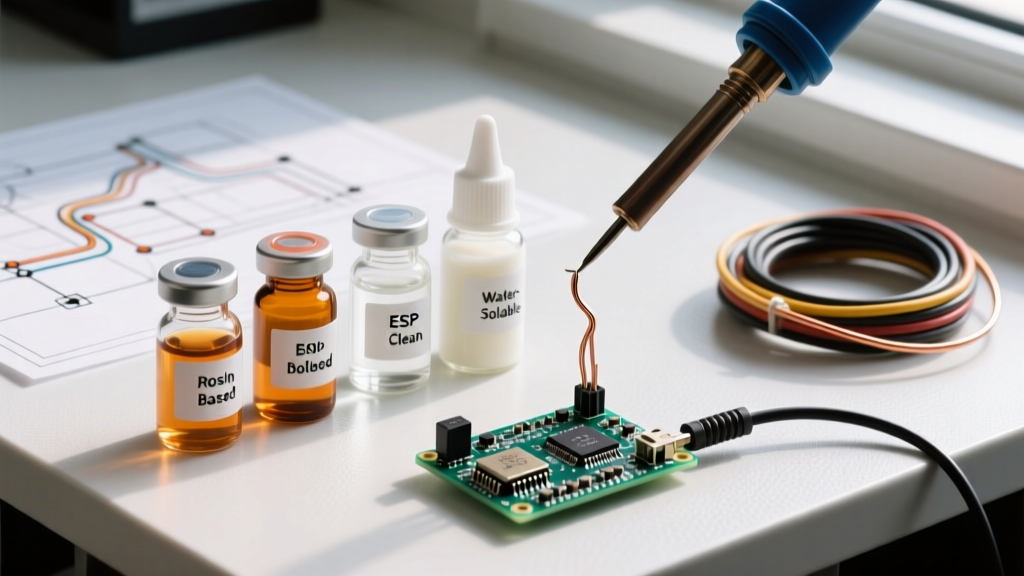
When purchasing flux for PCB assembly, rework, or general electronics wiring, you will encounter three primary categories. Here is how they compare in real-world scenarios:
| Flux Category | Base Material | Activity / Aggressiveness | Post-Solder Cleaning Required? | Best Application | Popular 2026 Product Example |
|---|---|---|---|---|---|
| Rosin (R, RMA, RA) | Natural Pine Rosin | Low to Moderate | Recommended (for aesthetics/inspection) | General wiring, through-hole, DIY | Kester 186 (RMA) Liquid |
| Water-Soluble (OA) | Organic Acids / Glycols | High | MANDATORY (with DI Water) | High-reliability, heavy oxidation | MG Chemicals 8341 / Kester 331 |
| No-Clean | Synthetic Resins | Low to Moderate | No (Residue is designed to be inert) | SMD, BGA, automated SMT lines | Amtech NC-559-V2-TF / Kester 951 |
Deep Dive: Selecting the Right Flux for Your Workflow
1. Rosin-Based Fluxes (R, RMA, RA)
Rosin fluxes are derived from pine tree sap. They are classified into three sub-types: Rosin (R - inactive), Rosin Mildly Activated (RMA), and Rosin Activated (RA). RMA is the gold standard for general electronics work. Kester 186 RMA remains a benchmark product in 2026, typically retailing for $18 to $25 per 2oz bottle. When heated, rosin becomes liquid and highly active, but upon cooling, it hardens into a solid, non-conductive, and generally non-corrosive glass-like state. While you can leave RMA residue on a board, it is sticky and will attract dust and moisture over time, which is why cleaning with 99% IPA is standard practice in professional repair shops.
2. Water-Soluble (Organic Acid) Fluxes
Water-soluble fluxes use organic acids as activators, making them incredibly aggressive. They excel at soldering to heavily oxidized surfaces, nickel-plated pads, and difficult alloys. However, the residue is highly acidic and conductive. If left on a PCB, it will cause rapid corrosion and dendritic growth (short circuits caused by metallic crystal formation between pads). Products like MG Chemicals 8341 ($15-$20) require immediate cleaning. Critical Note: You cannot clean water-soluble flux with standard Isopropyl Alcohol. IPA will merely smear the residue and trap it under components. You must use heated Deionized (DI) water, often with a saponifier, followed by a thorough bake to remove trapped moisture.
3. No-Clean Fluxes
Designed for high-volume Surface Mount Technology (SMT) manufacturing, no-clean fluxes use synthetic resins that encapsulate the activators upon cooling, rendering the residue electrically inert and safe to leave on the board. For advanced BGA rework and micro-soldering, tacky no-clean pastes like Amtech NC-559-V2-TF ($35 to $50 for a 10cc syringe) are industry favorites because they provide excellent component tack and minimize solder balling. The primary failure mode with no-clean flux is 'white residue' or 'frosting,' which occurs if the flux is heated beyond its thermal degradation point without proper reflow profiling, leaving behind a stubborn white powder that is difficult to remove.
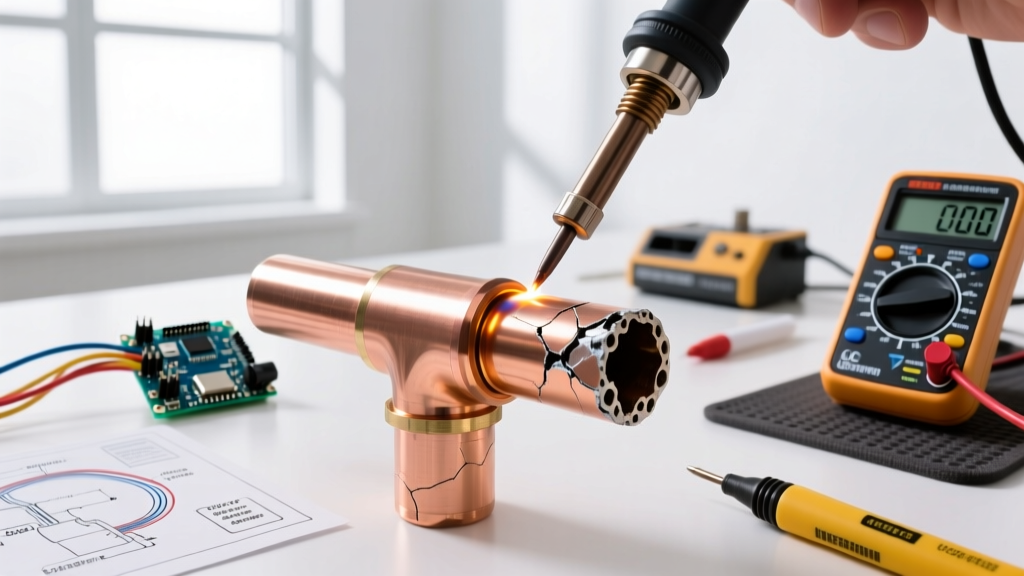
CRITICAL WARNING: Never Use Plumbing Flux on Electronics
Plumbing fluxes (like Oatey No. 95 Tinning Flux or standard zinc chloride pastes) are inorganic acid fluxes. They are designed to eat through heavy copper oxidation on water pipes. If applied to a PCB or electronic wire, the zinc chloride will permanently destroy the copper traces, cause immediate galvanic corrosion, and ruin the board. Always verify your flux is explicitly rated for electronics (IPC-J-STD-004 compliant).
Failure Modes: The Cost of Improper Flux Management
According to reliability data published by the NASA Electronic Parts and Packaging (NEPP) Program, flux-induced failures are a leading cause of anomalous behavior in high-impedance and RF circuits. Here are the specific failure modes you must engineer against:
- Electrochemical Migration (ECM): Occurs when ionic flux residues (common in water-soluble and cheap RA fluxes) combine with ambient humidity and a DC bias voltage. Metal ions migrate from the anode to the cathode, forming conductive 'dendrites' that eventually short the circuit.
- Parasitic Capacitance: In high-frequency RF circuits, even 'safe' no-clean flux residue can alter the dielectric constant between closely spaced microstrip traces, detuning antennas and filters.
- Outgassing and Voiding: During BGA rework, applying too much liquid flux causes rapid solvent boiling. The trapped gas cannot escape the large thermal mass of the BGA, resulting in massive voids inside the solder spheres, severely compromising mechanical shear strength.
Professional Cleaning Protocols for 2026
If your application requires flux removal (such as medical devices, aerospace, or high-impedance analog audio), follow these professional cleaning steps:
- For Rosin (RMA/RA): Use 99%+ Isopropyl Alcohol (IPA) and a lint-free swab or an ultrasonic cleaner. For heavy buildup, use a dedicated rosin solvent like Chemtronics Flux-Off aerosol.
- For Water-Soluble: Rinse immediately with Deionized (DI) water (resistivity > 1 MΩ·cm). Use a soft brush to agitate under low-clearance components. Follow with a DI water rinse and bake at 85°C for 2 hours.
- For No-Clean (When removal is necessary): Standard IPA struggles to dissolve cured no-clean resin. You must use a specialized saponified cleaner or a high-solvency aerosol like MicroCare StencilClean, followed by an IPA rinse to prevent streaking.
Frequently Asked Questions (FAQ)
Can I use liquid flux with solder wire that already has a rosin core?
Yes, and in many cases, you should. While rosin-core solder wire contains 1% to 3% flux by weight, this is often insufficient for soldering to large thermal masses (like heavy ground planes) or slightly oxidized vintage pads. Adding a small drop of external Kester 186 RMA liquid or tacky paste ensures the oxide layer is fully broken down before the solder melts, preventing cold joints.
Why does my no-clean flux leave a sticky, messy residue?
No-clean fluxes are designed to undergo a specific thermal profile. If you apply a soldering iron at 400°C directly to the flux for an extended period, you burn off the encapsulating resins and leave behind the raw, un-neutralized activators. Use the lowest effective temperature (typically 320°C to 350°C for lead-free SAC305) and minimize dwell time to ensure the residue cures properly into a hard, inert shell.
What is the shelf life of soldering fluxes?
Most liquid and paste fluxes have a manufacturer-rated shelf life of 12 to 24 months when stored in a cool, dark place. However, the solvents will slowly evaporate over time, increasing the viscosity. If your tacky flux becomes stiff or your liquid flux develops a sludge at the bottom, it is time to replace it. Never attempt to thin electronics flux with standard rubbing alcohol, as the water content (usually 30% in drugstore IPA) will introduce severe oxidation risks.