
The Chemistry of Soldering Fumes: Why One Mask Doesn't Fit All
When selecting a respirator for soldering, the most common mistake electronics hobbyists and production technicians make is treating all soldering smoke as a single, uniform hazard. In reality, soldering fumes are a complex, two-phase aerosol consisting of solid particulates and volatile organic compounds (VOCs). As of 2026, the industry's massive shift toward halogen-free, no-clean fluxes in consumer electronics has actually increased the VOC output at the workbench, making material-specific respiratory protection more critical than ever.
To choose the correct respiratory protection, you must first understand the material compatibility between your specific solder alloy, the flux chemistry, and the NIOSH-rated filter cartridges. A standard N95 dust mask will stop particulates but will do absolutely nothing to protect your respiratory tract from the sensitizing gases released by burning rosin or synthetic resins.
Debunking the Lead Fume Myth
Expert Insight: You cannot get lead poisoning from inhaling standard soldering fumes. The boiling point of lead is 1,749°C (3,180°F). Standard soldering irons and reflow ovens operate between 250°C and 400°C. Therefore, lead does not vaporize during standard PCB assembly. Lead exposure in soldering is strictly a contact/ingestion hazard (e.g., transferring lead dust from hands to food). However, mechanical abrasion of leaded solder can create airborne lead dust, which is why a P100 particulate filter is still recommended for heavy rework environments.
The true respiratory danger in soldering comes from the flux. When flux reaches its activation temperature, it undergoes pyrolysis, releasing irritating and potentially sensitizing gases.
Material Compatibility Matrix: Matching Filters to Flux
The cornerstone of respiratory safety is matching the filter media to the chemical byproduct of your specific soldering material. Below is the definitive compatibility guide for modern soldering applications.
| Material / Flux Type | Primary Chemical Hazard | Required NIOSH Filter Rating | Recommended Cartridge Configuration |
|---|---|---|---|
| Rosin Core (Sn63Pb37 / SAC305) | Colophony (Abietic Acid) Particulates | P100 + Nuisance OV | 3M 2297 or 3M 7093 (OV Relief) |
| No-Clean (Halogen-Free) | VOCs, Aldehydes, Synthetic Resins | OV (Organic Vapor) + P100 | 3M 6001 Cartridge + 5P71 Pre-filter |
| Water-Soluble / Acid (Plumbing) | Zinc Chloride, Hydrochloric Acid Gas | AG (Acid Gas) + P95/P100 | 3M 6003 Cartridge + 5P71 Pre-filter |
| Polyurethane Wire Coatings | Formaldehyde, Isocyanates | OV / Formaldehyde Specific | 3M 6005 (Formaldehyde/OV) |
Deep Dive: Rosin vs. No-Clean Flux Hazards
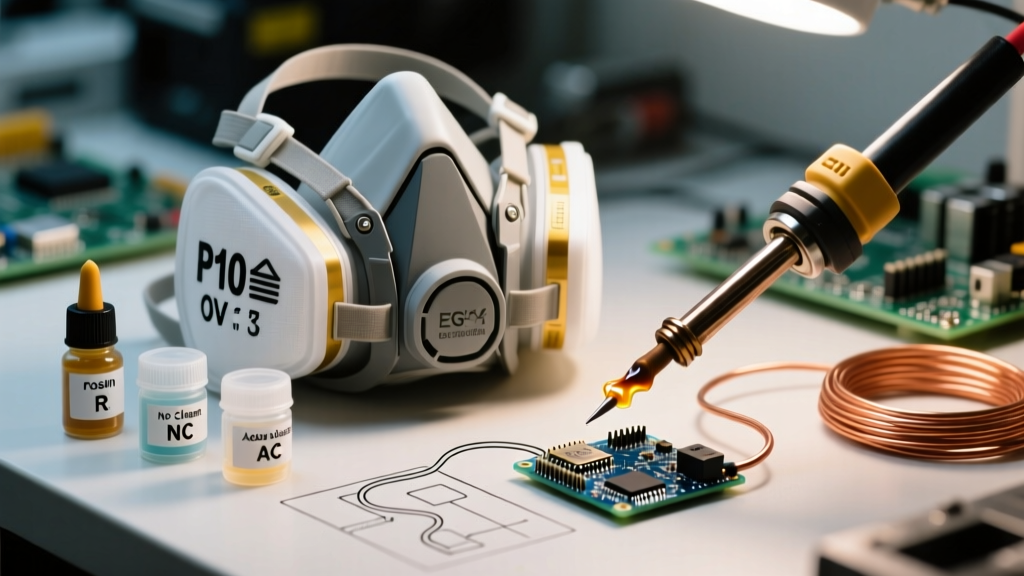
Rosin (Colophony) Flux: Natural rosin contains abietic acid. When heated, it creates a sub-micron particulate smoke that is a known respiratory sensitizer. Repeated exposure can lead to occupational asthma. Because the hazard is primarily particulate with a strong odor, a P100 filter with a nuisance-level Organic Vapor (OV) relief layer is the gold standard. The P100 blocks 99.97% of the abietic acid particulates, while the thin carbon layer reduces the distracting smell.
No-Clean Flux: Modern no-clean fluxes rely on synthetic resins and alcohol-based solvents. When these burn off, they release true VOC gases, not just particulates. A standard P100 filter will let these gases pass right through. You must use an activated carbon Organic Vapor (OV) cartridge paired with a P100 pre-filter to trap both the gaseous VOCs and any solid resin ash.
Top Respirator Configurations for the Workbench
Based on current 2026 pricing and ergonomic requirements for electronics work (where binocular microscopes and magnifying lamps limit headspace), here are the top three hardware setups.
1. The Electronics Hobbyist Setup (Best for Rosin/SAC305)
- Facepiece: 3M 7502 Half Facepiece (Medium)
- Filters: 3M 2297 P100 Particulate Filters with Nuisance OV Relief
- Estimated Cost: $45 - $55 USD
- Why it works: The 3M 7502 features a cool-flow exhalation valve that reduces moisture buildup, and the drop-down straps allow you to let the mask hang around your neck when not actively soldering. The 2297 filters are low-profile, meaning they won't bump into your microscope eyepieces.
2. The Production Solderer Setup (Best for No-Clean/VOCs)
- Facepiece: GVS SPR457 Elipse P100 Half Mask
- Filters: GVS SPR316 Replacement Cartridge Filters (P100/OV combined)
- Estimated Cost: $60 - $75 USD
- Why it works: The Elipse is famously compact. It uses a specialized pleated HEPA media that integrates the carbon layer directly into a single, low-profile cartridge. For technicians doing 8-hour shifts with heavy no-clean flux, this reduces facial fatigue while providing genuine OV protection.
3. The Heavy Rework & Plumbing Setup (Best for Acid/Water-Soluble)
- Facepiece: 3M 6200 Half Facepiece
- Filters: 3M 6003 Acid Gas Cartridges + 3M 5P71 P95 Prefilters + 501 Retainers
- Estimated Cost: $75 - $90 USD
- Why it works: If you are sweating copper pipes with zinc-chloride paste or using aggressive water-soluble fluxes for heavy rework, you need dedicated Acid Gas (AG) cartridges. The 5P71 prefilter catches the bulky smoke particulates, extending the life of the expensive AG carbon cartridges.
Understanding NIOSH Ratings and Compliance
When shopping for a respirator for soldering, you will encounter various alphanumeric codes. According to the CDC NIOSH Respirator Selection guidelines, particulate filters are categorized by oil resistance and efficiency:
- N-Series (N95, N99, N100): Not resistant to oil. Adequate for dry soldering environments.
- R-Series (R95): Somewhat resistant to oil. Rarely needed for standard soldering.
- P-Series (P95, P100): Strongly oil-proof. P100 is the recommended standard for soldering, as it blocks 99.97% of airborne particulates, including sub-micron flux ash and metallic dust.
For commercial shops, compliance with the OSHA 1910.134 Respiratory Protection Standard requires a formal medical evaluation, fit testing, and a written respiratory protection program if respirators are mandated by the employer. Hobbyists should still perform a user seal check every time they don their mask.
Cartridge Lifespan and Breakthrough Indicators
A critical failure mode in soldering respiratory protection is using expired carbon cartridges. Unlike P100 particulate filters, which simply clog and become hard to breathe through over time, Organic Vapor (OV) and Acid Gas (AG) cartridges fail silently through a process called breakthrough.
- The Smell Test: If you can smell the flux or taste a metallic/sweet sensation in the back of your throat while wearing the mask, the activated carbon is fully saturated. Remove the mask immediately and replace the cartridges.
- Time Limits: In a high-volume no-clean soldering environment, standard OV cartridges may only last 8 to 12 hours of active exposure. Keep a log of your cartridge usage.
- Storage: Carbon cartridges absorb ambient VOCs and humidity even when not in use. Always store your respirator in an airtight Ziploc bag or a dedicated sealed plastic bin when off the bench to prevent premature saturation.
Summary: Match the Mask to the Material
Investing in a high-quality respirator for soldering is an investment in your long-term pulmonary health. Stop relying on generic dust masks or poorly positioned desk fans. Identify your primary flux chemistry—whether it is the particulate-heavy abietic acid of traditional rosin, the VOC-laden synthetic resins of no-clean, or the corrosive gases of acid flux—and select the corresponding NIOSH-rated P100, OV, or AG cartridges. By aligning your respiratory protection with your specific material compatibility needs, you ensure a safer, more focused, and highly professional workbench environment.