
Beyond the Dictionary: Why 'How to Spell Soldering' is a Material Science Question
Every day, thousands of beginners enter the electronics and plumbing trades with a simple, albeit awkward, search query: how to spell soldering. Often misspelled as 'soldering,' 'souldering,' or confused entirely with 'soldiering,' this linguistic hurdle is merely the tip of the iceberg. As a senior technician, I can tell you that failing to grasp the correct spelling and terminology of soldering doesn't just make your search history look bad—it leads to catastrophic material incompatibility.
When you misunderstand or misspell core industry terms, you buy the wrong filler metals, select incompatible fluxes, and ultimately destroy your workpieces. In 2026, with the widespread adoption of complex lead-free alloys and bismuth-based low-temperature pastes, precision in terminology is just as critical as precision in temperature control. This guide bridges the gap between linguistic accuracy and material science, ensuring you know exactly what to search for, what to buy, and what to avoid.
The Most Dangerous Misnomer: 'Silver Solder' vs. Silver Brazing
The most expensive spelling and terminology trap in the metalworking world is the phrase 'silver solder.' If you search for this term intending to join copper refrigeration lines or stainless steel fittings, you will likely purchase a silver brazing alloy (such as Harris Safety-Silv 45, which contains 45% silver and melts at roughly 615°C / 1139°F).
However, if you attempt to use a standard 60W Weller WES51 soldering iron meant for electronics on this 'silver solder,' you will experience a thermal mismatch failure. The iron maxes out around 450°C, meaning the brazing alloy will never reach its liquidus state. You will be left with a cold, mechanical smear that will fail under pressure.
The AWS Definition Breakdown
According to the American Welding Society (AWS), the dividing line between soldering and brazing is strictly thermal:
- Soldering: Joining metals using a filler metal that melts below 450°C (842°F). (e.g., SAC305, Sn60Pb40).
- Brazing: Joining metals using a filler metal that melts above 450°C (842°F). (e.g., Silver brazing alloys, brass).
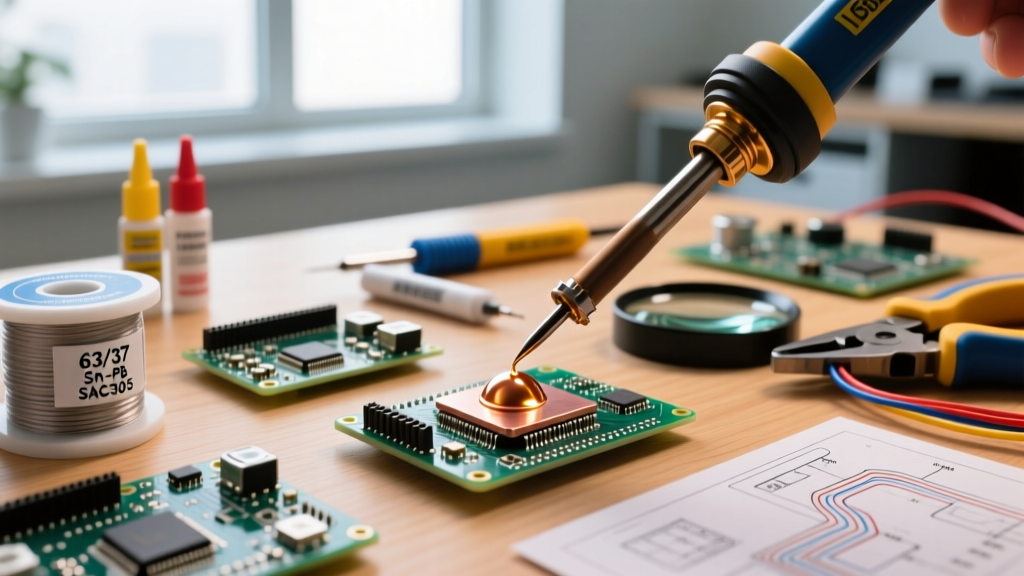
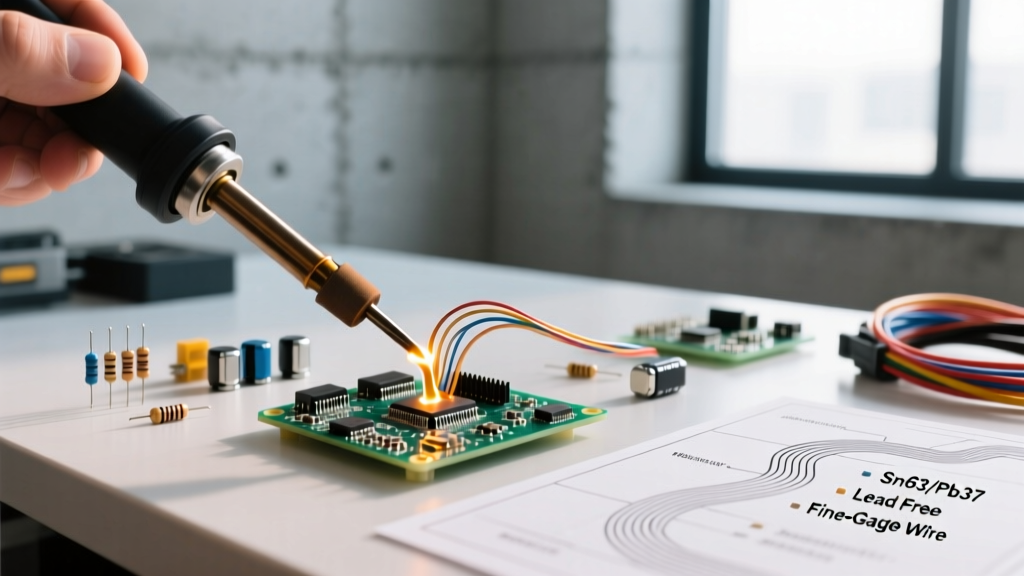
Expert Insight: Never use the term 'hard solder' or 'silver solder' when ordering materials for PCB work. Always specify 'soft solder' or use the exact alloy designation (e.g., Sn63/Pb37 or SAC305) to ensure the supplier provides a low-temperature electronics alloy with a compatible rosin core.
Flux Nomenclature: Rosin, Acid, and the Cost of Confusion
Another area where sloppy terminology leads to ruined projects is flux selection. Beginners often search for 'soldering paste' or 'welding flux,' resulting in severe chemical incompatibilities.
The Chemistry of Misspelled Fluxes
If you mistakenly purchase plumbing flux (often labeled simply as 'soldering flux' in big-box hardware stores) for a printed circuit board, you are introducing zinc chloride and hydrochloric acid to delicate copper traces. While this acid flux is necessary to strip heavy oxidation from thick copper pipes, it is highly corrosive and electrically conductive. Using it on a PCB will result in dendritic growth, short circuits, and the eventual dissolution of your traces.
For electronics, you must specifically search for and purchase Rosin-based flux (R, RMA, RA) or No-Clean synthetic flux. As detailed in the IPC J-STD-004 standards for fluxes, electronics fluxes rely on mild organic activators that leave behind a non-conductive, benign residue. A 100g syringe of genuine Kester 44 or Amtech no-clean flux costs between $15 and $25 in 2026—a small price to pay to avoid destroying a $50 microcontroller board.
Solder Paste vs. Flux Paste: A Buyer's Trap
Terminology confusion peaks when buyers search for 'solder paste' but actually need 'flux paste.'
- Solder Paste: A sticky mixture of microscopic metal spheres (like SAC305 powder) suspended in flux. It is used for SMD reflow soldering. If you try to use this for hand-soldering through-hole wires, the flux will boil away before the metal powder can coalesce, leaving you with a porous, high-resistance joint.
- Flux Paste (Tacky Flux): Contains zero metal. It is used to hold BGA components in place or to revive oxidized pads before applying solid solder wire.
2026 Material Compatibility & Terminology Matrix
Use this matrix to ensure your search terms match your material requirements. Buying the wrong item due to a terminology mix-up is the leading cause of beginner joint failure.
| Correct Term / Alloy | Common Misspelling / Misnomer | Base Material Compatibility | Required Heat Source | Incompatible Scenario (Failure Mode) |
|---|---|---|---|---|
| SAC305 (Sn96.5/Ag3.0/Cu0.5) | Lead-free silver solder wire | Copper PCBs, SMD pads | Iron (350°C+), Hot Air | Using on aluminum (will not wet without specialized flux). |
| Sn42/Bi58 (Bismuth Alloy) | Low-temp melting glue | Heat-sensitive components, flex PCBs | Iron (180°C) | Mixing with leaded solder (creates brittle ternary eutectic that cracks under vibration). |
| Sn96.5/Ag3.5 (Plumbing) | Silver plumbing solder | Copper water pipes (potable) | Propane/MAPP Torch | Using on electronics (lacks rosin core, requires external corrosive flux). |
| Stay-Brite (Sn/Ag with Acid Core) | Hard solder for steel | Stainless steel, cast iron | Torch, High-Watt Iron | Using on PCBs (acid core will destroy fiberglass and traces). |
Modern 2026 Alloys and the Bismuth Shift
As the electronics industry continues to navigate the environmental mandates of the 2020s, bismuth-based alloys (like Sn42/Bi58) have become mainstream for hobbyists and repair technicians. However, searching for 'bismuth solder' often yields conflicting results. You must understand that bismuth alloys are strictly incompatible with leaded (Sn/Pb) environments. If you use a bismuth alloy on a pad that previously had 63/37 leaded solder, the resulting alloy drops to a melting point of roughly 96°C but becomes incredibly brittle. A simple drop of the device will cause the joint to shatter like glass. Always specify 'pure bismuth lead-free solder' and ensure your workstation is completely decontaminated of leaded residues.
Sourcing Genuine Materials in a Market of Counterfeits
When you finally know how to spell soldering and understand the terminology, you must protect yourself from counterfeit materials. In 2026, unverified online marketplaces are flooded with 'soldering wire' that is actually just aluminum or zinc wire coated in a cheap, non-active resin.
A 500g spool of genuine Kester 44 Rosin-Core Sn63/Pb37 costs around $45-$60. If you find a listing for 'premium electronics soldering wire' at $15, you are buying counterfeit wire. It will lack the internal flux cores, oxidize instantly upon contact with your iron, and result in cold, grainy joints. Always cross-reference your terminology with trusted manufacturer catalogs, such as the Kester Flux and Solder Portfolio, to verify part numbers before purchasing.
FAQ: Spelling, Searching, and Sourcing
Is it 'soldering' or 'soddering'?
The correct spelling is soldering (with an 'l'), though the 'l' is silent in standard American English pronunciation. In British English, the 'l' is often vocalized. Regardless of pronunciation, always use the 'l' when searching for technical datasheets and IPC standards to ensure accurate algorithmic results.
What do I search for to join aluminum wires?
Do not search for 'aluminum soldering wire.' Standard tin/lead or SAC alloys will not wet aluminum due to its instant oxide layer. You must search for zinc-based aluminum solder (like AlumiConn or specialized Zn/Al alloys) and use a dedicated aluminum flux or mechanical abrasion technique to break the oxide barrier.
Why does my 'soldering paste' smoke and leave black residue?
You likely purchased 'soldering paste' intended for heavy plumbing or stained glass (which contains aggressive ammonium chloride or zinc chloride) instead of 'tacky no-clean flux' for electronics. The high activator content burns and carbonizes at standard electronics reflow temperatures, leaving a conductive, corrosive black sludge.