
The Great HVAC Misconception: Soldering vs. Brazing AC Lines
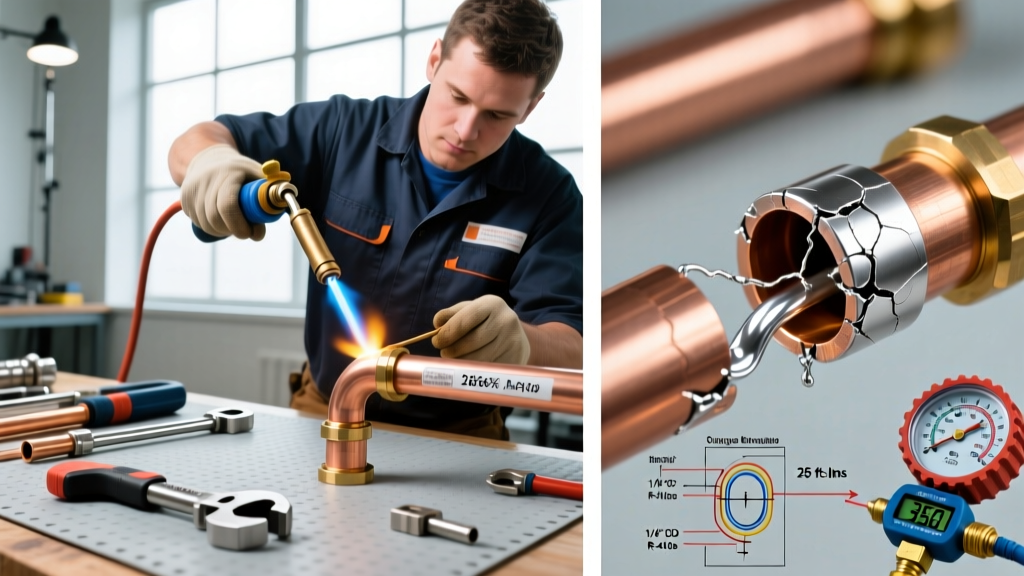
If you are searching for a guide on soldering AC lines, you have likely encountered a critical terminology trap that leads to catastrophic system failures. In the HVAC/R industry, joining copper refrigerant lines is technically brazing, not soldering. While both processes use capillary action to draw molten filler metal into a joint, the distinction lies in temperature and metallurgy.
According to the American Welding Society (AWS), soldering occurs at temperatures below 800°F (427°C) using soft alloys like tin-antimony or tin-lead. Brazing occurs above 800°F, utilizing high-strength copper, silver, and phosphorus alloys. Attempting to soft-solder an AC refrigerant line is a guaranteed path to system failure, environmental violations, and expensive compressor replacements.
Expert Insight: With the 2026 industry-wide transition to A2L mildly flammable refrigerants like R-32 and R-454B under the AIM Act, leak prevention is no longer just about efficiency—it is a critical safety mandate. Soft solder joints cannot contain these gases under high-pressure thermal cycling.
The Physics of Failure: Why Soft Solder Cannot Survive HVAC Systems
To understand why soldering AC lines is prohibited by every major manufacturer, you must look at the operating parameters of modern air conditioning systems.
- High-Side Pressures: R-410A and R-32 systems routinely operate with high-side pressures exceeding 425 PSI on a 120°F summer day. Soft solder (such as 95/5 Tin-Antimony) has a burst pressure that degrades rapidly under thermal stress, often failing at pressures as low as 150 PSI when subjected to compressor discharge temperatures.
- Vibration Fatigue: Reciprocating and scroll compressors generate high-frequency harmonic vibrations. Soft solder lacks the tensile strength and fatigue resistance of brazed alloys, leading to micro-fractures at the joint shoulder.
- Thermal Expansion Mismatch: Copper lines expand and contract significantly between winter heating and summer cooling cycles. Brazed joints form a metallurgical bond with the base copper, whereas soft solder merely adheres to the surface, eventually shearing under thermal stress.
Essential Buyer’s Guide: Torches, Tips, and Alloys for AC Lines
Executing a proper brazed joint on AC copper lines requires specialized equipment. Here is the 2026 buyer’s breakdown for professional and advanced DIY setups.
1. Torch Setups and Fuel Gases
You need a flame temperature capable of heating thick-walled copper (Type L or ACR) to 1,300°F without oxidizing the exterior to a burnt, flaky scale.
- Victor Journeyman II (Acetylene/Oxygen): The industry gold standard. Priced around $240–$280 for the torch body, it provides a concentrated, high-BTU flame necessary for 7/8" and 1-1/8" suction lines. Pair it with a #2 or #3 swirl combustion tip.
- Bernzomatic TS8000 (MAP-Pro): Priced around $65, this high-intensity propane torch is acceptable only for small 1/4" to 3/8" liquid lines. It lacks the thermal mass output to properly braze larger suction lines before the flux burns out.
2. Filler Metals (Alloys)
Silver prices have fluctuated heavily into 2026, impacting alloy costs. Choose your filler metal based on the base metals being joined.
- Lucas-Milhaupt Sil-Fos 5 (or Harris Stay-Silv 5): Contains 5% Silver, 92.7% Copper, and 2.3% Phosphorus. The phosphorus acts as a self-fluxing agent on copper-to-copper joints. Estimated Cost: $45–$55 per troy ounce.
- Harris Stay-Silv 15: Contains 15% Silver, 80% Copper, and 5% Zinc. Required when transitioning from copper to brass (e.g., service valves, TXV fittings) or copper to steel. Estimated Cost: $140–$170 per troy ounce.
3. Flux Requirements
While Sil-Fos alloys are self-fluxing on pure copper, you must use a white paste flux (like Harris Stay-Silv White Flux) when brazing copper to brass or steel. The flux dissolves oxides and allows the silver alloy to wet the brass surface. Note that flux is highly corrosive when hot and must be cleaned with a wet rag immediately after the joint cools to prevent long-term acid etching.
Step-by-Step: The Nitrogen-Purged Brazing Procedure
The hallmark of an amateur HVAC technician is brazing without a nitrogen purge. When copper is heated in the presence of atmospheric oxygen, it forms cupric oxide scale on the inside of the pipe. This black scale flakes off during operation, clogging the Thermostatic Expansion Valve (TXV) and destroying compressor bearings. The Copper Development Association (CDA) explicitly mandates inert gas purging during high-temperature copper joining.
Step 1: Establish the Nitrogen Purge
Connect a dry nitrogen cylinder to a regulator with a flowmeter. Insert a purge hose into one end of the line set and allow the gas to flow out the other. Set the flow rate to 2 to 3 SCFH (Standard Cubic Feet per Hour). You want enough flow to displace oxygen, but not so much that it blows the molten filler metal out of the joint capillary.
Step 2: Joint Preparation
Clean the outside of the tube and the inside of the fitting using emery cloth or a dedicated fiberglass abrasive pad. Never use a wire brush; wire bristles can break off and become embedded in the soft copper, creating leak paths and contaminating the brazing pool.
Step 3: Heating the Base Metal
Use a neutral flame. Sweep the flame back and forth across the fitting and the tube, keeping the hottest part of the flame (the inner cone) about 1 inch away from the copper. Do not point the flame directly at the filler rod. The goal is to heat the base metal until it is hot enough to melt the rod on contact.
Step 4: Capillary Action and Filler Application
Once the copper reaches a dull cherry-red color (approx. 1,300°F), touch the filler rod to the joint interface, not the flame. If the base metal is hot enough, capillary action will instantly suck the molten alloy deep into the fitting. Keep feeding the rod until a continuous, smooth fillet forms around the entire circumference.
Comparison Matrix: HVAC Filler Metals & Use Cases
| Alloy Type | Composition | Melting Range | 2026 Est. Cost/oz | Primary Use Case |
|---|---|---|---|---|
| Sil-Fos 5 | 5% Ag, 92.7% Cu, 2.3% P | 1190°F – 1475°F | $45 – $55 | Copper-to-Copper (Self-fluxing) |
| Stay-Silv 15 | 15% Ag, 80% Cu, 5% Zn | 1225°F – 1450°F | $140 – $170 | Copper-to-Brass / Copper-to-Steel |
| 95/5 Soft Solder | 95% Sn, 5% Sb | 452°F – 464°F | $2 – $4 | NEVER USE ON AC LINES (Drain/Water only) |
Troubleshooting Edge Cases and Failure Modes
Even with the right equipment, brazing AC lines presents unique challenges. Here is how to diagnose and fix common joint failures:
- Cold Joints (Alloy Balling): If the filler metal balls up and rolls off the fitting instead of drawing inside, the base metal is not hot enough. Remove the rod, apply more heat to the heavy brass fitting (which acts as a heat sink), and try again.
- Oxide Inclusions (Pinhole Leaks): If a joint passes a standing pressure test but leaks under vacuum, or if you cut the joint open and see black slag inside, your nitrogen purge was insufficient. The internal oxidation compromised the capillary draw.
- Flux Burnout: If brazing copper-to-brass, the white flux can turn into a hard, glassy slag if overheated. This slag blocks the silver alloy from entering the joint. Maintain a sweeping flame motion and apply the rod the moment the flux turns clear and watery.
Regulatory Compliance and Safety Standards
Working on AC refrigerant lines is heavily regulated. Under the EPA Section 608 regulations, it is a federal offense to knowingly vent refrigerant into the atmosphere. Furthermore, any individual brazing lines that connect to a pressurized refrigerant circuit must hold an active EPA 608 certification.
Additionally, the transition to A2L refrigerants requires strict adherence to ASHRAE Standards (specifically Standard 15 and 15.2) regarding leak mitigation. Because R-32 and R-454B have a lower flammability limit (LFL), a poorly brazed joint that leaks into an enclosed mechanical space poses a deflagration risk. Pressure testing with dry nitrogen at 500 PSI for 24 hours, followed by a micron vacuum decay test down to 250 microns, is the only acceptable method to verify joint integrity before releasing the system charge.
Final Verdict
Stop searching for how to "solder" AC lines and start investing in proper brazing infrastructure. The upfront cost of an oxy-acetylene setup, dry nitrogen, and 15% silver alloy is a fraction of the cost of replacing a compressor destroyed by copper oxide scale or losing a $300 refrigerant charge to a ruptured soft-solder joint. Respect the pressures, purge your lines, and braze with precision.