
The Pre-Propane Era: Mouth Blowpipes and Liquid Fuel
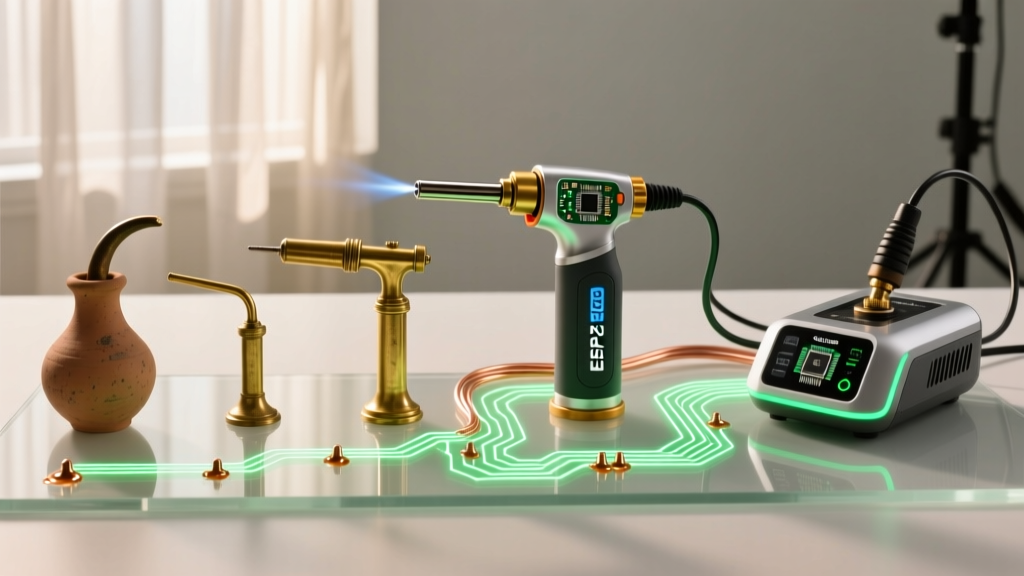
Long before the ubiquitous blue and yellow cylinders became a staple in every plumber's truck and DIYer's garage, the art of joining metals with heat and filler alloys relied on primitive, labor-intensive methods. Ancient Egyptian and Roman artisans utilized mouth-blown pipes directed at charcoal fires to concentrate heat for rudimentary jewelry soldering. By the 19th century, the mouth blowpipe had evolved into a standard tool for jewelers and assay offices, but it was entirely unsuited for the heavy thermal demands of plumbing and structural metalwork.
For heavy-duty applications, tradesmen relied on liquid fuel blowtorches. These brass contraptions, often fueled by gasoline, kerosene, or alcohol, required manual pre-heating of the vaporization chamber and constant pumping to maintain pressure. They were notoriously dangerous, prone to explosive flare-ups, and difficult to modulate. The transition away from these volatile liquid fuel torches would require a breakthrough in hydrocarbon chemistry.
1910 and the Propane Revolution
The pivotal moment for portable heat occurred in 1910 when Dr. Walter Snelling, a chemist with the U.S. Bureau of Mines, successfully isolated and liquefied propane gas. According to the Propane Education & Research Council, Snelling discovered that propane could be compressed into a liquid state at relatively low pressures, allowing it to be stored in portable steel cylinders. This singular discovery birthed the modern propane industry.
By the 1920s and 1930s, early propane torches began appearing in industrial settings. However, they were heavy, utilized rudimentary valve systems, and lacked the precision required for delicate sweat soldering. It wasn't until the post-World War II housing boom that propane soldering truly found its defining application.
The Post-War Copper Boom and Sweat Soldering
The mid-20th century saw a massive shift in residential plumbing from galvanized steel and lead-wiped joints to lightweight copper tubing. Copper required 'sweat soldering'—a capillary action process where molten solder is drawn into the microscopic gap between a pipe and a fitting. The portability, instant-on capability, and clean-burning nature of propane made it the undisputed fuel of choice for this new era of plumbing.
During this era, the standard solder alloy was 50/50 lead-tin (melting at approximately 361°F to 421°F). Plumbers using early stamped-steel propane pencil torches could easily achieve the 700°F to 900°F joint temperatures required to melt the solder and activate the rosin or organic acid fluxes. However, as environmental science advanced, the metallurgy of soldering was forced to evolve.
The Lead-Free Mandate and Metallurgical Shifts
The evolution of propane soldering wasn't just about the torch; it was equally about the filler metal. The Safe Drinking Water Act Amendments of 1986 effectively banned the use of lead-based solder in potable water systems. The industry shifted to lead-free alloys, primarily Tin-Silver-Copper (Sn-Ag-Cu) and Tin-Copper (Sn-Cu). As noted by the EPA's guidelines on lead-free plumbing, these modern alloys require significantly higher melting temperatures, typically between 420°F and 440°F, and demand much tighter thermal control to avoid 'cold joints' or scorched flux.
This metallurgical shift exposed the limitations of cheap, standard pencil-flame propane torches. The higher thermal threshold required for modern lead-free solder necessitated an evolution in torch burner design.
Technological Leaps: Piezo Ignition and Swirl Burners
In the 1990s and 2000s, propane torch technology underwent a massive ergonomic and thermal redesign. The traditional flint-and-steel striker was gradually replaced by Piezoelectric ignition systems, allowing one-handed operation—a critical safety and convenience factor when working on ladders or in tight joist bays.
More importantly, the burner head evolved. Standard pencil tips produce a laminar, localized flame that struggles to heat the entire circumference of a large-diameter copper fitting simultaneously. The introduction of the swirl combustion chamber changed the game. By engineering internal baffles that force the propane-air mixture into a high-velocity vortex before ignition, manufacturers created a flame that wraps around the pipe, providing uniform, rapid heating. This innovation drastically reduced the time-to-melt and minimized the risk of scorching the flux, which causes it to lose its ability to clean the copper oxide layer.
2026 Gas Matrix: Propane vs. MAP-Pro vs. Butane
Modern buyers must navigate a landscape where 'propane' is often conflated with other portable fuel gases. The discontinuation of true MAPP gas (methylacetylene-propadiene) in 2008 led to the rise of MAP-Pro (propylene). Understanding the thermal differences is critical for selecting the right fuel for your specific soldering application.
| Gas Type | Chemical Base | Max Flame Temp (Air) | Avg. Cylinder Cost (2026) | Best Application |
|---|---|---|---|---|
| Standard Propane | Alkane (C3H8) | 3,600°F (1,982°C) | $4.50 - $6.00 (14.1 oz) | 1/2' to 3/4' copper plumbing, stained glass, general DIY |
| MAP-Pro | Propylene (C3H6) | 3,730°F (2,054°C) | $11.00 - $14.00 (14.1 oz) | 1' to 2' copper pipes, HVAC brazing, heavy thermal mass joints |
| Butane | Alkane (C4H10) | 2,610°F (1,432°C) | $3.00 - $5.00 (8 oz) | Micro-electronics, jewelry, fine gauge wire, shrink tubing |
Modern Propane Soldering: Overcoming Thermal Mass Failures
The most common failure mode in modern propane soldering is the 'cold joint,' caused by thermal mass sinking. When soldering a 1-inch Type L copper pipe, the sheer volume of the metal acts as a heat sink. A standard propane pencil torch simply cannot input BTUs faster than the copper dissipates them into the surrounding air and water residues.
Furthermore, residual water inside a pipe will boil at 212°F, creating a vapor barrier that prevents the joint from reaching the 450°F+ required to melt lead-free solder and activate modern water-soluble fluxes. To combat this, professionals utilize the 'Two-Torch Technique' or upgrade to high-BTU swirl burners fueled by MAP-Pro to overwhelm the thermal mass of the joint.
Expert Protocol for Large-Diameter Joints
- Prep: Sand the pipe and fitting to bright copper using 120-grit emery cloth. Apply a thin, even layer of NSF-approved water-soluble flux.
- Heat Application: Apply the flame to the fitting, not the pipe. The capillary action relies on the fitting being slightly hotter than the pipe to draw the solder inward.
- The Solder Test: Touch the solder wire to the opposite side of the joint from the flame. If it melts instantly, the joint is at thermal equilibrium. Remove the flame immediately to prevent burning the flux.
Essential Modern Gear & Pricing (2026 Buyer's Guide)
For the modern DIYer or professional looking to invest in a reliable propane soldering setup, here are the benchmark tools that define the current market:
- Bernzomatic TS4000 High-Intensity Trigger Start Torch (~$48 - $55): The undisputed king of the job site. Features a cast-zinc swirl burner, instant piezo ignition, and a lock-on button for continuous use. It handles both standard propane and MAP-Pro cylinders seamlessly.
- Worthington 14.1 oz Propane Cylinder (~$5.00): The industry standard portable fuel source. Features a rust-inhibiting inner coating and precise threading that prevents micro-leaks when attached to modern brass torch valves.
- Oatey Safe Flo Lead-Free Silver-Bearing Solder (~$35 for 4oz spool): Contains a trace amount of silver to improve flow characteristics and joint tensile strength. Meets all IAPMO Uniform Plumbing Code standards for potable water.
- La-Co Regular Paste Flux (~$8 for 4oz tub): A petroleum-based organic flux that aggressively cleans copper oxides at high temperatures, essential for preventing pinhole leaks in pressurized systems.
Conclusion
The evolution of propane soldering is a testament to how a single chemical discovery in 1910 cascaded into a century of metallurgical and mechanical innovation. From the dangerous, pump-pressurized gasoline blowtorches of the early 20th century to the precision-engineered, piezo-ignited swirl burners of 2026, the technology has continuously adapted to meet the demands of safer, stronger, and more complex plumbing systems. Understanding this history—and the thermal physics that govern modern lead-free alloys—empowers today's tradesmen and DIYers to create joints that will last a lifetime.