
The Metallurgical Journey of Soldering and Rework
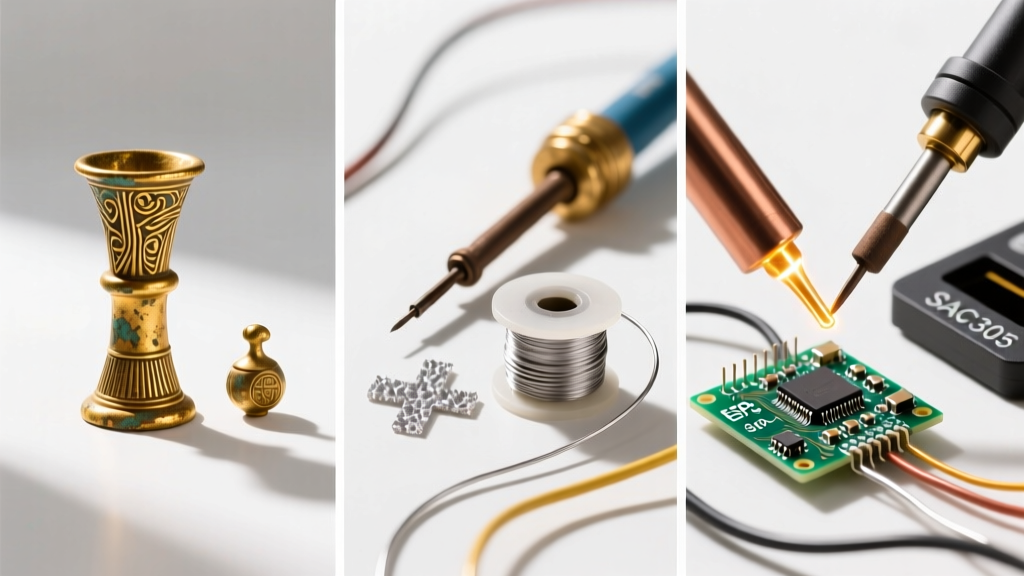
The landscape of soldering and rework has transformed from a rudimentary craft into a highly controlled metallurgical science. What began with ancient artisans using gold-tin amalgams to craft jewelry has evolved into the precise, automated thermal management systems used to assemble 2-nanometer semiconductor packages in 2026. For electronics professionals, DIYers, and procurement engineers, understanding this historical evolution is not just an academic exercise—it directly dictates how you select equipment, manage thermal profiles, and avoid catastrophic failure modes like pad cratering or component delamination today.
The Golden Age of Eutectic: Sn63/Pb37 and the Magnastat Era
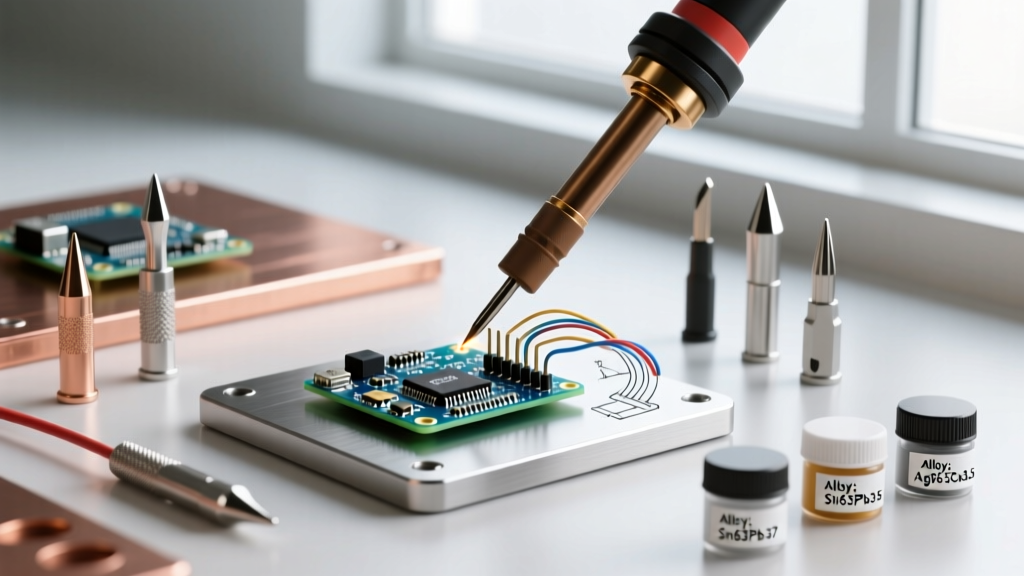
For the latter half of the 20th century, the electronics industry was built on a single, miraculous alloy: Sn63/Pb37 (63% Tin, 37% Lead). This specific ratio is eutectic, meaning it transitions directly from a solid to a liquid at a single temperature: 183°C (361°F). There is no "plastic" or semi-solid phase, which virtually eliminated cold solder joints caused by micro-movements during cooling.
During the 1970s and 1980s, rework was primarily focused on Through-Hole Technology (THT). The dominant tool was the Weller WTCP series, which utilized a revolutionary "Magnastat" temperature control system. Instead of relying on a slow thermocouple feedback loop, the WTCP used a magnetic sensor inside the tip that lost its magnetism exactly at the Curie point (the target temperature), physically breaking a reed switch. This provided instant, drift-free thermal regulation that modern digital stations still struggle to match in pure mechanical simplicity.
The SMT Shift and the Birth of Hot Air Rework (1980s–1990s)
As the industry pushed for miniaturization, Surface Mount Technology (SMT) replaced THT. Components like SOICs and QFPs (Quad Flat Packages) with 0.65mm pitches made traditional iron rework impossible without bridging adjacent pins. This era birthed the modern hot air rework station.
The Surface Mount Technology Association (SMTA) and early IPC guidelines began formalizing convective heating profiles. The Hakko FR-803B became the undisputed workhorse of the 1990s rework bench. By directing a focused stream of 300°C air through specialized nozzles, technicians could melt all pins of a QFP simultaneously. However, this era also introduced the risk of the "popcorn effect," where trapped moisture inside plastic IC packages would vaporize and crack the silicon die from the inside out, necessitating the invention of dry-box storage and pre-baking protocols.
The RoHS Shockwave: Lead-Free Alloys and Thermal Penalties (2006–Present)
The most disruptive event in the history of soldering and rework was the implementation of the RoHS (Restriction of Hazardous Substances) directive. The industry was forced to abandon eutectic tin-lead and adopt lead-free alternatives, primarily SAC305 (96.5% Sn, 3.0% Ag, 0.5% Cu).
This metallurgical shift fundamentally changed rework physics:
- Higher Melting Point: SAC305 melts at 217°C (422°F), a 34°C increase over Sn63/Pb37.
- Thermal Penalty: To achieve proper wetting, iron tip temperatures had to increase from 300°C to 350°C–380°C.
- Oxidation Rates: Tip oxidation accelerates exponentially above 350°C, reducing tip lifespan by up to 60% compared to the lead era.
Expert Insight: "The transition to lead-free didn't just change the solder; it broke the thermal margins of legacy equipment. A 50W ceramic heater from 1998 simply cannot recover fast enough when touching a large ground plane with SAC305, leading to prolonged dwell times and severe flux burn-off." — Thermal Management in Electronics Assembly
Evolution Matrix: Solder Alloys and Rework Parameters
| Alloy Designation | Composition | Melting Point | Recommended Rework Tip Temp | Primary Failure Mode |
|---|---|---|---|---|
| Sn63/Pb37 (Legacy) | 63% Sn, 37% Pb | 183°C | 300°C - 320°C | Cold joints (if disturbed) |
| SAC305 (Standard RoHS) | 96.5% Sn, 3% Ag, 0.5% Cu | 217°C | 350°C - 380°C | Pad cratering, tip oxidation |
| SAC0307 (Low Silver) | 99% Sn, 0.3% Ag, 0.7% Cu | 217°C - 225°C | 360°C - 390°C | Head-in-pillow (BGA) |
| Sn42/Bi57/Ag1 (Low Temp) | 42% Sn, 57% Bi, 1% Ag | 138°C - 174°C | 250°C - 280°C | Brittle fracture under mechanical shock |
The Micro-Era: 01005, WLCSP, and Laser Rework (2016–2026)
Today, the miniaturization trend has pushed passive components down to the 01005 imperial size (0.4mm x 0.2mm), and ICs are packaged in Wafer-Level Chip Scale Packages (WLCSP) with bump pitches below 0.35mm. At this scale, traditional hot air is too turbulent, and physical iron tips are too large.
This has driven the adoption of advanced rework methodologies:
- Micro-Hot Air & Nitrogen Shrouding: Stations like the JBC NASE-2C integrate nitrogen gas to prevent oxidation at the micro-scale, allowing lower tip temperatures while maintaining perfect wetting on 0.3mm pads.
- Infrared and Laser Rework: For complex BGAs on dense server motherboards, systems from manufacturers like Finetech use targeted laser heating. The laser is tuned to the specific absorption spectrum of the solder joint, heating the metal without thermally stressing the adjacent fiberglass substrate.
- Active-Tip Cartridge Technology: Pioneered by JBC with their C245 and C115 handles, the heating element is integrated directly into the tip cartridge. This reduces the thermal path from inches to millimeters, allowing a 130W station to recover from a 25°C temperature drop in under 1.5 seconds.
Actionable Buyer’s Guide: Choosing Equipment Based on Historical Context
Understanding this evolution allows you to buy the right tool for your specific era of technology. Do not overspend on micro-rework stations if you are only repairing 1990s audio amplifiers, and do not buy a legacy station if you are reworking modern smartphone logic boards.
1. The Legacy & Hobbyist Tier (THT and Large SMT)
If you are working with Sn63/Pb37, large through-hole capacitors, or basic SOICs, thermal recovery is less critical.
- Recommended Tech: Standard ceramic heating elements with thermocouple feedback.
- Top Pick: Hakko FX-888D (approx. $115). A 70W workhorse that perfectly handles legacy eutectic soldering.
- Avoid: Cheap 60W unregulated irons; they lack the thermal mass to handle ground planes.
2. The Modern Professional Tier (Lead-Free SMT & Standard BGA)
For SAC305 rework, multilayer PCBs, and standard BGAs, you must prioritize thermal recovery and active tip technology to prevent pad delamination caused by prolonged heating.
- Recommended Tech: Cartridge-style active tips, minimum 120W power supply.
- Top Pick: Pace ADS200 (approx. $650) or JBC CD-2BQF (approx. $750). Both offer sub-2-second thermal recovery, essential for dragging solder across a 100-pin QFP without freezing on the ground pins.
3. The Micro-Rework & Advanced Tier (Smartphones, WLCSP, 01005)
When reworking components under a microscope where a 10°C overshoot can destroy a $500 PMIC (Power Management IC), precision and atmospheric control are mandatory.
- Recommended Tech: Integrated nitrogen hot-air, micro-cartridge handles (JBC C115 or NT115), and precision XY stages.
- Top Pick: JBC NANE-2C (approx. $2,800). The integrated nitrogen reduces required tip temps by 30°C, saving both the component and the tip.
Adhering to Modern Standards
Regardless of the era of equipment you choose, all modern soldering and rework must comply with current industry benchmarks. The IPC standards (specifically J-STD-001 and IPC-A-610) dictate the acceptability of solder joints, emphasizing proper wetting, fillet formation, and the absence of disturbances during the solidification phase. As we move further into 2026, with the rise of bismuth-based low-temperature alloys for eco-friendly manufacturing, the rework landscape will continue to shift, demanding even tighter thermal profiling and advanced flux chemistries.