
The 2026 Soldering Landscape: Why Gear Matters More Than Ever
As we navigate through 2026, the electronics manufacturing and repair landscape has shifted dramatically. The industry-wide mandate for lead-free assemblies in commercial sectors, coupled with the miniaturization of 0201 and 01005 surface-mount components, means that your choice of soldering tools and equipment is no longer just about comfort—it is about thermal precision and joint reliability. To cut through the marketing noise, we convened a panel of three industry veterans: Marcus Vance (an IPC-A-610 Certified Trainer), Dr. Elena Rostova (Aerospace Electronics Engineer), and Kenji Sato (High-Volume Microsoldering Technician). Together, they evaluated the current market to bring you this definitive expert roundup.
The Core: Soldering Stations That Professionals Trust
The soldering station is the heartbeat of any workbench. Our experts unanimously agreed that active tip technology and rapid thermal recovery are non-negotiable for modern PCBs with heavy ground planes.
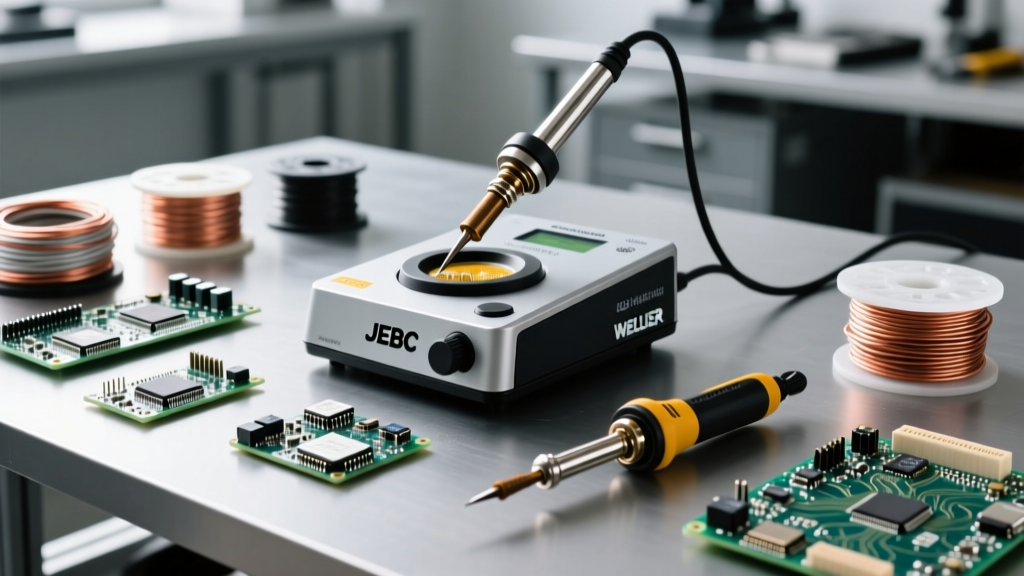
JBC CD-2BE: The Aerospace Benchmark
According to Dr. Rostova, the JBC CD-2BE (priced around $550 in 2026) remains the undisputed king of thermal management. Utilizing the C245 cartridge system, the heating element is integrated directly into the tip, achieving 350°C in under two seconds. 'When working on multi-layer avionics boards, the JBC's exclusive heating system detects heat loss the millisecond the tip touches a massive copper pour, delivering instant wattage without overshooting,' Rostova explains. The ergonomic handle is exceptionally light, reducing fatigue during 8-hour shifts, though the proprietary tip cost ($45-$60 each) is a premium you pay for performance.
Hakko FX-951: The High-Volume Workhorse
For production environments and general repair, Marcus Vance champions the Hakko FX-951 (~$280). While it uses traditional T18 tips where the heater and sensor are in the wand rather than the tip, Hakko's induction heating and closed-loop sensor technology provide remarkably stable temperatures. 'The FX-951 is the Toyota Hilux of soldering stations,' Vance notes. 'It survives drops, chemical spills, and years of abuse. For 90% of through-hole and standard SMD work, it meets the IPC J-STD-001 standard requirements flawlessly without the JBC price tag.'
Weller WE1010NA: The Prosumer Sweet Spot
Kenji Sato points to the Weller WE1010NA (~$115) as the best entry-to-mid-level station. Featuring a digital interface and 70W output, it handles standard DIY and hobbyist tasks well. However, Sato warns against using it for heavy RF shielding or thick multi-layer boards, as the thermal mass of the ET series tips struggles to recover quickly, leading to cold joints if the operator lingers too long.
| Model | Est. Price | Wattage | Tip Technology | Best Use Case |
|---|---|---|---|---|
| JBC CD-2BE | $550 | 130W (Peak) | Integrated Cartridge (C245) | Aerospace, Micro-BGA, Heavy Ground Planes |
| Hakko FX-951 | $280 | 70W | Induction / T18 Sensors | High-Volume Production, General Repair |
| Weller WE1010NA | $115 | 70W | Standard ET Series | Hobbyist, Prosumer, Light SMD |
Hand Tools: The Unsung Heroes of the Workbench
A $600 soldering station is useless if you are tearing pads with subpar cutters. Our experts emphasize that hand tools dictate the mechanical integrity of your prep work.
- Flush Cutters: The Knipex 78 61 125 (Super Knips) is the panel's top pick for precision lead trimming and zip-tie cutting. At $32, its zero-backlash joint ensures a true flush cut every time. For budget-conscious techs, the Hakko CHP-170 ($8) is acceptable but requires frequent replacement as the carbon steel edges dull rapidly against copper.
- Tweezers: For SMD placement, Dr. Rostova insists on Vetus ESD-safe titanium tweezers (Model ST-15 or ST-36). Titanium is non-magnetic and highly resistant to flux corrosion, unlike standard stainless steel which can pit and harbor contaminants over time.
- Wire Strippers: The Engineering PA-09 or Kaipu KP-180 are preferred for stripping 24AWG to 32AWG silicone and PTFE wires without nicking the copper strands, a critical failure point in high-vibration environments.
Consumables: Alloys and Fluxes Dictate Success
The consumables you choose will make or break your wetting action and joint reliability. The experts break down the chemistry you need to know.
Solder Alloys: Leaded vs. Lead-Free
While the Sn63/Pb37 (63% Tin, 37% Lead) eutectic alloy remains the gold standard for hobbyists and exempt aerospace applications due to its low 183°C melting point and shiny, easy-to-inspect joints, commercial manufacturers must use lead-free alternatives. The industry standard SAC305 (96.5% Sn, 3.0% Ag, 0.5% Cu) melts at 217°C. 'SAC305 requires higher tip temperatures, typically 330°C to 350°C, which accelerates tip plating dissolution,' warns Vance. 'If you are forced to use SAC305, you must use a nitrogen-assisted environment or heavily fluxed cores to prevent oxidation.'
Flux Chemistry
Flux removes oxidation and promotes wetting. For rework, the panel recommends Kester 245 No-Clean liquid flux or Amtech NC-559-V2-TF tacky flux for BGA reballing. 'Never use plumbing acid flux on electronics,' Sato states bluntly. 'It will corrode the traces within weeks. Stick to Rosin Mildly Activated (RMA) or synthetic No-Clean formulations that meet the NASA Workmanship Standards for ionic cleanliness.'
Fume Extraction and ESD Safety: Non-Negotiables
Solder fume contains colophony (rosin) and volatile organic compounds (VOCs) that can cause occupational asthma. A simple desk fan blowing smoke into your face is a severe health hazard.
'Investing in a localized HEPA and activated carbon extraction system is as important as the iron itself. The BOFA ADQ-200 or even the benchtop Hakko FA-400 with proper carbon filtering will protect your respiratory system over a 20-year career.' — Dr. Elena Rostova
Furthermore, Electrostatic Discharge (ESD) can silently destroy sensitive CMOS and MOSFET components. Ensure your soldering station is grounded to a common point ground, and use an ESD-safe silicone mat connected to a 1-megohm wrist strap. Institutions like MIT Environment, Health & Safety strictly mandate these grounding protocols in all university and research labs to prevent catastrophic component failure.
Expert Troubleshooting: Common Equipment Failure Modes
Even the best equipment fails if mismanaged. Our experts outline the most common failure modes and how to avoid them:
- Tip Oxidation and Non-Wetting: Caused by leaving the station at 400°C while idle, or wiping on a dry brass sponge without re-tinning. Fix: Always turn down the temperature to 250°C when idle, and leave a generous blob of solder on the tip before powering off.
- Heater Burnout in Ceramic Elements: Dropping the Hakko FX-951 wand or applying extreme lateral pressure can fracture the internal ceramic heater core. Fix: Let the chemistry (flux) do the work, not brute mechanical force.
- Ground Loop Noise: If your oscilloscope shows 50/60Hz noise when probing a circuit being soldered, your station's grounding is faulty. Fix: Verify the ground pin on your AC outlet and ensure the station's 3-prong plug is not adapted to a 2-prong cheater plug.
The Final Verdict
Building the ultimate workbench in 2026 requires balancing thermal physics, ergonomics, and chemical safety. If budget allows, the JBC CD-2BE is a lifetime investment that will handle everything from massive ground planes to microscopic 01005 passives. For the pragmatic professional, the Hakko FX-951 paired with Knipex cutters and Kester flux remains the undisputed champion of reliability. By prioritizing high-quality soldering tools and equipment, you not only ensure IPC-compliant joints but also protect your health and the longevity of the electronics you build and repair.