
The 2026 Landscape: Why IPC Certification Soldering Matters Now
In the electronics manufacturing, aerospace, and medical device sectors, the phrase IPC certification soldering carries significant weight. As we move through 2026, the miniaturization of components (with 01005 and 008004 imperial packages becoming standard in high-density interconnects) and the strict reliability demands of lead-free alloys like SAC305 and SAC405 have made formalized training more critical than ever. But with initial training costs hovering around $2,000 and requiring biennial renewal, is the investment actually worth it for individual technicians and engineers?
To answer this, we convened a panel of industry veterans, Approved Training Center (ATC) directors, and hiring managers to dissect the real-world ROI, technical rigor, and career impact of obtaining your Certified IPC Specialist (CIS) credentials.
Meet the Expert Panel
- Sarah Jenkins: Director of Manufacturing at a Tier-1 Aerospace & Defense Supplier.
- Marcus Thorne: Master Certified IPC Trainer (CIT) with 22 years of experience running an independent ATC.
- David Lin: Freelance Prototyping Engineer and former lead hand-solderer for a major EV startup.
Breaking Down the Core Certifications
Before evaluating the ROI, it is crucial to understand which certification aligns with your career goals. The IPC ecosystem is vast, but for hands-on soldering professionals, two standards dominate the landscape. According to the official IPC Certification Hub, the CIS pathway is the baseline for operators and technicians.
| Certification Standard | Target Audience | Core Focus | 2026 Avg. Initial Cost |
|---|---|---|---|
| IPC-J-STD-001 | Soldering Operators, Rework Techs | Requirements for materials, methods, and criteria for soldered assemblies. | $1,400 - $1,800 |
| IPC-A-610 | Quality Inspectors, QA Engineers | Visual acceptability criteria for electronic assemblies (The "Picture Book"). | $1,300 - $1,700 |
| IPC-7711/7721 | Advanced Rework & Repair Techs | Rework, modification, and repair of electronic assemblies. | $1,600 - $2,200 |
"Most technicians get J-STD-001 and A-610 bundled in a 5-day bootcamp. If you are strictly doing bench work and rework, J-STD-001 is your bible. If you are doing final QA sign-offs, A-610 is non-negotiable."
— Marcus Thorne, Master CIT
The ROI Debate: Is the $2,000 Investment Worth It?
The financial barrier to entry is the most common deterrent. A standard 4-day CIS training course for IPC-J-STD-001 costs between $1,400 and $1,800 at most ATCs. Add $150 for the required physical handbook, $100 for testing fees, and travel expenses, and you are easily looking at a $2,200 out-of-pocket expense if your employer won't foot the bill.
The Employer Perspective
Sarah Jenkins, who oversees a manufacturing floor producing flight-critical avionics, views IPC certification as a strict liability shield. "In aerospace and medical (Class 3 environments), we cannot legally or ethically allow an uncertified technician to touch a flight-critical PCB. The certification isn't just about skill; it's about traceability and legal compliance. If a board fails in the field, the first thing the auditors ask for is the CIS certification log of the operator who soldered it."
For Jenkins, the ROI is immediate because uncertified candidates are simply filtered out of the resume pile for Class 3 roles.
The Freelancer / Independent Perspective
David Lin offers a more nuanced view for independent contractors. "If you are building consumer IoT prototypes or doing basic through-hole kits, IPC certification is overkill. However, the moment I pivoted to contracting for medical device startups and automotive LiDAR companies, my day rate jumped from $65/hour to $110/hour. The certification acts as a trust signal that bypasses their need to administer a 4-hour bench test during the interview process."
Technical Deep Dive: What the Practical Exam Actually Tests
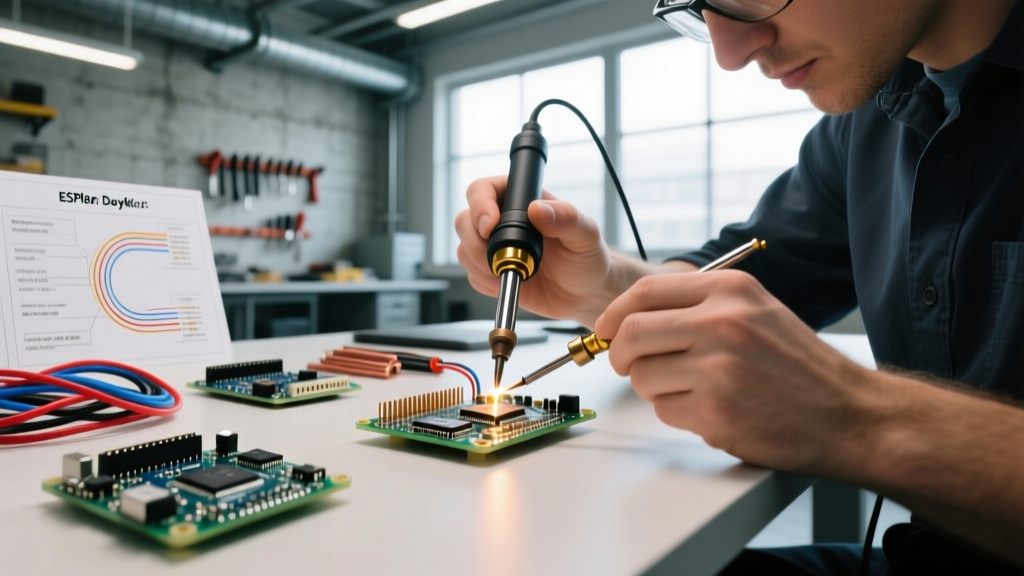
Many assume the practical exam is merely about making a shiny solder joint. In reality, the CIS J-STD-001 practical test is a grueling exercise in thermal management, flux chemistry control, and strict adherence to dimensional criteria. Candidates are typically required to assemble a test board featuring a mix of Plated Through-Hole (PTH) and Surface Mount Technology (SMT) components, including fine-pitch ICs and bottom-termination components (BTCs).
Class 2 vs. Class 3 Criteria
Understanding the difference between product classes is where most candidates fail the written and practical exams.
- Class 2 (Dedicated Service Electronics): Requires a minimum of 50% barrel fill for PTH components. Solder fillets must be smooth and concave, but slight interruptions in the wetting angle are permissible if structural integrity is maintained.
- Class 3 (High-Performance/Life Support): Demands a minimum of 75% barrel fill for PTH components. The wetting angle must be strictly less than 90 degrees, with a smooth, continuous concave fillet. Any evidence of a disturbed joint, cold solder, or solder wicking above the component shoulder results in an automatic fail for that specific joint.
Common Failure Modes in the 2026 Classroom
Marcus Thorne notes that the shift toward complex lead-free alloys has changed how students fail. "Ten years ago, students failed because they didn't use enough heat. Today, with advanced flux-cored wires, they fail because they overheat the joint. They burn out the ROL0 (Rosin, Low activity, 0% halides) flux before the SAC305 alloy fully liquefies, resulting in oxidized, grainy joints that fail the visual inspection criteria for wetting."
Expert Tips for Passing the Practical Exam on the First Try
Based on our panel's combined experience training and testing over 5,000 technicians, here are the actionable strategies to ensure you pass the CIS practical exam without needing a costly retest.
- Master Your Thermal Profile: Do not just crank your soldering station to 400°C to melt lead-free solder faster. If using a station like the Metcal PS-900 or Weller WXD2, select a cartridge tip that matches the thermal mass of the pad. For a standard 0603 SMT pad, a 350°C chisel tip provides the optimal heat transfer without scorching the flux or lifting the PCB laminate.
- Respect the Flux Chemistry: The exam provides specific solder wire, usually Sn63Pb37 for legacy training or SAC305 for modern RoHS compliance. Pay attention to the flux core diameter and percentage. If you need to add external liquid or tacky flux, ensure it is compatible. Using an aggressively activated RMA (Rosin Mildly Activated) flux when the exam specifies a no-clean or ROL0 process will result in a deduction for improper material usage.
- Utilize Magnification Relentlessly: You are allowed to use magnification during the practical test. Use a 10x illuminated loupe to inspect your own PTH barrel fill and SMT wetting angles before calling the proctor over to grade your board. Catching a slightly convex fillet and reworking it properly (using desoldering braid and fresh flux) is better than submitting a defective board.
- Cleanliness is Graded: Even if you are using a 'no-clean' flux, IPC standards dictate that if you choose to clean the board, you must clean it thoroughly. Partially cleaned boards with white, powdery flux residue trapped under components are flagged as defects. Use 99% Isopropyl Alcohol (IPA) and lint-free wipes (like Kimwipes) to achieve a pristine finish.
The Recertification Reality: A Hidden Ongoing Cost
One aspect often glossed over in buying guides is the maintenance of the credential. IPC certifications are valid for exactly 24 months. To maintain your CIS status, you must complete a recertification course before your expiration date. According to data from top-tier training providers like BEST Inc., recertification typically requires a 2-day (16-hour) refresher course and a shortened exam, costing between $600 and $850. If your certification lapses by even one day, you are forced to retake the full 4-day initial course and pay the full $2,000+ price tag again.
Final Verdict from the Panel
Is IPC certification soldering worth it in 2026? The consensus from our experts is a resounding yes, but with caveats.
If your goal is to work in aerospace, medical devices, military contracting, or high-reliability automotive electronics, the CIS J-STD-001 certification is not just an advantage—it is a mandatory barrier to entry. The $2,000 investment will pay for itself with your first paycheck in a Class 3 manufacturing environment.
However, if you are a hobbyist, a general consumer electronics repair technician, or a firmware engineer who only occasionally solders a header pin, the rigorous financial and time commitments of IPC certification will not yield a proportional return on investment. For those professionals, mastering the fundamental physics of solder wetting, thermal management, and flux activation through self-study and practice remains the most practical path forward.