
The Global Search for 'Precio Arduino Uno': Why Cost Dictates Design in 2026
For years, the Arduino Uno has been the undisputed king of the electronics workbench. However, as the maker economy has globalized, a massive volume of search traffic originates from Spanish-speaking engineering and hobbyist communities querying the precio arduino uno (Arduino Uno price). In 2026, evaluating this price is no longer just about looking at the MSRP on the official store; it requires a deep dive into import markups, the transition from the legacy ATmega328P to the Arm-based R4 series, and the hidden hardware costs of cheap clones.
Whether you are sourcing boards via MercadoLibre in Latin America, Amazon.es in Spain, or direct from distributors in the US, understanding the true cost-to-value ratio is critical for project suitability. This analysis breaks down the 2026 pricing landscape and dictates exactly when you should pay the premium for a genuine board, and when alternative microcontrollers make more financial sense.
2026 Microcontroller Pricing & Feature Matrix
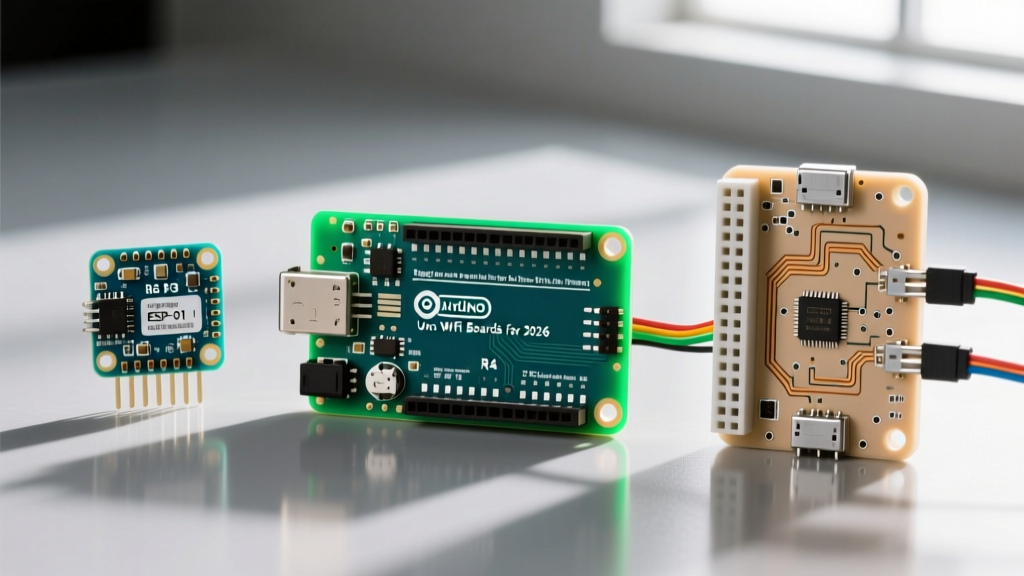
The market has bifurcated. On one side, we have the genuine Arduino ecosystem, which has largely pivoted to the Arduino Uno R4 WiFi and Minima. On the other, a sea of third-party clones. Below is the current 2026 pricing and specification matrix for the most common Uno form-factor boards.
| Board Model | MCU Core | Avg. Price (USD) | Connectivity | Best Project Tier |
|---|---|---|---|---|
| Genuine Uno R4 Minima (ABX00080) | Renesas RA4M1 (Cortex-M4F, 48MHz) | $20.00 | None (USB-C) | Education, DSP, 12-bit DAC Prototyping |
| Genuine Uno R4 WiFi (ABX00087) | RA4M1 + ESP32-S3 | $27.50 | Wi-Fi, BLE, 8x12 LED Matrix | IoT Dashboards, Cloud-connected Sensors |
| Genuine Uno R3 (Legacy) | ATmega328P (AVR, 16MHz) | $27.00 | None (USB-B) | Legacy Shield Compatibility, 5V Logic Systems |
| Premium Clone (e.g., Elegoo/DFRobot) | ATmega328P + CH340G UART | $12.00 - $15.00 | None (USB-B or C) | Budget Robotics, Permanent Home Installations |
| Standalone ESP32-S3 DevKit | Xtensa LX7 (Dual-core, 240MHz) | $6.00 - $9.00 | Wi-Fi, BLE | High-compute IoT, Camera Interfacing |
Project Suitability Analysis by Price Tier
When makers search for the precio arduino uno, they are often trying to justify the $20-$30 investment over a $6 ESP32 or a $12 clone. The right choice depends entirely on your project's end-goal and environmental constraints.
Tier 1: Educational, DSP, and Rapid Prototyping (The Genuine Premium)
If your project involves audio processing, precise waveform generation, or classroom deployment, the Arduino Uno R4 Minima at $20 is unbeatable. The Renesas RA4M1 chip brings a 32-bit Arm Cortex-M4F running at 48 MHz, alongside a true 12-bit DAC (Digital-to-Analog Converter).
- Why pay the premium? You are paying for the Arduino core library optimization, zero-driver USB-C connectivity (no CH340 driver headaches on school PCs), and rigorous QA on the voltage regulation circuitry.
- Suitability: University labs, digital synthesizers, and precision sensor calibration rigs.
Tier 2: Permanent Home Automation & Budget Robotics (The Clone Reality)
For a permanent installation—like an automated greenhouse watering system or a basic obstacle-avoidance robot—paying $27 for a genuine board is a poor allocation of capital. A $12 clone utilizing the CH340G USB-UART bridge is perfectly adequate. However, you must engineer around the hardware compromises of cheap clones.
Expert Warning on Clone Voltage Regulators: Most sub-$15 Uno clones use a generic AMS1117-5.0 linear regulator with inadequate thermal pads. If you power the board via the barrel jack at 12V and draw more than 250mA from the 5V pin, the regulator will thermally throttle or fail catastrophically. Always power high-draw clone projects via a dedicated 5V buck converter directly into the 5V pin, bypassing the onboard regulator entirely.
Tier 3: IoT & High-Compute (When the Uno is the Wrong Choice)
If your project requires Wi-Fi, Bluetooth, or high-speed data logging, the precio arduino uno for the R4 WiFi ($27.50) starts to look inflated compared to raw silicon alternatives. While the R4 WiFi is an excellent board featuring an integrated ESP32-S3 and a gorgeous 8x12 LED matrix, a standalone ESP32-S3 DevKit costs under $9 and offers dual-core 240MHz processing.
- Choose the Uno R4 WiFi if: You need the physical Uno shield footprint to stack legacy hardware (like a specific motor shield or GPS shield) while adding cloud connectivity.
- Choose a raw ESP32 if: You are designing a custom PCB, space is constrained, or you need to interface with a camera module (OV2640) which the Uno architecture cannot handle efficiently.
Hidden Hardware Costs: Beyond the Sticker Price
Analyzing the true cost of an Arduino project requires looking past the initial checkout price. In 2026, several secondary costs impact the overall bill of materials (BOM):
- Import and Regional Markups: For makers in LATAM or parts of Europe, the localized precio arduino uno on regional marketplaces can be inflated by 40% to 60% due to import taxes and distributor margins. Buying in bulk via global freight forwarders often reduces the per-unit cost of genuine R4 boards to near MSRP.
- The USB-C Transition: The legacy Uno R3 uses the outdated USB Type-B cable. The R4 series uses USB-C. If your lab or workshop is still stocked with Type-B cables, factor in the cost and e-waste of upgrading your tethering infrastructure.
- Logic Level Translation: The R4 Minima and WiFi operate at 5V logic, but many modern I2C/SPI sensors (like the BME688 or high-end LiDAR modules) are strictly 3.3V. Unlike the 3.3V-native ESP32, using an Uno R4 with modern sensors requires a $2 bi-directional logic level shifter, adding hidden BOM costs and wiring complexity.
Frequently Asked Questions
Is the legacy Arduino Uno R3 still worth buying in 2026?
Only if you are maintaining legacy infrastructure. If you have a fleet of older 5V shields or educational curriculums built specifically around the AVR ATmega328P architecture and direct port manipulation (e.g., manipulating PORTD registers), the R3 remains necessary. For all new designs, the R4 Minima offers vastly superior processing power and memory at a lower $20 price point.
Why do clone boards use the CH340G chip instead of the ATmega16U2?
Cost and licensing. The genuine Arduino uses an ATmega16U2 programmed as a USB-to-Serial converter, which requires specific USB VID/PID licensing and firmware flashing during manufacturing. The CH340G is a highly integrated, mass-produced silicon chip from WCH that costs pennies, allowing clone manufacturers to keep the precio arduino uno equivalent well under $15. The trade-off is that Windows and macOS users often must manually install CH340 drivers.
Can I use the Arduino Uno R4 for industrial PLC replacements?
No. While the R4 is robust for a hobbyist board, it lacks the opto-isolation, 24V logic tolerance, and DIN-rail mounting required for industrial environments. If your project suitability analysis points toward factory automation, bypass the Uno entirely and look into the Arduino Opta (a micro PLC starting around $180) or traditional Siemens/Allen-Bradley hardware.
Final Verdict
The search for the best precio arduino uno is ultimately an exercise in matching the tool to the task. In 2026, the genuine Arduino Uno R4 series justifies its $20-$27 price tag through modern Arm architecture, native USB-C, and unparalleled software support. However, for high-volume consumer deployments, strict IoT applications, or budget-constrained robotics, makers must be willing to pivot to clones or ESP32 alternatives to maximize their engineering ROI.