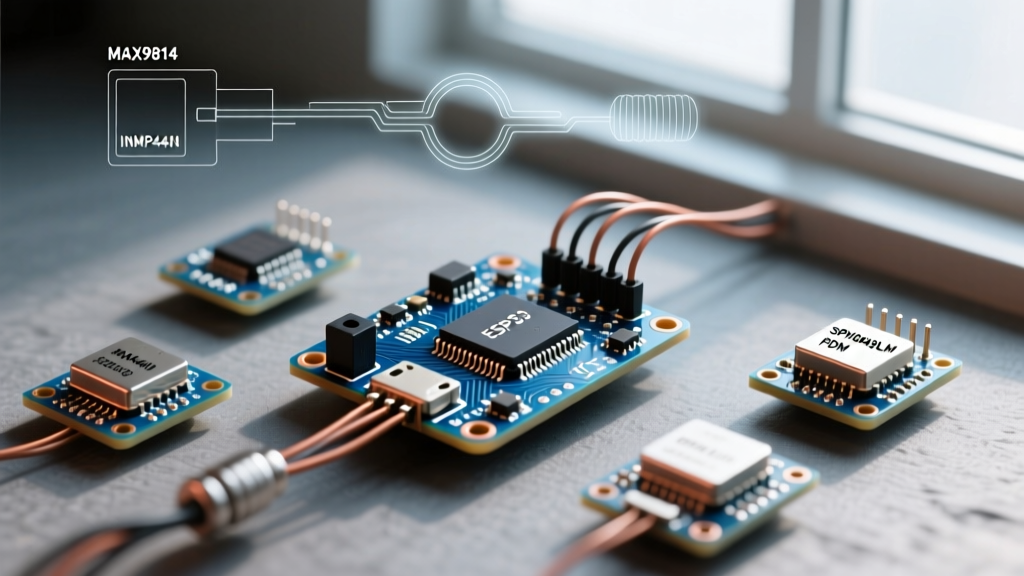

Navigating the Arduino Microphones Ecosystem
Audio acquisition in embedded systems requires matching the sensor's signal-to-noise ratio (SNR) and interface protocol to the host microcontroller's hardware capabilities. When makers and engineers search for arduino microphones, they are often met with a fragmented market of cheap sound detection sensors and high-fidelity MEMS (Micro-Electro-Mechanical Systems) modules. As of 2026, the ecosystem has firmly split into three distinct architectural pillars: Analog Envelope/Raw Audio, Digital I2S (Inter-IC Sound), and PDM (Pulse Density Modulation). Choosing the wrong interface for your target board—such as attempting to stream I2S data on an ATmega328P-based Arduino Uno—will result in immediate hardware failure or severe audio aliasing.
This ecosystem overview dissects the technical realities, exact model numbers, and wiring edge cases of the most prominent microphone modules available today, providing a decision framework for everything from basic clap-switches to Edge AI voice recognition.
Comparative Matrix: The 2026 Sensor Lineup
Before diving into protocol-specific architectures, review the hardware specifications of the dominant modules in the maker ecosystem. Pricing reflects typical 2026 market rates for authentic breakout boards.
| Module / IC | Interface | SNR / Sensitivity | Price Range | Ideal Use Case |
|---|---|---|---|---|
| KY-038 (LM393) | Analog / Digital | Low / N/A | $1 - $2 | Clap switches, noise triggers |
| MAX9814 | Analog (Raw) | 65dB / -44dBV | $6 - $10 | Audio visualization, FFT |
| INMP441 | I2S Digital | 61dB / -26dBFS | $3 - $5 | ESP32 audio streaming |
| SPH0645LM4H | I2S Digital | 65dB / -26dBFS | $4 - $6 | Stereo recording, Pi Pico |
| MP34DT06JTR | PDM Digital | 66dB / -26dBFS | $8 - $12 (Integrated) | TinyML, Edge AI voice |
The Analog Bottleneck: ADC Limits and Auto-Gain
Analog microphones output a continuous voltage waveform that must be digitized by the microcontroller's Analog-to-Digital Converter (ADC). This is where many beginners encounter the Nyquist-Shannon sampling theorem the hard way.
The ATmega328P Sampling Limitation
The standard Arduino Uno (ATmega328P) features a 10-bit successive approximation ADC. A single analogRead() call takes approximately 100 microseconds (µs). This hard-limits your maximum sampling rate to roughly 10,000 Hz (10 kHz). According to the Nyquist theorem, a 10 kHz sampling rate can only accurately reconstruct frequencies up to 5 kHz. Human speech intelligibility requires up to 8 kHz, meaning analog audio captured on an Uno will sound muffled and heavily aliased.
Module Spotlight: MAX9814 vs. KY-038
The KY-038 is largely a digital threshold sensor. It uses an LM393 comparator to output a simple HIGH/LOW signal when sound exceeds a potentiometer-set threshold. It is useless for capturing actual audio waveforms.
Conversely, the MAX9814 is a true analog audio amplifier. It features a built-in Automatic Gain Control (AGC) circuit that dynamically adjusts amplification to prevent clipping on loud noises while boosting whispers. Priced around $8, it is the premium choice for analog audio-reactive LED projects, provided you are using a faster ADC board like the Arduino Due or Teensy 4.1.
The I2S Revolution: High-Fidelity Digital Audio
To bypass the limitations of onboard ADCs, the ecosystem shifted toward I2S (Inter-IC Sound) MEMS microphones. I2S transmits digital audio data directly from the microphone's internal ADC to the microcontroller via dedicated clock and data lines, completely eliminating analog noise pickup on the PCB traces.
Why Arduino Uno Cannot Do I2S
I2S requires high-speed serial clocks (often 2.048 MHz or 3.072 MHz) and Direct Memory Access (DMA) to stream data into memory buffers without CPU intervention. The 16 MHz AVR architecture lacks native I2S peripherals and DMA. Therefore, I2S microphones like the INMP441 and SPH0645LM4H are strictly incompatible with standard 5V AVR Arduinos.
To use I2S, you must migrate to the modern ecosystem staples:
- ESP32 Family (ESP32-S3): Features dual I2S peripherals and DMA. Ideal for Wi-Fi audio streaming.
- Raspberry Pi Pico (RP2040): Uses Programmable I/O (PIO) state machines to bit-bang I2S flawlessly.
- Arduino Nano RP2040 Connect: Brings the RP2040 silicon into the official Arduino Nano form factor.
Wiring Edge Cases: The L/R Pin Strapping
When wiring an INMP441 or SPH0645 to an ESP32, the most common failure mode involves the L/R (Left/Right) channel selection pin. According to the Adafruit I2S MEMS guide, the L/R pin dictates the I2S time-slot.
- L/R tied to GND: Microphone outputs data on the Left channel (clock low phase).
- L/R tied to 3.3V: Microphone outputs data on the Right channel (clock high phase).
If you leave this pin floating, the microphone will randomly drop out or output static. Furthermore, these modules operate strictly at 3.3V logic. Connecting the data out (SD) pin directly to a 5V logic microcontroller will fry the MEMS IC over time due to back-feeding.
PDM and the Edge AI Frontier
Pulse Density Modulation (PDM) is the standard for modern ultra-low-power audio and Edge AI. Unlike I2S, which outputs multi-bit words (e.g., 24-bit) at standard sample rates (44.1 kHz), PDM outputs a 1-bit stream at a massive clock rate (typically 2.0 MHz to 3.0 MHz). The density of the 1s and 0s represents the audio amplitude.
Hardware Decimation and TinyML
Processing a 2.4 MHz 1-bit stream requires significant CPU overhead to 'decimate' it down to a usable 16 kHz PCM (Pulse Code Modulation) signal. This is why PDM microphones, such as the MP34DT06JTR manufactured by STMicroelectronics, are usually found integrated directly onto advanced boards like the Arduino Nano 33 BLE Sense. The Nano 33 BLE Sense utilizes an nRF52840 Cortex-M4 processor equipped with hardware DSP (Digital Signal Processing) instructions specifically designed to handle PDM decimation in the background.
'PDM microphones offer superior immunity to electromagnetic interference (EMI) compared to analog mics because the 1-bit digital signal is highly resistant to noise floor degradation over short PCB traces,' notes the STMicroelectronics MEMS sensor documentation.
For developers building keyword-spotting models using TensorFlow Lite for Microcontrollers (TinyML), PDM is the mandatory starting point. The official Arduino Nano 33 BLE Sense microphone tutorial demonstrates how the onboard PDM library seamlessly feeds 16-bit PCM buffers directly into neural network inference engines.
Real-World Troubleshooting: Conquering the Noise Floor
Regardless of whether you choose analog, I2S, or PDM, the embedded audio ecosystem is plagued by power supply noise. The most notorious culprit is the 5V USB rail from standard PC ports and cheap wall adapters, which often carries 50 mV to 100 mV of high-frequency switching ripple.
The Decoupling Protocol
If your audio stream features a persistent 50/60 Hz mains hum or high-pitched whine, implement the following hardware-level fixes:
- Local Decoupling: Solder a 100nF (0.1µF) ceramic capacitor as close to the microphone's VCC and GND pins as physically possible. This shunts high-frequency RF noise.
- Bulk Capacitance: Add a 10µF tantalum or electrolytic capacitor across the main power rails of your breadboard to stabilize low-frequency voltage droops during transient audio peaks.
- LDO Isolation (For Analog): If using a MAX9814 on a noisy 5V line, do not power it directly from the Arduino's 5V pin. Use a dedicated 3.3V Low Dropout Regulator (like the AMS1117-3.3) powered from the raw USB input. This rejects the switching ripple before it reaches the sensitive analog pre-amplifier.
- Ground Loops: Never share a ground return path between high-current components (like motor drivers or LED matrices) and your microphone. Route the microphone ground directly to the microcontroller's primary GND pin in a 'star ground' topology.
Final Ecosystem Verdict
The era of relying on a basic KY-038 for anything beyond a simple noise trigger is over. For pure audio visualization on legacy AVRs, the MAX9814 remains the analog king, provided you respect the ADC Nyquist limits. For high-fidelity recording, streaming, and DSP on the ESP32 or RP2040, the INMP441 and SPH0645 I2S modules offer unbeatable value and clarity. Finally, for engineers pushing the boundaries of offline voice recognition and TinyML, migrating to boards with native PDM support like the Nano 33 BLE Sense is not just recommended—it is architecturally required.