
Understanding the Turkey Electrical Outlet Standard
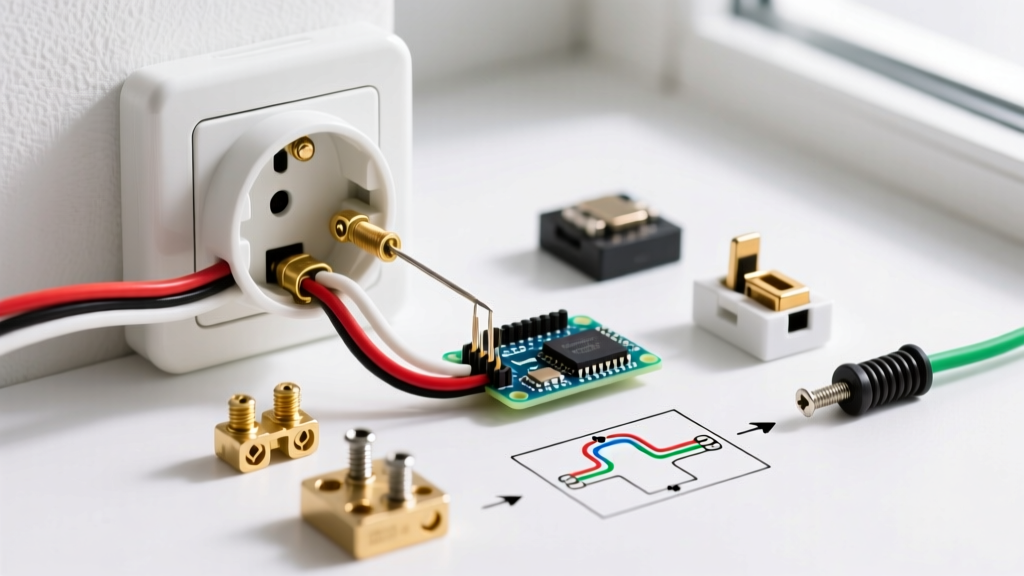
When dealing with international electrical systems, the turkey electrical outlet operates on the standard European Type F (CEE 7/3) 'Schuko' receptacle. Whether you are an expat wiring a new property in Istanbul, a contractor maintaining imported Turkish industrial equipment, or a North American homeowner installing a dedicated 240V circuit for a high-end Arçelik or Beko appliance, understanding the exact wiring parameters is critical for safety and compliance.
As of 2026, Turkey's electrical grid delivers 230V at 50Hz. The country has largely standardized on the TN-C-S and TN-S earthing systems in urban centers, though older rural installations may still rely on TT earthing. Misinterpreting these grounding schemes or attempting to wire a Schuko outlet using North American color codes can result in catastrophic equipment failure or fatal electric shock.
Key Specifications & Pin Configuration
| Parameter | Turkey Standard (Type F) | North American Equivalent (NEMA 6-20) |
|---|---|---|
| Voltage | 230V AC | 240V AC |
| Frequency | 50Hz | 60Hz |
| Receptacle Type | CEE 7/3 (Schuko) | NEMA 6-20R |
| Earth Connection | Twin side grounding clips | U-Shaped Ground Pin |
| Pin Diameter | 4.8 mm | 6.35 mm (Blade) |
| Standard Breaker | 16A (C-Curve MCB) | 20A (2-Pole) |
Scenario 1: Domestic Wiring Inside Turkey
If you are physically wiring a turkey electrical outlet within the Republic of Turkey, you must adhere to IEC 60364 standards and local Turkish electrical codes. The standard domestic circuit utilizes a 16A miniature circuit breaker (MCB) paired with a 30mA Residual Current Device (RCD).
IEC Wire Color Codes
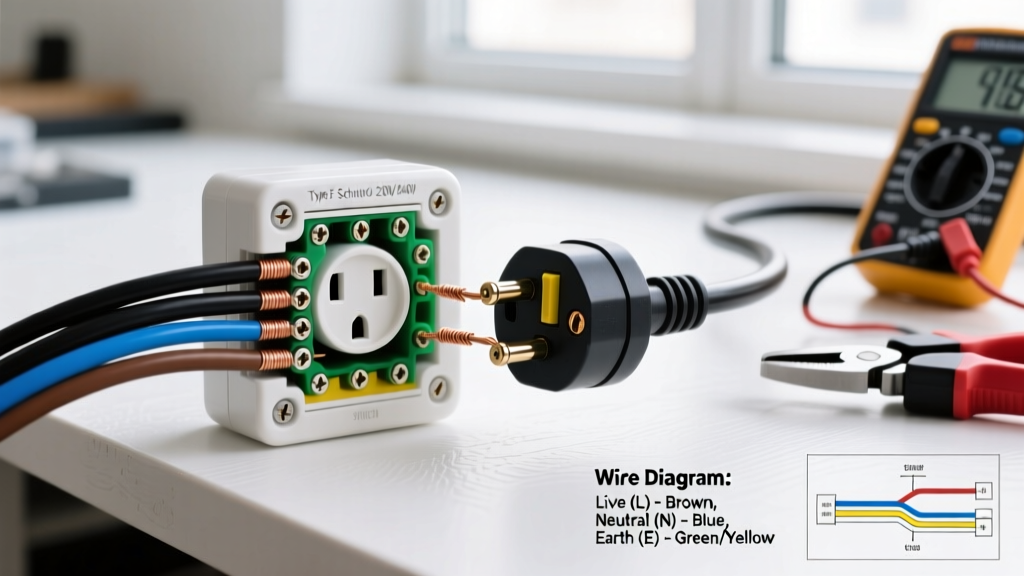
Never use North American wire colors when terminating a Turkish outlet. The mandated IEC 60446 color scheme for single-phase 230V circuits is:
- Phase (L): Brown
- Neutral (N): Blue
- Protective Earth (PE): Green/Yellow striped
Critical Safety Warning: In older Turkish buildings utilizing a TT earthing system, the earth impedance can be dangerously high. You must verify that the earth loop impedance (Ze) is low enough to trip the 30mA RCD within the required 0.4 seconds. Always test with a calibrated earth loop impedance tester before energizing the receptacle.
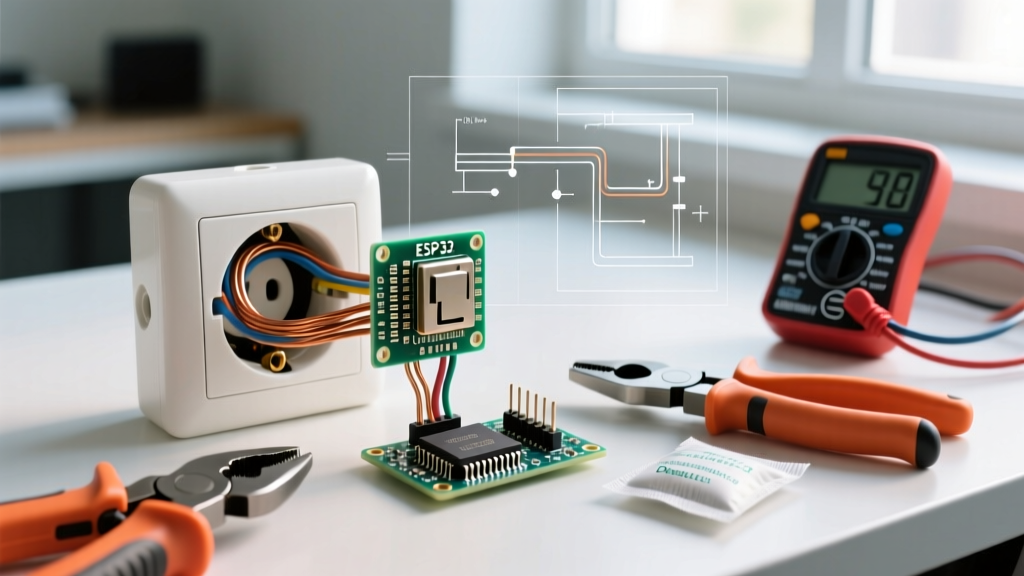
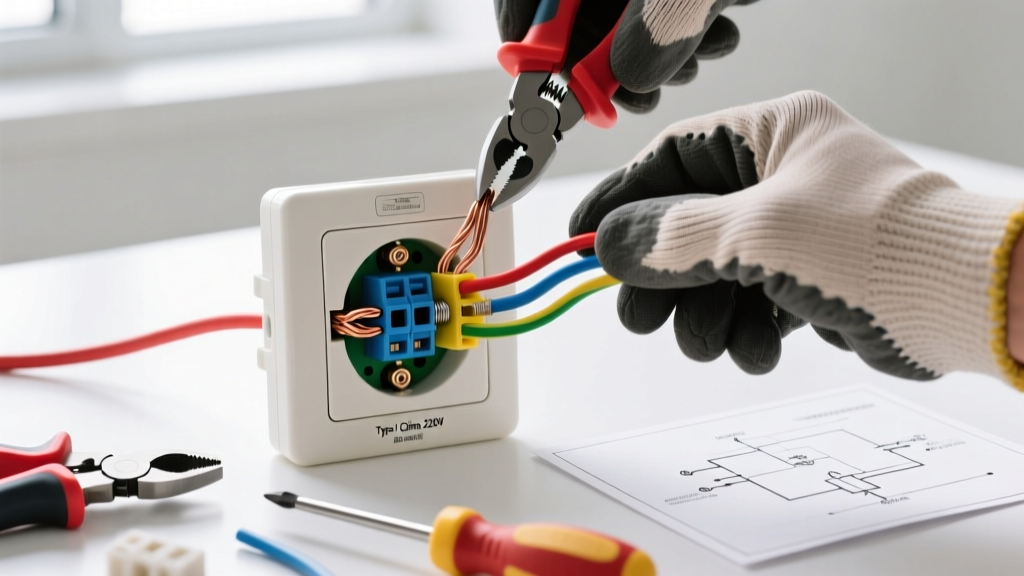
For the physical termination, strip 12mm of insulation from 2.5mm² (approx. 13 AWG) solid copper wire. Insert the brown wire into the right-hand terminal (Phase), the blue wire into the left-hand terminal (Neutral), and the green/yellow wire into the central earth screw. While Type F outlets are technically reversible regarding phase and neutral polarity, maintaining consistent polarity across a dwelling is a hallmark of professional-grade workmanship.
Scenario 2: Installing a 240V Schuko Outlet in North America
A highly common wiring scenario in the US and Canada involves importing heavy-duty Turkish or European appliances—such as commercial espresso machines, industrial textile irons, or high-end audio amplifiers. These devices require 230V and feature a molded Type F plug. Using a step-up transformer is inefficient, generates excessive heat, and degrades power quality. The superior solution is wiring a dedicated 240V Schuko-style receptacle directly from your North American panel.
The 50Hz vs. 60Hz Frequency Trap
Before wiring a 240V outlet for an imported appliance, you must evaluate the load type. North American grids operate at 60Hz. While 240V is close enough to 230V for most electronics, the frequency difference is a major edge case:
- Resistive Loads (Heaters, Ovens, Irons): Completely unaffected by the 60Hz frequency. Safe to wire directly.
- Inductive Loads (Motors, Compressors, Pumps): The synchronous speed of an AC motor is dictated by the formula Ns = 120f / P. A Turkish 4-pole motor designed for 1500 RPM at 50Hz will attempt to run at 1800 RPM on a 60Hz grid. This 20% over-speed causes severe mechanical stress, increased amperage draw, and eventual thermal failure. You must install a Variable Frequency Drive (VFD) to step the 60Hz down to 50Hz for these specific appliances.
Step-by-Step North American 240V Schuko Wiring
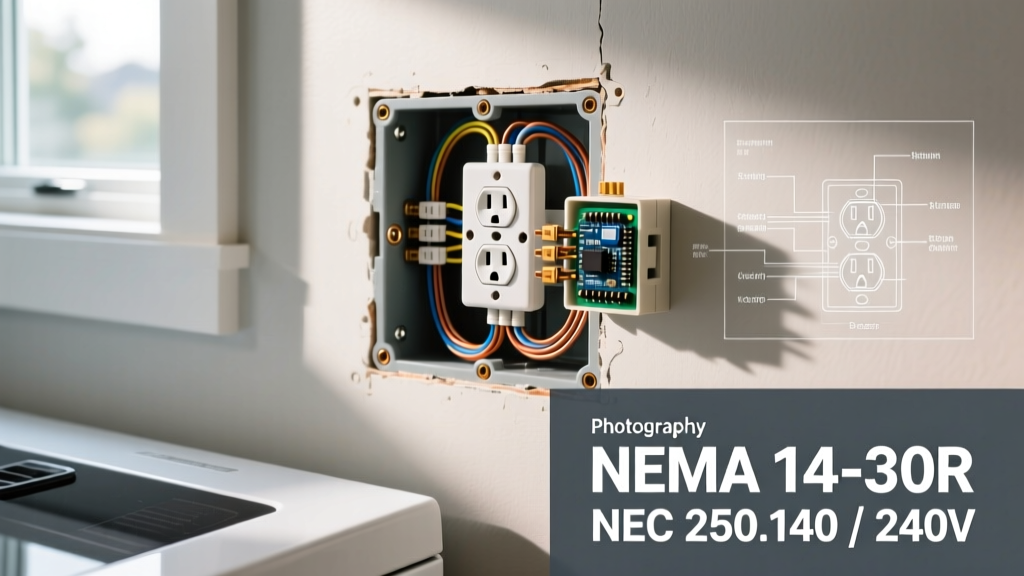
To wire a turkey electrical outlet equivalent in a US home, you will use a NEMA 6-20 circuit adapted to a flush-mount Euro-receptacle (such as a Hubbell or Leviton industrial panel-mount Schuko).
- Install the Breaker: Install a 2-pole, 20A common-trip breaker (e.g., Eaton BR220 or Square D HOM220) in your main service panel.
- Run the Cable: Pull 12/2 NM-B (Romex) cable from the panel to the outlet location. This cable contains a black (hot), white (neutral), and bare (ground) wire.
- Re-identify the White Wire: Per NFPA 70 (NEC) Article 200.7(C), a white wire used as an ungrounded conductor (hot leg) must be permanently re-identified. Wrap both ends of the white wire in black or red electrical tape, or use heat-shrink tubing.
- Terminate the Ground: Connect the bare copper wire to the green grounding screw on the Schuko receptacle. This connects to the side earth clips of the turkey electrical outlet standard.
- Terminate the Phase Legs: Connect the black wire to one brass terminal and the re-identified white wire to the other brass terminal. Because standard Type F appliances do not utilize a neutral pin, both legs act as 120V phase lines, providing 240V across the load.
- Test Voltage: Before plugging in the appliance, use a multimeter to verify exactly 240V AC across the two brass terminals.
Common Failure Modes & Troubleshooting
When adapting or maintaining a turkey electrical outlet, technicians frequently encounter specific failure modes. Understanding these edge cases separates DIYers from master electricians.
Floating Neutrals in TT Earthing Systems
If you are troubleshooting a Type F outlet in a rural Turkish property, you may encounter a 'floating neutral' condition. In TT systems, the earth is provided by a local ground rod, not the utility transformer. If the ground rod dries out or corrodes, the earth reference is lost. A standard receptacle tester will not catch this. You must measure the voltage between Neutral and Earth; it should read less than 2V. If it reads 115V or 230V, the earth bond has failed, presenting a lethal shock hazard.
Adapter Overheating (Type F to Type E/F Hybrid)
Many travelers and expats use 'universal' adapters that claim to support both French (Type E) and Turkish (Type F) outlets. As noted by World Standards, Type F relies on side grounding clips, while Type E uses a protruding male earth pin. Cheap hybrid adapters often rely on thin, stamped-metal internal wipers to bridge these connections. When pulling 16A (approx. 3600W) for a Turkish space heater, these wipers exhibit high resistance, leading to thermal melting of the adapter faceplate. Always use a dedicated, molded CEE 7/7 hybrid plug on the appliance cord itself, rather than relying on a mechanical travel adapter for high-draw loads.
FAQ: Turkey Electrical Outlet Queries
Can I plug a US 120V appliance into a turkey electrical outlet?
No. Plugging a 120V North American appliance directly into a 230V Type F outlet will instantly destroy the appliance's power supply and poses a severe fire risk. You must use a step-down voltage transformer (230V to 120V) rated for at least 25% more wattage than the appliance's maximum draw.
Does the Type F outlet have a specific 'up' or 'down' orientation?
Unlike North American NEMA outlets where the ground pin is traditionally oriented downward, the Schuko (Type F) outlet is completely symmetrical. There is no code-mandated 'up' or 'down' orientation in Turkey, as the plug is designed to be inserted in either direction (unpolarized).
What size wire is required for a 16A Turkish outlet circuit?
Standard Turkish electrical codes mandate a minimum of 2.5mm² (roughly equivalent to 13 AWG) solid copper wire for 16A receptacle circuits. For longer runs exceeding 25 meters, upsizing to 4.0mm² is recommended to mitigate voltage drop, ensuring the appliance receives a stable 230V under load.