
Understanding the Italian Socket Landscape
Wiring an Italian electric outlet requires navigating a unique intersection of historical legacy and modern European safety standards. Unlike the standardized Type G (UK) or Type B (North America) systems, Italy’s residential electrical infrastructure has historically relied on the Type L standard (CEI 23-50). However, the proliferation of high-wattage European appliances has forced a shift toward hybrid receptacles. For electricians, expats, and DIY renovators, understanding the physical and regulatory nuances of these outlets is critical to preventing thermal overload and ensuring compliance with the Comitato Elettrotecnico Italiano (CEI).
According to the IEC World Plugs database, Italy operates on a 230V supply voltage and 50Hz frequency. The physical receptacles you will encounter in 2026 generally fall into three categories:
| Socket Type | Pin Configuration & Spacing | Max Current | Common Application |
|---|---|---|---|
| Type L (10A) | 3 inline pins, 4mm spacing (19mm length) | 10 Amps | Lighting, low-draw electronics, older homes |
| Type L (16A) | 3 inline pins, 8mm spacing (26mm length) | 16 Amps | Ovens, washing machines, HVAC units |
| Schuko (Type F) | 2 round pins + earth clips, 19mm spacing | 16 Amps | Imported EU appliances, modern EV chargers |
| Bipasso (Hybrid) | Accepts 10A, 16A, and Schuko plugs | 16 Amps | Standard modern residential wall outlets |
CEI 64-8 Code Compliance: The Core Mandates
The CEI 64-8 standard is the Italian equivalent of the US National Electrical Code (NEC). It dictates everything from minimum circuit counts to mandatory residual current device (RCD) protections. When installing or upgrading an Italian electric outlet, strict adherence to these rules is not optional—it is a legal requirement for obtaining the Dichiarazione di Conformità (Declaration of Conformity) needed for property insurance and occupancy permits.
⚠️ CRITICAL SAFETY WARNING: In Italy, the earth ground connection (messa a terra) is mandatory for all socket circuits. Operating appliances without a verified ground path voids insurance and creates a lethal shock hazard, especially in older masonry buildings where structural dampness can lower skin resistance.
Minimum Circuit and Outlet Requirements
Under the latest CEI 64-8 revisions, a standard residential apartment (up to 75 square meters) must feature a minimum of three dedicated circuits:
- Circuit 1 (Lighting): Protected by a 10A or 16A MCB (Magnetic-Thermal Breaker).
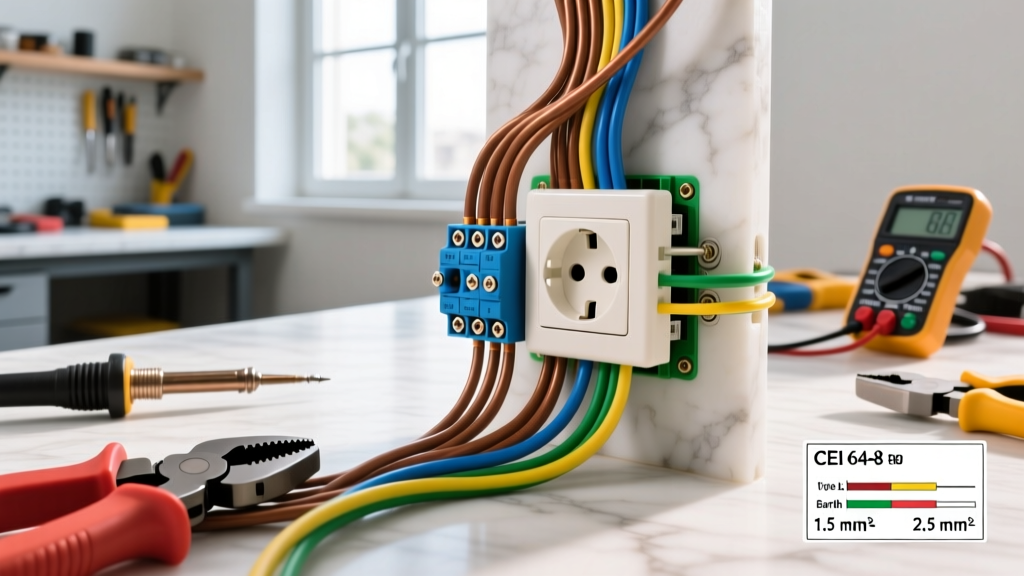
- Circuit 2 (Standard Outlets): Protected by a 16A MCB, utilizing 1.5mm² or 2.5mm² copper conductors.
- Circuit 3 (Heavy Appliances): Dedicated lines for kitchens, washing machines, and HVAC, each requiring independent 16A or 20A protection.
Furthermore, the code mandates a minimum number of outlets per room based on square footage. A living room over 20 square meters requires at least six socket outlets, while kitchens require a minimum of five, strategically placed above the countertop work zones.
Wire Sizing, Color Codes, and Conduit Specs
Italian wiring practices differ significantly from North American Romex (NM-B) cable runs. In Italy, single-core conductors are pulled through rigid or corrugated PVC conduit (tubo corrugato) embedded directly into the masonry walls or plaster. This method allows for future wire replacement without destroying the wall finish.
Standard Conductor Sizing
- 1.5 mm² Copper: Used for lighting circuits and standard 10A/16A Bipasso outlets. Maximum continuous load is roughly 16A when installed in conduit (Method B2).
- 2.5 mm² Copper: Mandatory for dedicated 16A appliance outlets (ovens, dishwashers) and general-purpose socket rings in high-density areas.
- 4.0 mm² to 6.0 mm² Copper: Reserved for main sub-panel feeds, electric cooktops, and modern Level 2 EV charging stations.
IEC Color Code Compliance
Modern Italian installations follow the IEC 60446 harmonized color codes. However, renovators must be prepared to encounter legacy colors in pre-1980s buildings.
- Phase (L): Brown (L1), Black (L2), Grey (L3). Legacy: Red, Brown, or Black.
- Neutral (N): Light Blue. Legacy: Light Blue or Grey.
- Earth (PE): Green/Yellow striped. Legacy: Bare copper or solid Yellow.
Bathroom and Kitchen Zone Restrictions
Water proximity drastically alters outlet placement rules. CEI 64-8 divides bathrooms into specific safety zones:
- Zone 0 (Inside bathtub/shower): Absolutely no outlets or switches permitted.
- Zone 1 (Directly above tub/shower to 2.25m): No standard outlets. Only IPX5-rated shaver sockets with an integrated isolation transformer are permitted.
- Zone 2 (60cm radius from water source): Outlets must be IPX4 rated and protected by a 30mA RCD. Standard hair dryer outlets are typically placed here.
In kitchens, outlets must be positioned at least 20cm above the countertop surface to prevent water ingress, and no socket may be installed directly above a gas hob or sink basin.
Recommended 2026 Hardware and Pricing
When sourcing components, rely on established Italian manufacturers that certify their products to CEI 23-50. Leading brands like BTicino and Vimar dominate the market, offering modular systems that fit into standardized 3-module, 4-module, or 7-module flush-mounting boxes (scatole da incasso).
| Brand & Model | Type | Key Features | Avg. Retail Price (2026) |
|---|---|---|---|
| BTicino Living Now K4003N | Bipasso 16A + Schuko | Integrated child safety shutters, IP21 rating | €9.50 - €12.00 |
| Vimar Eikon Evo 20030 | Bipasso 16A | Silver-plated contacts for low thermal resistance | €7.00 - €9.50 |
| ABB Aura 2093-02N | Schuko (Type F) | Recessed well, ideal for bulky smart plugs | €11.00 - €14.50 |
Note: Prices reflect the mechanism only; faceplates and mounting frames are sold separately in the Italian modular system.
Troubleshooting Common Italian Wiring Faults
- Thermal Degradation of 10A Sockets: A frequent failure mode occurs when users employ forced adapters to plug 16A appliances (like space heaters) into older 10A wall sockets. The 4mm pin spacing and thinner internal brass contacts cannot dissipate the heat, leading to melted faceplates and arc faults. Solution: Upgrade the wall box to a 7-module size and install a 16A Bipasso socket wired with 2.5mm² cable.
- Nuisance Tripping of the 'Salvavita' (RCD): Colloquially known as the salvavita (life-saver), the main 30mA RCD trips frequently in older homes. This is often caused by cumulative leakage current from multiple aging appliances, or the use of outdated Type AC RCDs that cannot handle the DC leakage from modern inverter-driven washing machines. Solution: Upgrade the main panel to a Type A or Type F RCD, which is mandatory for 2026 compliance when variable-frequency drives are present.
- Loose Neutral Connections in Conduit: Because wires are pulled through corrugated tubing, tension during installation can cause the neutral wire to slip slightly out of the screw terminal inside the outlet. This results in voltage fluctuations and flickering lights. Solution: Always use ferrule crimps on stranded wire (H07V-K) before inserting them into BTicino or Vimar screw terminals, and torque to 0.8 Nm.
Frequently Asked Questions
Can I install a US-style Type B outlet in my Italian home?
While physically possible if you bring a 120V step-down transformer, it is highly discouraged and violates CEI 64-8 if wired directly to the 230V mains. Instead, use a high-quality travel adapter or replace the appliance's power cord with an Italian Type L or Schuko plug.
Are smart Italian electric outlets available?
Yes. The BTicino Living Now line integrates with Netatmo, offering smart Bipasso outlets (Model K4003N connected via the K4027C smart relay) that provide real-time energy monitoring and voice control, fully compliant with Italian safety shutters and grounding requirements.
Do I need a permit to replace a single outlet?
Like-for-like replacement of a damaged outlet mechanism does not require a new Dichiarazione di Conformità. However, adding new circuits, upgrading the main panel, or altering the grounding system legally requires a certified Italian electrician to issue updated compliance documentation.