
Introduction to UAE Electrical Outlet Standards
When tackling electrical projects in the United Arab Emirates, understanding the local infrastructure is non-negotiable. The UAE electrical outlet standard is firmly rooted in the British BS 1363 specification, commonly known as the Type G plug and socket system. Operating on a 230V supply voltage and 50Hz frequency, the Emirates' grid requires strict adherence to safety protocols governed by local authorities such as DEWA (Dubai Electricity and Water Authority), ADDC (Abu Dhabi Distribution Company), and SEWA (Sharjah Electricity and Water Authority).
As of 2026, the Ministry of Industry and Advanced Technology (MoIAT) enforces rigorous compliance for all electrical accessories sold and installed in the country. Whether you are an expatriate DIYer upgrading your villa's receptacles or a junior electrician reviewing local code adaptations of the IET Wiring Regulations (BS 7671), mastering common wiring scenarios for the UAE electrical outlet is essential for safety and compliance.
Understanding the BS 1363 Standard in the Emirates
The Type G socket is renowned for its integrated safety shutters and the requirement for fused plugs. However, the wall-mounted outlet itself relies on robust internal connections and proper circuit protection. In the UAE, standard socket outlets are typically rated at 13 Amps and must be protected by a 30mA Residual Current Device (RCD) or Residual Current Breaker with Overcurrent protection (RCBO) at the distribution board.
Cable Colors and Terminal Mapping
The UAE follows the harmonized European/UK cable color codes for fixed wiring. Misidentifying these wires is a primary cause of electrical faults and failed DEWA inspections.
| Function | Insulation Color (BS 7671) | Terminal Marking | Position in Type G Socket |
|---|---|---|---|
| Live (Phase) | Brown | L | Right (Bottom Right) |
| Neutral | Blue | N | Left (Bottom Left) |
| Earth (Ground) | Green & Yellow | E | Top (Center) |
Scenario 1: Wiring a Standard 13A Switched Socket Outlet
The most common residential scenario involves replacing or installing a standard 13A single or double switched socket. Brands like MK Logic Plus, Schneider Electric, and Legrand dominate the UAE market due to their MoIAT certification and durability in high-temperature environments.
Step-by-Step Installation Guide
- Isolate the Circuit: Turn off the specific MCB or RCBO at the consumer unit. Use a certified CAT III voltage tester to confirm zero voltage at the existing outlet.
- Prepare the Cables: Strip the outer PVC sheath back to the backbox entry point. Strip exactly 12mm of insulation from the 2.5mm² copper conductors. Over-stripping exposes bare copper, creating a shock hazard; under-stripping causes the terminal screw to bite into the insulation, leading to thermal failure.
- Terminate the Earth First: Connect the Green/Yellow earth wire to the top terminal. If the backbox is metal, you must also run a 2.5mm² earth fly-lead from the backbox's earth terminal to the socket's earth terminal to ensure continuous grounding.
- Connect Neutral and Live: Insert the Blue wire into the Neutral (N) terminal and the Brown wire into the Live (L) terminal. For switched sockets, the Brown live wire connects to the switch mechanism's 'Common' or 'In' terminal, while a short internal link wire routes power to the socket's 'L' terminal when switched on.
- Torque and Secure: Tighten the terminal screws to the manufacturer's specification (typically 1.2Nm to 1.5Nm). Push the wires neatly into the backbox, ensuring no cables are pinched behind the mounting plate.
DEWA Compliance Warning: According to DEWA Electrical Services guidelines, all fixed electrical installations must be tested and certified. While minor like-for-like replacements are generally tolerated for homeowners, any new circuit additions require a formal inspection and NOC (No Objection Certificate) from a DEWA-approved electrical contractor.
Scenario 2: Upgrading to Smart and USB-C Integrated Outlets
With the proliferation of high-draw mobile devices and smart home ecosystems in UAE smart cities, upgrading to a USB-C PD (Power Delivery) integrated outlet or a Wi-Fi-enabled smart socket is a highly requested scenario. Modern 65W GaN (Gallium Nitride) USB-C wall outlets require specific wiring considerations.
Backbox Depth and Heat Dissipation
Standard UAE flush-mounted backboxes are often 35mm deep. However, smart sockets and USB-C integrated outlets house complex PCBs and step-down transformers. Installing these in a shallow 35mm box leads to severe heat buildup, which degrades the internal electronics and poses a fire risk.
- Minimum Requirement: Always use a 47mm deep backbox for USB-C or Smart Type G outlets.
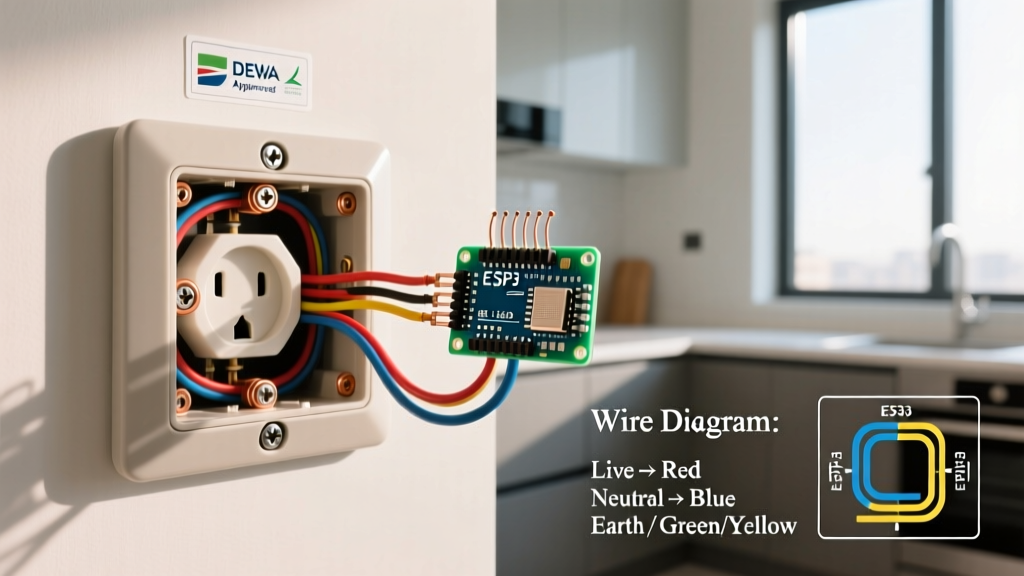
- Neutral Wire Availability: Many older UAE apartments (pre-2010) were wired with switch-loop configurations that do not pull a neutral wire to the switch/outlet backbox. Smart outlets require a permanent Live and Neutral to power their internal Wi-Fi/Zigbee radios. If no neutral is present, you must pull a new 1.5mm² blue neutral wire from the nearest junction box or ceiling rose.
- Load Balancing: A 65W USB-C outlet draws roughly 0.3A from the mains. While negligible on its own, daisy-chaining multiple high-draw smart outlets on a single 16A radial circuit requires careful load calculation to prevent nuisance tripping.
Scenario 3: High-Load Radial Circuits for Kitchen and AC Appliances
While standard 13A outlets handle general household electronics, UAE villas frequently feature heavy-duty appliances like built-in espresso machines, double ovens, or localized split-AC units. Plugging these into a standard 13A ring or radial circuit is a severe violation of safety codes.
Wiring a 20A Double Pole (DP) Switched Outlet
For appliances drawing between 3kW and 4.5kW (13A to 20A), electricians must install a dedicated radial circuit protected by a 20A or 32A MCB, terminating in a 20A Double Pole switched flex outlet or a specialized industrial socket.
- Cable Sizing: Use a minimum of 4.0mm² twin and earth cable for a 20A radial circuit, or 6.0mm² for a 32A circuit, accounting for the high ambient temperatures in UAE ceilings and walls which require derating factors.
- Double Pole Isolation: Unlike a standard single-pole switch that only breaks the Live conductor, a DP switch physically disconnects both the Live (Brown) and Neutral (Blue) wires. This is mandatory for high-load fixed appliances to ensure complete isolation during maintenance.
- Flex Outlet vs. Socket: Instead of a standard Type G socket, a flex outlet plate is used to hardwire the appliance's trailing cable directly into the wall, eliminating the risk of a 13A plug fuse blowing under sustained heavy loads.
Troubleshooting Common UAE Outlet Failures
The extreme climate of the UAE presents unique failure modes for electrical outlets that are rarely seen in temperate climates.
1. Nuisance Tripping of 30mA RCBOs
The Issue: The RCBO protecting the socket circuit trips randomly, especially during the humid summer months (June to September).
The Cause: Condensation buildup inside external IP66-rated weatherproof outlets, or high humidity penetrating poorly sealed interior backboxes in villas with aggressive AC cooling. This creates a micro-path to earth, triggering the 30mA sensitivity threshold.
The Fix: Inspect outdoor outlets for degraded silicone gaskets. Apply dielectric grease to the internal terminal screws and ensure the IP66 weather flap springs are intact. For interior walls, check for AC condensation pipe leaks running behind the drywall near the backbox.
2. Thermal Degradation and Melted Faceplates
The Issue: The plastic faceplate around the Live terminal shows brown scorch marks or feels hot to the touch.
The Cause: Loose terminal connections. In the UAE, high ambient temperatures combined with the heavy inrush currents of compressor-based appliances (like window ACs or large refrigerators) cause thermal expansion and contraction. Over time, poorly torqued screws loosen, increasing contact resistance and generating intense localized heat.
The Fix: Isolate power, remove the outlet, and cut back any heat-damaged copper wire. Re-strip the wire, ensure a tight mechanical connection, and torque the screws precisely. Replace the outlet if the internal brass contacts show pitting or carbon tracking.
Frequently Asked Questions
Can I install a US-standard 110V Type A/B outlet in my UAE home?
Directly wiring a 110V outlet to the UAE's 230V grid will instantly destroy connected appliances and cause a fire. If you require a dedicated 110V outlet for imported US equipment, you must install a hardwired, locally fused step-down transformer (230V to 110V) in the ceiling void or a dedicated utility cupboard, and run a separate, clearly labeled 110V circuit to a distinctively colored (usually yellow or red) faceplate to prevent accidental 230V plug insertion.
Are Ring Main circuits still used in the UAE?
Historically, British-designed compounds in the UAE utilized 32A Ring Main circuits with 2.5mm² cable. However, modern UAE electrical design heavily favors Radial circuits protected by 16A or 20A MCBs. Radial circuits are easier to fault-find, eliminate the risk of a broken ring conductor overloading a single cable leg, and align better with modern Institution of Engineering and Technology (IET) best practices for residential zoning.
Do I need a permit to change my own wall sockets in Dubai?
While changing a damaged socket faceplate for a like-for-like replacement is rarely policed, any alteration to the circuit topology, adding new outlets, or upgrading the consumer unit legally requires a DEWA-approved contractor. Unauthorized modifications can void your home insurance and result in failed annual safety inspections for rented properties.