
Why Upgrading Your Range Outlet is Critical in 2026
If you live in a home built before 1996, your kitchen likely features an outdated 3-prong NEMA 10-50 range receptacle. While the National Electrical Code (NEC) allowed these for decades, modern safety standards mandate a dedicated equipment grounding conductor. Upgrading your setup by wiring an electric range outlet to the current 4-prong NEMA 14-50 standard is no longer just a code recommendation; it is a critical safety measure to prevent severe shock hazards and electrical fires.
According to the Electrical Safety Foundation International (ESFI), improper grounding and loose connections in high-amperage kitchen appliances are leading causes of residential electrical fires. Furthermore, as of 2026, many homeowners are leveraging their upgraded 50A NEMA 14-50 outlets to double as Level 2 EV charging stations when the range is not in use, making this upgrade a high-ROI home improvement project.
NEMA 10-50 vs. NEMA 14-50: Understanding the Shift
Before you begin wiring an electric range outlet, you must understand the functional differences between the legacy and modern configurations. The primary difference lies in how the appliance handles neutral and ground currents.
| Feature | NEMA 10-50 (Legacy 3-Prong) | NEMA 14-50 (Modern 4-Prong) |
|---|---|---|
| Wire Count | 3 (Hot, Hot, Neutral/Ground) | 4 (Hot, Hot, Neutral, Ground) |
| Grounding Method | Neutral wire doubles as ground (Bonded) | Dedicated equipment grounding conductor |
| Shock Risk | High (if neutral breaks, chassis becomes energized) | Low (chassis remains at zero potential) |
| NEC Status | Prohibited for new installations since 1996 | Required for all new installations and upgrades |
Pre-Upgrade Assessment: Panel Capacity and Wire Gauge
Wiring an electric range outlet requires pulling significant current. A standard electric range demands a 50-amp, 240-volt circuit. Before purchasing materials, verify the following:
- Service Panel Capacity: Ensure your main panel has at least 100A to 200A total capacity and two adjacent open slots for a 50A double-pole breaker.
- Wire Gauge Verification: For a 50A circuit, the NEC mandates a minimum of 6 AWG Copper (THHN/THWN-2) or 4 AWG Aluminum (XHHW). If your existing 3-prong setup uses undersized 8 AWG wire, you must pull a completely new cable from the panel; you cannot simply swap the receptacle.
- Cable Type: For retrofitting through finished walls, 6/3 NM-B (Romex) with a ground wire is standard. For conduit runs, individual THHN wires are preferred.
Step-by-Step: Wiring an Electric Range Outlet (4-Prong)
Replacing a damaged NEMA 14-50R or upgrading from a 10-50R requires precision. Always turn off the main breaker before opening the panel or working on the branch circuit.
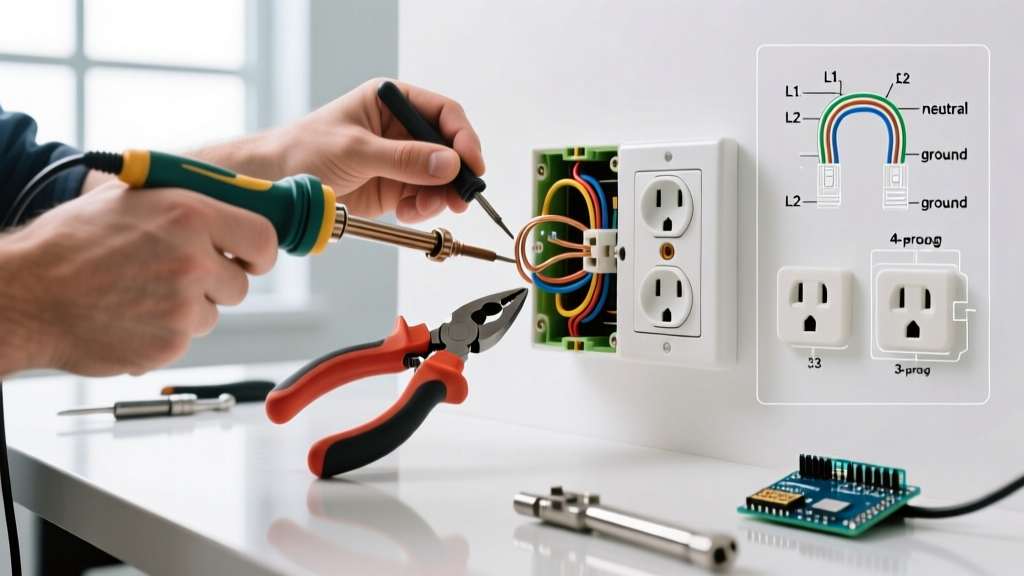
- Disconnect Power and Verify: Shut off the 50A double-pole breaker. Use a non-contact voltage tester and a multimeter to confirm zero voltage at the existing receptacle.
- Remove the Old Receptacle: Unscrew the faceplate and extract the old NEMA 10-50. Disconnect the wires, noting their positions. If upgrading, you will need to route a new 6/3 NM-B cable from the panel to this junction box.
- Prepare the Wire Ends: Strip exactly 3/4 inch of insulation from the black, red, white, and bare copper wires. Do not nick the copper conductor, as this creates a weak point that can snap under thermal expansion.
- Terminate the Ground (Green Terminal): Connect the bare copper ground wire to the green grounding screw on the new NEMA 14-50R receptacle (e.g., Hubbell 9450A or Leviton 279-S00). This is your most critical safety connection.
- Terminate the Neutral (Silver Terminal): Connect the white neutral wire to the silver-colored terminal. In a 4-prong setup, the neutral only carries the 120V return current for the oven light and clock; it does not carry the 240V heating load.
- Terminate the Hots (Brass Terminals): Connect the black and red wires to the two brass-colored hot terminals. Polarity between the two hots does not matter for a standard range.
- Torque and Secure: Tighten all terminal screws to the manufacturer's specified torque (detailed below). Push the wires neatly into the extra-deep junction box and mount the receptacle.
The Missing Link: Upgrading the Range Cord and Removing the Bonding Jumper
Critical Safety Warning: If you upgrade the wall outlet to a 4-prong NEMA 14-50, you must also install a 4-prong range cord on the stove and remove the internal bonding strap. Failing to do so will create a parallel neutral path, energizing the ground wire and creating a severe shock hazard.
Many DIYers successfully wire the new outlet but forget the appliance side. To complete the upgrade:
- Remove the access panel on the back of the electric range.
- Locate the bonding jumper (usually a copper strap or a green wire) connecting the center neutral terminal to the metal chassis.
- Remove and discard the bonding jumper. The neutral and ground must remain strictly isolated on the appliance side when using a 4-prong cord.
- Attach the new 4-prong range cord, matching the ground to the chassis screw, the neutral to the center terminal, and the hots to the outer terminals.
Torque Specifications: The #1 Cause of Receptacle Fires
The U.S. Consumer Product Safety Commission (CPSC) frequently cites loose electrical connections as a primary ignition source in high-draw appliances. When wiring an electric range outlet, 'hand-tight' is not acceptable. You must use a calibrated torque screwdriver.
Standard Torque Specs for NEMA 14-50R (50A)
- 6 AWG Copper Wire: 35 to 50 inch-pounds (in-lbs).
- 4 AWG Aluminum Wire: 45 to 55 inch-pounds (in-lbs).
Under-torquing leads to micro-arcing and thermal runaway. Over-torquing can strip the terminal threads or snap the wire strands. Always check the specific data sheet for your chosen receptacle brand, as Hubbell, Leviton, and Bryant have slight variances in their terminal block designs.
Cost Breakdown: DIY vs. Professional Electrician
Upgrading your range circuit involves material and labor costs that vary based on your home's layout. Below is a 2026 pricing estimate for a standard upgrade from a 3-prong to a 4-prong setup.
| Component / Service | DIY Material Cost | Pro Electrician (Installed) |
|---|---|---|
| 50A Double-Pole Breaker | $12 - $25 | Included in Labor/Material |
| NEMA 14-50R Receptacle (Commercial Grade) | $15 - $35 | Included in Labor/Material |
| 6/3 NM-B Cable (per foot) | $4.50 - $6.00 | $8.00 - $12.00 |
| 4-Prong Range Cord (6ft) | $25 - $40 | $45 - $65 |
| Labor (Panel to Kitchen Run) | $0 (Your Time) | $450 - $1,200+ |
| Total Estimated Cost | $150 - $300 | $600 - $1,500 |
Note: If your main service panel requires an upgrade to handle the additional 50A load, costs will increase significantly. Always consult the National Fire Protection Association (NFPA) guidelines or a licensed master electrician if your panel is near its maximum busbar rating.
Frequently Asked Questions
Can I just use an adapter plug to convert my 3-prong range to a 4-prong outlet?
No. Using a passive adapter plug (cheater plug) to bridge a 3-prong appliance to a 4-prong wall outlet defeats the dedicated grounding path and violates the NEC. You must physically change the cord on the range and remove the internal bonding strap.
Does the outlet need to be on a GFCI or AFCI breaker?
Under the latest NEC revisions, a 50A receptacle dedicated solely to an electric range in a kitchen does not typically require GFCI protection, as ranges are not considered small-appliance branch circuits. However, if you install a NEMA 14-50 in a garage or outdoors for dual-use EV charging, GFCI protection is strictly required. Always verify with your local Authority Having Jurisdiction (AHJ).
Why is my new 4-prong outlet getting hot to the touch?
A warm receptacle during a heavy self-cleaning oven cycle is normal, but a hot or melting receptacle indicates a failure. This is almost always caused by inadequate torque on the terminal screws, using a cheap residential-grade receptacle instead of an industrial/commercial grade (like the Hubbell 9450A), or undersized wiring. Immediately shut off the breaker and inspect the terminations.