
The 2026 Landscape of EV Home Charging
As electric vehicle (EV) adoption accelerates in 2026, installing a dedicated electric outlet for car charging has become one of the most common and critical residential wiring scenarios. Whether you are upgrading a garage for a Level 2 EVSE (Electric Vehicle Supply Equipment) or running power to an outdoor carport, the electrical demands are significant. Unlike standard household appliances that cycle on and off, EV chargers draw a continuous, high-amperage load for hours on end. This continuous duty pushes standard receptacles and undersized wiring to their thermal limits, making precision and code compliance non-negotiable.
According to the U.S. Department of Energy, Level 2 home charging remains the most practical and cost-effective method for daily EV replenishment, adding roughly 25 to 30 miles of range per hour of charging. To achieve this, a robust 240V circuit is required.
Understanding Receptacle Types for EV Charging
Before pulling any wire, you must select the correct termination point. While hardwiring is increasingly popular to bypass certain receptacle codes, a plug-in setup offers portability. Here is how the most common 240V configurations compare for EV applications:
| Configuration | Breaker Size | Max Continuous Load | Wire Gauge (Copper) | Best Use Case |
|---|---|---|---|---|
| NEMA 14-50R | 50 Amp | 40 Amps | 6 AWG THHN / 6 AWG NM-B | Standard garages; compatible with 95% of portable EVSEs and RVs. |
| NEMA 6-50R | 50 Amp | 40 Amps | 6 AWG THHN | EV-only setups (no neutral required); saves wire cost. |
| NEMA 10-30R | 30 Amp | 24 Amps | 10 AWG THHN | Dryer outlets; slower charging (approx. 17 miles/hr). |
| Hardwired | 60 Amp | 48 Amps | 4 AWG THHN | High-speed charging (11.5kW); avoids GFCI nuisance tripping. |
Step-by-Step Wiring Scenario: Installing a NEMA 14-50 Receptacle
Wiring an electric outlet for car charging requires strict adherence to the National Electrical Code (NEC), specifically Article 625, which governs EV charging systems. Below is the professional workflow for a standard 50A NEMA 14-50 installation.
1. Load Calculation and Panel Prep
Never install a 50A circuit without verifying your panel's spare capacity. Use a standard NEC Article 220 load calculation. If your home has a 200A main service and is heavily loaded with electric HVAC, ovens, and dryers, you may need a smart load management system (like the Emporia Smart Load Center or Span Panel) to prevent main breaker trips.
2. Running the Feeder Circuit
For a 50A continuous load, NEC Article 210.19(A)(1) requires conductors to be sized at 125% of the continuous load. Therefore, 40A x 1.25 = 50A. 6 AWG copper THHN/THWN-2 wire is the industry standard. While 6/3 NM-B (Romex) is permitted in some jurisdictions for short, exposed indoor runs, pulling individual THHN conductors through 3/4-inch EMT or PVC conduit is vastly superior for heat dissipation and future upgrades.
- Hot 1 (Black): X terminal
- Hot 2 (Red): Y terminal
- Neutral (White): W terminal (Center)
- Ground (Bare/Green): G terminal (U-shaped pin)
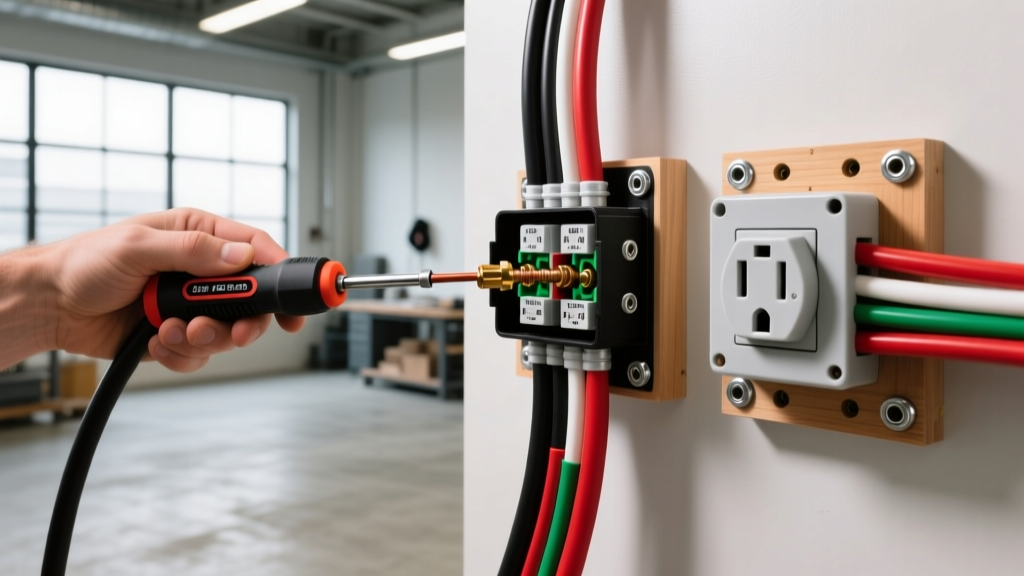
3. Terminating the Receptacle with Precision
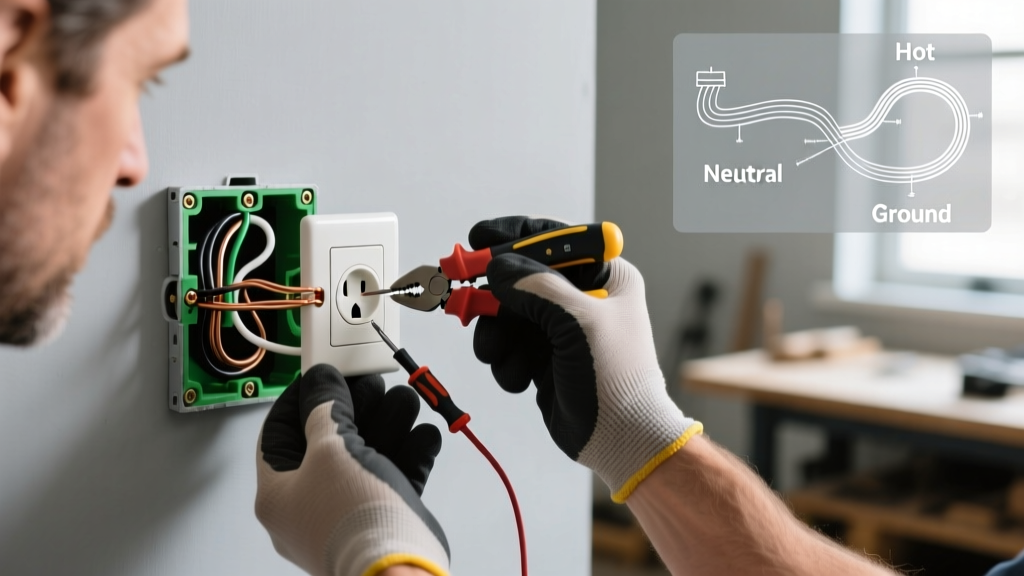
The physical termination is where most DIY failures occur. You must strip exactly 3/4-inch of insulation and ensure no bare copper is exposed outside the terminal block. Crucially, NEC 110.14(D) mandates the use of a calibrated torque tool. Most industrial 14-50R receptacles require 45 to 50 inch-pounds of torque. Guessing the tightness leads to loose connections, which generate immense heat under continuous 40A loads.
Expert Insight: Never buy a generic $15 NEMA 14-50 receptacle from big-box stores for EV charging. Their internal brass contacts are too thin for continuous 40A duty. Invest in the Hubbell 9450A or the Bryant 9450FR (typically $75–$95). These feature massive, heavy-duty contacts and thermoset bodies that resist melting and deformation over years of thermal cycling.
The GFCI Dilemma: Code vs. Reality
One of the most heavily debated topics in 2026 electrical forums is the GFCI requirement for EV receptacles. Recent NEC cycles mandate GFCI protection for 50A receptacles in garages and outdoors. This requires purchasing a 50A GFCI breaker, which costs between $120 and $160.
The problem? Most modern EVSE charging cables have built-in GFCI protection. Stacking a GFCI breaker on top of a GFCI EVSE often results in nuisance tripping, leaving the car uncharged in the morning. If you experience this, the National Fire Protection Association (NFPA) code allows for hardwiring the EVSE, which bypasses the receptacle GFCI requirement entirely while maintaining safety.
Common Wiring Mistakes and Failure Modes
When inspecting failed EV charging setups, electrical professionals consistently find the same catastrophic errors:
- Undersized Neutral on 14-50: Some outdated guides suggest using a smaller gauge wire for the neutral. This is a code violation. All current-carrying conductors must be the same gauge (6 AWG).
- Backstabbing or Push-in Connectors: Never use push-in terminals for high-amperage circuits. Always use the mechanical screw terminals with a torque screwdriver.
- Over-torquing Aluminum Wire: If you use 4 AWG aluminum SER cable to save money, you must apply anti-oxidant paste (like Noalox) and strictly follow the lower torque specifications printed on the receptacle. Over-torquing aluminum causes cold flow and eventual arcing.
- Missing Strain Relief: Heavy EV plugs pull downward on the receptacle. Install a strain relief bracket or secure the cable tightly within 12 inches of the box to prevent the wires from backing out of the terminals.
120V Outdoor Scenarios: Block Heaters and Trickle Charging
Not every vehicle requires a 240V Level 2 setup. For plugin hybrids (PHEVs), engine block heaters, or battery maintainers in extreme climates, a standard 120V outdoor carport outlet is sufficient. However, the outdoor environment demands specific hardware.
For these scenarios, wire a 20A circuit using 12 AWG UF-B or THHN in rigid conduit. Terminate the circuit at a Weather-Resistant (WR), Tamper-Resistant (TR) GFCI receptacle, such as the Leviton GFNT2-W. You must pair this with an extra-duty, in-use weather cover (like the Taymac MX1010) to ensure the outlet remains sealed even when the EV trickle charger cord is plugged in.
Frequently Asked Questions
Can I use a 30A dryer outlet for my EV?
Yes, but you will need a NEMA 10-30 or 14-30 adapter cord provided by your EVSE manufacturer. Charging will be limited to 24 amps (roughly 5.7kW), yielding about 17 miles of range per hour. Never use a cheap, third-party 'cheater' adapter that bypasses the ground pin.
Do I need a permit to wire an electric outlet for car charging?
Absolutely. Adding a 50A 240V circuit requires a permit and inspection in nearly all municipalities. An inspector will verify your panel load calculation, wire gauge, torque marks, and proper grounding. Unpermitted work can void your home insurance in the event of an electrical fire.
Is aluminum wire safe for a NEMA 14-50 EV outlet?
Yes, provided you use the correct gauge and terminations. Because EV loads are continuous, you must upsize to 4 AWG or 2 AWG aluminum (depending on the insulation temperature rating and terminal limits). Always use anti-oxidant compound and a torque wrench rated for the specific receptacle's aluminum specifications.