
Understanding the South Korea Electrical Outlet Standard
If you are upgrading an older property in Seoul, wiring a dedicated circuit for imported Korean appliances (like high-capacity Samsung or LG 220V Kimchi refrigerators), or standardizing a commercial space, understanding the modern South Korea electrical outlet standard is critical. Managed by the Korea Electric Power Corporation (KEPCO), the national grid delivers 220V at 60Hz. While South Korea historically utilized a chaotic mix of Type A (US-style flat blade) and Type C (ungrounded Europlug) receptacles, the nation has fully standardized on the Type F (Schuko / CEE 7/4) grounded outlet for all modern residential and commercial installations.
Installing a Type F receptacle requires strict adherence to Korean Industrial Standards (KS C IEC 60884) and proper metric wire sizing. Unlike North American 120V systems, a 220V circuit carries significantly higher arc-flash risks and demands precise torque specifications on terminal screws to prevent thermal runaway. In this 2026 guide, we will walk through the exact step-by-step installation process for a 16A/20A Type F South Korea electrical outlet.
Evolution of Korean Receptacle Standards
Before cutting into any drywall or opening a distribution board, it is vital to understand what you might find behind an old wall plate versus what is required by modern code.
| Standard | Type | Pins / Grounding | Rating | Status in South Korea |
|---|---|---|---|---|
| Type A | NEMA 1-15 | 2 Flat Pins / Ungrounded | 15A / 120V | Obsolete (Found in pre-1990s homes) |
| Type C | CEE 7/16 | 2 Round Pins / Ungrounded | 2.5A / 250V | Phased out (Unsafe for heavy appliances) |
| Type F | CEE 7/4 (Schuko) | 2 Round Pins (4.8mm) + Side Ground Clips | 16A / 250V | Current National Standard (KS C) |
For comprehensive global plug and socket data, the International Electrotechnical Commission (IEC) maintains the definitive registry of world plugs, confirming South Korea's alignment with the CEE 7/4 Schuko standard. Furthermore, World Standards notes that the transition to Type F was driven by the need for reliable grounding in modern Korean homes saturated with high-draw, metal-chassis appliances.
Tools and Materials Required
Do not attempt to wire a 220V circuit using Imperial (AWG) wire if you are sourcing materials locally in Korea; the market relies entirely on metric cross-sectional areas.
- Receptacle: Schneider Electric AvatarOn or Legrand Arteor Type F (16A/250V) with child-proof shutters.
- Wire: 2.5 mm² (approx. 13 AWG) solid copper THHN/H07V-K for 16A circuits; 4.0 mm² (approx. 11 AWG) for 20A/30A dedicated appliance circuits.
- Breaker: 16A or 20A Miniature Circuit Breaker (MCB) paired with a 30mA Earth Leakage Circuit Breaker (ELCB) or RCBO.
- Tools: Metric wire strippers (calibrated for 2.5 mm² and 4.0 mm²), calibrated torque screwdriver (0.5 - 2.0 Nm range), digital multimeter (CAT III 600V rated), and a phase-sequence tester.
Step-by-Step Installation Guide
Step 1: Circuit Preparation and Breaker Sizing
Shut off the main power at the distribution board. Verify the circuit is dead using your CAT III multimeter. For a standard South Korea electrical outlet serving general-purpose 220V appliances, a 16A MCB is standard. However, if you are wiring a dedicated circuit for a Korean commercial air conditioner or a large Kimchi refrigerator, you must use a 20A breaker with 4.0 mm² wire to prevent voltage drop and thermal throttling over long runs.
Safety Warning: South Korean electrical code mandates that all 220V receptacle circuits in wet areas (kitchens, bathrooms, balconies with washing machines) must be protected by a 30mA ELCB. Never wire a Type F outlet in these zones without ground-fault protection.
Step 2: Navigating Korean Wire Color Codes
This is where many DIYers and expats make dangerous mistakes. South Korea's wire color codes have transitioned over the last two decades to align with IEC standards, but older homes still harbor legacy wiring.
- Modern (Post-2010 IEC Alignment): Brown (Line/Phase), Blue (Neutral), Green/Yellow (Earth).
- Legacy (Older KS/JIS influence): Red (Line/Phase), Black (Neutral), Green (Earth).
Always test with a multimeter before assuming the red wire is live and the black is neutral. In some poorly wired older apartments, these may be reversed or used as dual-phase lines for 380V systems.
Step 3: Stripping and Terminating the Wires
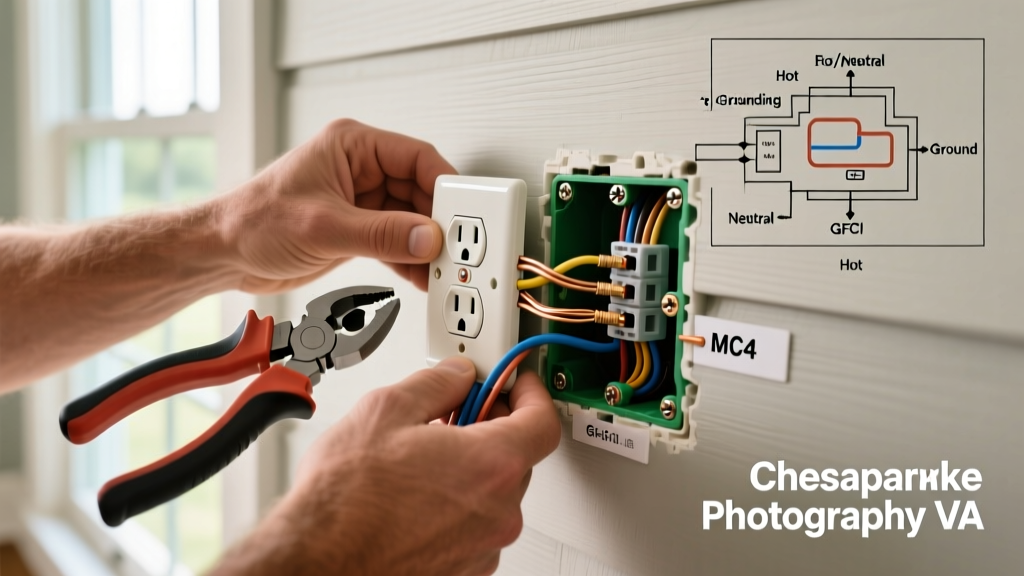
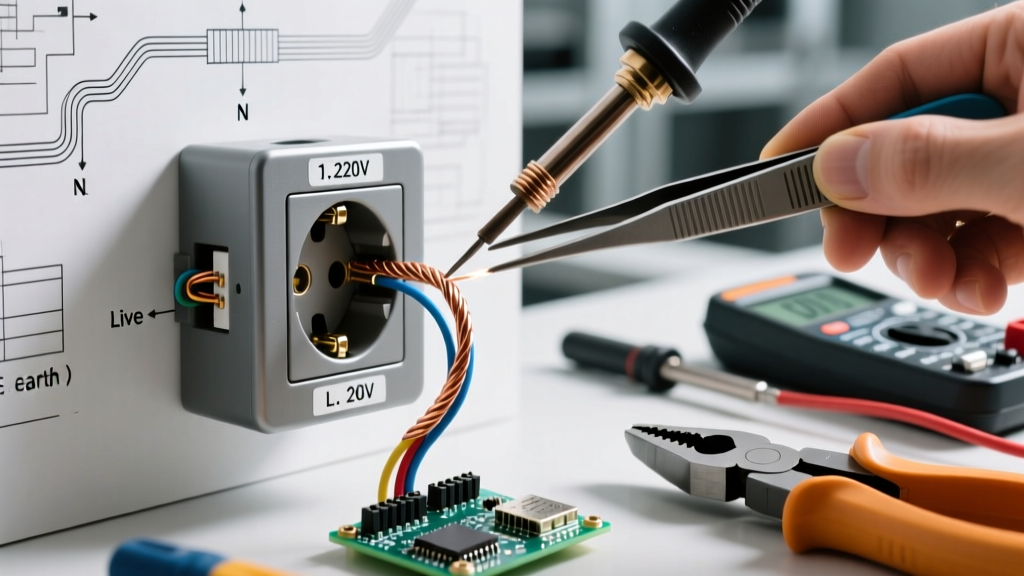
Strip exactly 12mm of insulation from the 2.5 mm² wires. Do not nick the copper conductor, as this creates a stress point that can snap under thermal expansion. Insert the wires into the Type F receptacle's terminal blocks:
- Line (L): Insert the Brown (or Red) wire into the terminal marked 'L'. While Type F plugs are technically unpolarized and can be inserted upside down, Korean electricians conventionally wire the Line to the right-hand side when facing the receptacle.
- Neutral (N): Insert the Blue (or Black) wire into the 'N' terminal on the left.
- Earth (Ground): Insert the Green/Yellow (or Green) wire into the central Earth terminal. This terminal bridges directly to the two metal side-clips of the Schuko receptacle, which provide the critical ground path for plugged-in appliances.
Step 4: Applying Correct Torque
Using your calibrated torque screwdriver, tighten the terminal screws to the manufacturer's specification—typically 0.8 Nm to 1.2 Nm for standard 16A receptacles. Under-tightening causes high-resistance connections, leading to arcing and melted faceplates. Over-tightening can crush the copper strands, reducing the effective wire gauge and causing a bottleneck for current flow.
Step 5: Mounting and Final Testing
Secure the receptacle to the standard European/Korean flush-mount backbox using the provided M3.5 machine screws. Ensure the side grounding clips are not obstructed by drywall or plaster. Restore power at the main breaker and perform the following tests:
- Voltage Check: Measure between Line and Neutral. You should read between 215V and 225V (KEPCO standard tolerance).
- Ground Continuity: Measure between Line and the side grounding clips. It should read the same ~220V. If it reads 0V or fluctuates wildly, your earth wire is disconnected or the building's ground bus is faulty.
- ELCB Test: Press the 'Test' button on your Earth Leakage breaker. It should trip instantly. If it does not, the grounding path is compromised.
2026 Smart Home Integration for Korean Outlets
As of 2026, energy monitoring is a major focus in South Korean smart homes due to tiered electricity pricing structures enforced by KEPCO. When installing a new South Korea electrical outlet in a living room or kitchen, consider utilizing a smart receptacle (such as the Legrand with Netatmo Type F) or installing a flush-mount smart relay (like the Schneider Wiser 16A module) behind the standard wall plate. These devices allow you to monitor the exact wattage of high-draw appliances via Matter or Zigbee protocols, helping users avoid crossing into KEPCO's expensive tier-3 and tier-4 billing brackets during peak summer cooling months.
Common Failure Modes and Troubleshooting
Even with a meticulous installation, specific environmental factors in Korea can cause issues:
- Corroded Side Ground Clips: In coastal cities like Busan or Incheon, high humidity and salt air can cause the external side-clips of the Type F outlet to oxidize. This increases ground impedance. Fix: Use receptacles with nickel-plated grounding clips rather than bare zinc.
- Loose Plug Retention: If a Korean appliance plug feels loose and falls out of the receptacle, the internal brass tension rings have fatigued. Type F relies on friction. Fix: Replace the receptacle immediately; do not attempt to bend the pins of the appliance plug.
- EMI Noise on Audio/Video Equipment: If high-end AV equipment plugged into the outlet exhibits a 60Hz hum, the Neutral and Ground may be bonded incorrectly at the sub-panel, creating a ground loop. Ensure the Neutral-Ground bond only exists at the main service entrance.
Final Thoughts
Wiring a South Korea electrical outlet requires respect for the 220V/60Hz environment and a strict adherence to metric wire sizing and IEC/KS color codes. By utilizing the correct 2.5 mm² or 4.0 mm² conductors, applying precise torque to the terminal blocks, and verifying the integrity of the Schuko side-grounding clips, you ensure a safe, code-compliant installation capable of handling the heavy loads of modern Korean appliances. For further reading on national grid specifications, you can review the official KEPCO English portal for up-to-date residential wiring guidelines and safety bulletins.