
Navigating the Vietnam Electrical Outlet Landscape
Wiring a Vietnam electrical outlet requires navigating a unique intersection of modern TCVN (Tiêu chuẩn Việt Nam) standards, legacy colonial-era infrastructure, and ubiquitous universal receptacles. Operating on a nominal 220V (often fluctuating between 210V and 235V) at 50Hz, Vietnam's residential grid presents specific challenges for electricians, expats, and DIYers. As of 2026, while new high-rise developments strictly adhere to IEC-harmonized safety codes, the vast majority of urban "tube houses" in Hanoi and Ho Chi Minh City still rely on a patchwork of ungrounded circuits and hybrid sockets.
This guide dissects the anatomy of Vietnamese receptacles, breaks down local wiring color codes, and provides actionable, step-by-step scenarios for safely upgrading and troubleshooting outlet circuits in masonry-based residential builds.
The Anatomy of a Vietnam Electrical Outlet
If you look at a standard wall plate in a Vietnamese home, you will rarely find a dedicated Type A, C, or G socket. Instead, the market is dominated by the universal hybrid receptacle. These outlets are designed to accept Type A (two flat parallel pins), Type C (two round pins), and sometimes Type G (three rectangular pins).
The Safety Deficit of Universal Sockets
While convenient for travelers, universal sockets are notorious for poor internal contact tension. According to the International Electrotechnical Commission (IEC), universal sockets often fail to meet the strict dimensional tolerances required for safe, high-draw connections. When a 2000W water heater or induction cooktop is plugged into a cheap universal socket, the loose internal brass wipers generate excessive resistance, leading to thermal runaway and melted faceplates.
Expert Insight: In 2026, premium brands like Schneider Electric (Zencelo series) and Panasonic (Wide Series) have introduced shuttered, high-tension universal modules that mitigate arc faults. However, for fixed high-draw appliances, local electricians are increasingly abandoning universal sockets in favor of dedicated 20A Type G (UK standard) or hardwired terminal blocks.
Vietnam Wiring Color Codes: TCVN vs. Legacy
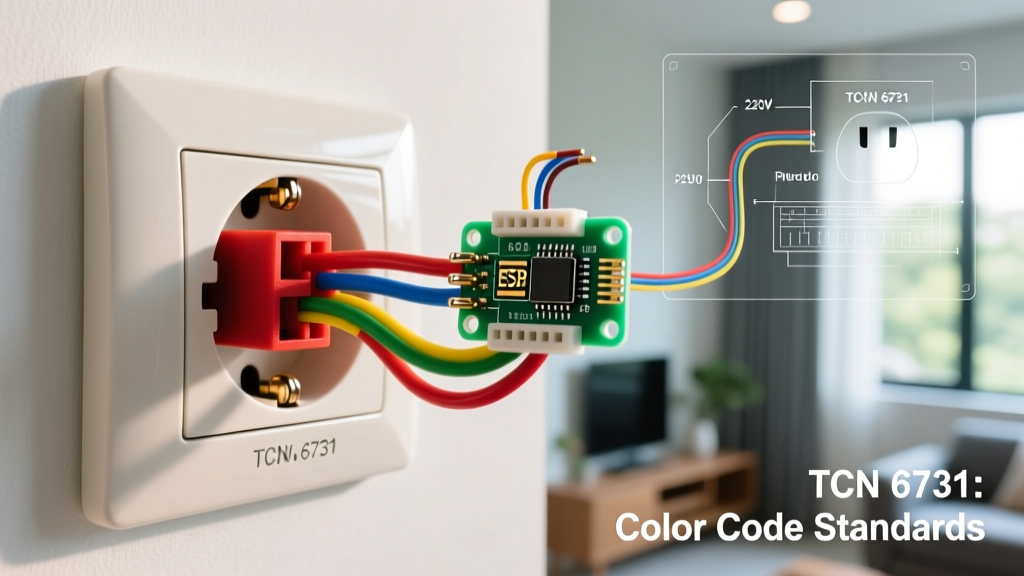
Before terminating any Vietnam electrical outlet, you must verify the wire colors. Vietnam officially adopted TCVN 7447 (harmonized with IEC 60446), but older homes frequently feature a chaotic mix of legacy colors. Always use a multimeter or non-contact voltage tester before assuming the neutral is safe to touch.
| Function | Modern TCVN Standard (IEC) | Legacy / Old French Standard | Common Local Substitutes |
|---|---|---|---|
| Phase (Live) | Brown or Black | Red | Yellow, Blue (if black unavailable) |
| Neutral | Light Blue | Black or White | White, Grey |
| Earth (Ground) | Green/Yellow Stripe | Bare Copper or Green | Often missing entirely |
Common Wiring Scenarios in Vietnamese Homes
Scenario 1: The Ungrounded "Tube House" Retrofit
The most frequent edge case encountered when wiring a Vietnam electrical outlet is the absence of an earth ground. In dense urban districts, homes are built on deep, narrow concrete foundations with no accessible damp earth for a traditional ground rod. Consequently, many local contractors simply leave the ground terminal on the receptacle floating, or worse, wire a "bootleg ground" connecting the earth terminal to the neutral wire—a lethal hazard if the neutral fails upstream.
The 2026 Solution: ELCB Integration and Localized Grounding
- Install an ELCB (Earth Leakage Circuit Breaker): Since a reliable earth path cannot be guaranteed, you must protect the receptacle circuit with a 30mA residual current device (RCD/ELCB) at the distribution board. This ensures the circuit trips on a ground fault even without a physical earth wire.
- Drive a Localized Earth Rod: If exterior space permits, drive a 16mm x 2.4m copper-clad steel rod into the earth. Connect it to the main distribution board's earth bar using 25mm² bare copper tape, then run a 2.5mm² green/yellow earth wire to your target receptacles.
- Isolate the Neutral: Never bond neutral and ground at the receptacle level. Ensure the earth bar and neutral bar are strictly separated in the sub-panels.
Scenario 2: Upgrading to a Dedicated 20A Kitchen Circuit
Vietnamese kitchens rely heavily on 2000W–3000W induction cooktops and rice cookers. Plugging these into a standard 16A universal socket wired with 1.5mm² wire is a primary cause of residential electrical fires.
- Wire Gauge: Pull a dedicated circuit using 4.0mm² Cu (Copper) wire. Leading local brands like Cadivi or Tran Phu provide THHN/THWN-2 rated cables suitable for wet masonry conduits.
- Protection: Protect the circuit with a 20A Type C MCB (Miniature Circuit Breaker) to handle the high inrush current of induction coils.
- Termination: Bypass the universal socket entirely. Install a dedicated 20A Type G receptacle (which features built-in shutters and higher contact pressure) or hardwire the appliance via a 30A rotary isolator switch.
Step-by-Step: Wiring an Outlet in a Masonry Wall
Unlike North American drywall construction, Vietnamese residential walls are typically solid fired brick or poured concrete, requiring rigid PVC conduit embedded in the masonry.
- Chasing the Wall: Use a rotary hammer with a chisel bit or a dedicated wall chaser to cut a channel (approx. 3cm deep) from the ceiling junction box down to the receptacle height (standard height in Vietnam is 1.2m to 1.4m from the finished floor, or 30cm for floor-level utility outlets).
- Conduit Installation: Embed 20mm rigid PVC conduit (brands like Bình Minh or Tiền Phong are industry standards). Secure with masonry nails and cement mortar. Ensure sweeping bends are used; sharp 90-degree elbows will trap wire and prevent future pulling.
- Wire Pulling: Use a nylon fish tape to pull three 2.5mm² stranded copper wires (Brown, Blue, Green/Yellow). Apply wire pulling lubricant to reduce friction and prevent insulation tearing.
- Backbox Mounting: Embed a standard 86mm x 86mm PVC or galvanized steel backbox into the wall using quick-setting gypsum plaster. Ensure the box is perfectly level.
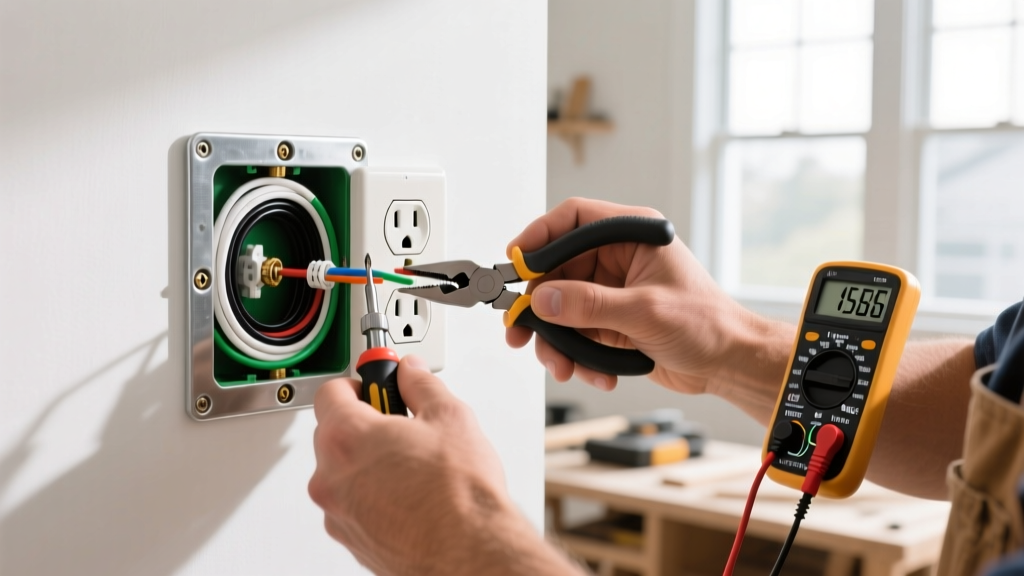
- Termination: Strip 12mm of insulation. Terminate the wires into the receptacle's screw terminals. Crucial: Wrap the terminal screws with high-quality vinyl electrical tape (e.g., 3M Super 33+) to prevent accidental short circuits against the metal backbox or masonry dust.
Troubleshooting Matrix: Common Vietnam Outlet Faults
When diagnosing a failing Vietnam electrical outlet, reference this matrix to identify the root cause based on measurable symptoms.
| Symptom | Likely Cause | Diagnostic & Fix |
|---|---|---|
| Voltage drops to 180V under load | Undersized wire or loose neutral at the DB (Distribution Board) | Check wire gauge (must be ≥2.5mm²). Tighten all neutral busbar screws. Upgrade to 4.0mm² if run exceeds 25 meters. |
| Receptacle faceplate is warm/melted | Internal brass wiper fatigue in universal socket | Replace with a high-tension modular socket (e.g., Panasonic Wide). Do not exceed 10A continuous load on universal sockets. |
| ELCB trips immediately upon plugging in | Bootleg ground (Neutral bonded to Earth at receptacle) | Remove receptacle cover. Sever the illegal neutral-to-ground jumper. Rely on upstream ELCB for fault protection. |
| Appliance hums or fails to start | Reversed polarity or shared neutral overload | Verify Phase/Neutral orientation with a tester. Ensure dedicated circuits for motorized appliances (AC units, pumps). |
Safety, Compliance, and the 2026 Grid Reality
As Vietnam's middle class expands, the demand for high-draw appliances (EV chargers, multi-zone induction ranges, and central HVAC) is straining older residential grids. The US International Trade Administration notes that while Vietnam's national grid is modernizing rapidly, the "last mile" wiring inside private residences remains largely unregulated and reliant on the skill of independent contractors.
For DIYers and expats managing property renovations, the golden rule of the Vietnam electrical outlet is defense in depth. Never trust the wall wiring. Always install localized 30mA RCDs, verify wire gauges with digital calipers, and abandon universal sockets for any appliance drawing more than 1500W. By adhering to TCVN standards and prioritizing high-tension terminations, you can ensure your electrical infrastructure is safe, resilient, and capable of handling modern loads.