
Decoding the United States Electrical Outlet: The NEMA Standard
When navigating the landscape of North American electrical wiring, understanding the united states electrical outlet configurations is non-negotiable for safety and code compliance. Unlike regions using the IEC 60906-1 standard, the US relies on the National Electrical Manufacturers Association (NEMA) naming convention. This system dictates voltage, amperage, phase, and grounding status, ensuring that a high-draw appliance cannot be accidentally plugged into an under-rated circuit.
According to the ANSI/NEMA WD 6 standard, every receptacle configuration is engineered with unique blade angles and prong spacings. In this comprehensive wiring diagram reference, we will break down the most common US receptacles, provide exact termination torque specifications, and outline the latest National Electrical Code (NEC) requirements for 2026.
CRITICAL SAFETY WARNING: Always verify the circuit is de-energized using a CAT III or CAT IV non-contact voltage tester (NCVT) and a digital multimeter before touching any bare copper or terminal screws. Assume all wires are live until proven otherwise.
The NEMA Naming Convention Explained
Before wiring any receptacle, you must decode its NEMA designation. A standard US outlet is typically labeled as 5-15R or 5-20R. Here is how to read the nomenclature:
- Prefix (e.g., 5, 6, 14): Indicates the voltage class, number of poles, and number of wires. For example, '5' means 125V, 3-wire (Hot, Neutral, Ground). '14' means 125/250V, 4-wire (Two Hots, Neutral, Ground).
- Number (e.g., 15, 20, 50-15A (14 AWG minimum wire)
$1.50 - $2.50 Leviton T5262 NEMA 5-20R 125V / 20A (12 AWG minimum wire) $4.00 - $6.50 Hubbell 5262 NEMA 6-15R 250V / 15A (14 AWG minimum wire) $3.50 - $5.00 Leviton 5031 NEMA 14-50R 125/250V / 50A (6 AWG copper wire) $12.00 - $18.00 Hubbell 9450A Step-by-Step Wiring: Standard 120V Receptacles (5-15R and 5-20R)
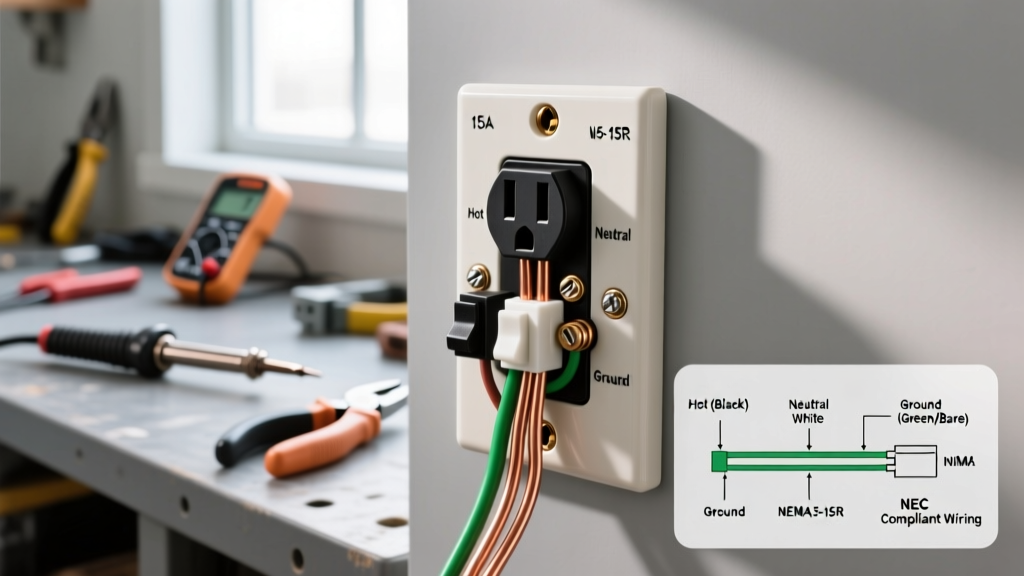
The vast majority of residential wiring involves 120V circuits. While the physical installation of a 15A and 20A receptacle is nearly identical, the internal contacts and neutral slot differ. The 5-20R features a T-shaped neutral slot to accommodate both 15A and 20A plugs.
1. Wire Preparation and Stripping
Use a precision wire stripper to remove exactly 1/2 inch to 5/8 inch of insulation from 14 AWG or 12 AWG solid copper wire. Stripping too much leaves exposed copper outside the terminal, creating a shock hazard. Stripping too little causes the screw to bite into the insulation, leading to high-resistance connections and potential arc faults.
2. Termination Method: Side-Wire vs. Back-Wire
Never use the push-in backstab connectors found on cheap builder-grade outlets. These spring-loaded clips degrade over time, causing voltage drops and fires. Instead, use one of two approved methods:
- Side-Wiring (Hook Method): Form a J-hook in the wire and loop it clockwise around the terminal screw. This ensures the screw tightens the loop rather than pushing it out.
- Screw-Clamp Back-Wiring: Found on commercial-grade receptacles (like the Hubbell 5262), this method allows you to insert a straight-stripped wire into a rear clamp and tighten the screw, which applies massive, even pressure to the wire.
3. Torque Specifications
The NEC now mandates that terminations be torqued to the manufacturer specifications. For most 15A and 20A receptacles, the brass (hot) and silver (neutral) screws require 14 in-lbs of torque, while the green ground screw requires 12 in-lbs. Using a calibrated torque screwdriver prevents stripped threads and ensures optimal electrical contact.
240V Outlets: NEMA 6-15R and 14-50R Diagrams
High-draw appliances like window air conditioners, welders, and Electric Vehicle (EV) chargers require 240V circuits. These circuits utilize two hot legs from the main panel, providing double the voltage potential.
Wiring the NEMA 14-50R (EV Chargers and Ranges)
The NEMA 14-50R is the gold standard for Level 2 EV charging and electric ranges. It requires a 50A double-pole breaker and 6 AWG copper wire (or 4 AWG aluminum). The 4-wire configuration includes:
- X (Hot 1): Black wire connected to the left brass terminal.
- Y (Hot 2): Red wire connected to the right brass terminal.
- W (Neutral): White wire connected to the top silver terminal.
- G (Ground): Bare or green wire connected to the bottom green terminal.
Expert Insight: When installing a 14-50R for an EV charger, many modern EVSE (Electric Vehicle Supply Equipment) units do not utilize the neutral wire. However, the NEC still requires the neutral to be pulled and terminated at the receptacle to maintain code compliance and future-proof the circuit for appliances that do require 120V/240V split-phase power.
NEC Compliance: AFCI, GFCI, and TR Requirements
The National Fire Protection Association (NFPA 70) continuously updates the National Electrical Code to mitigate electrical fires and shocks. As of the latest code cycles enforced through 2026, DIYers and electricians must adhere to the following:
- Tamper-Resistant (TR) Receptacles: All 15A and 20A, 125V and 250V receptacles in residential dwellings must be TR-rated. These feature internal plastic shutters that only open when equal pressure is applied to both slots simultaneously, preventing children from inserting foreign objects.
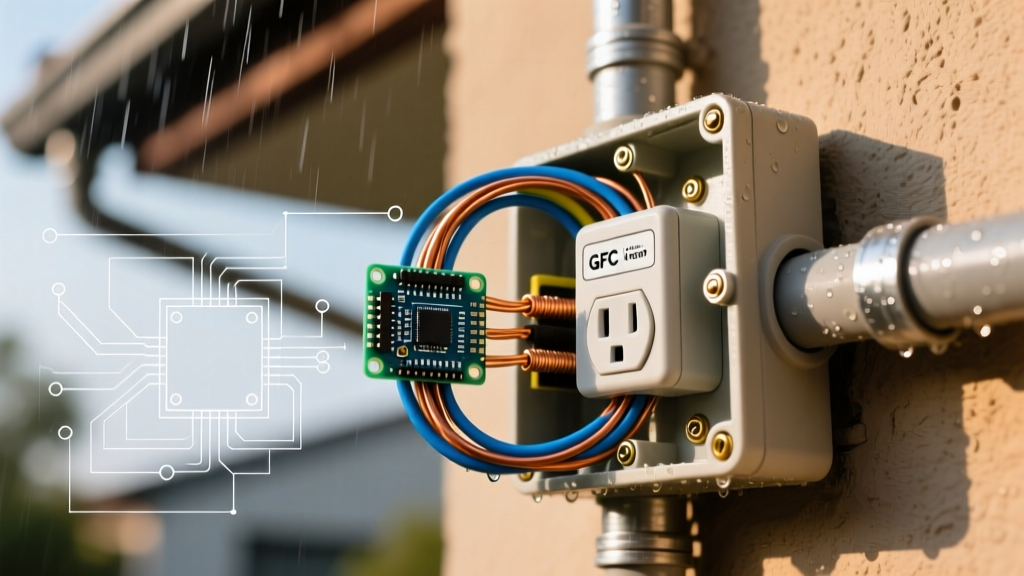
- GFCI Protection: Ground Fault Circuit Interrupter protection is now required for all 125V/250V, 15A/20A receptacles in kitchens, bathrooms, garages, outdoors, crawl spaces, unfinished basements, and within 6 feet of sinks or wet bars.
- AFCI Protection: Arc Fault Circuit Interrupter breakers or receptacles are mandatory in living rooms, bedrooms, hallways, and closets to detect dangerous parallel and series arcing conditions.
Troubleshooting Common Wiring Faults
Even with perfect diagrams, field conditions can introduce errors. Here is how to diagnose common US outlet failures:
Hot-Neutral Reversal
If a receptacle tester shows a red and yellow light, the hot and neutral wires are swapped. This is incredibly dangerous because the appliance switch will disconnect the neutral, leaving the internal components energized at 120V even when turned off. Fix: Swap the black wire to the brass screw and the white wire to the silver screw.
Open Ground
Indicated by a yellow light on a standard tester. This means the equipment grounding conductor is disconnected. In older homes with Knob & Tube or ungrounded Romex, you cannot simply bootleg a ground to the neutral. Fix: Replace the standard receptacle with a GFCI receptacle and label it 'No Equipment Ground' as permitted by the NEC, or pull a new grounding wire back to the panel.
Voltage Drop Under Load
If a vacuum cleaner causes the lights on the same circuit to dim, you likely have a high-resistance connection. This is almost always caused by backstabbed wires or undertorqued terminal screws. Fix: Remove the receptacle, cut back the damaged wire, strip it fresh, and terminate using the screw-clamp method.
Frequently Asked Questions
Can I install a 20A outlet on a 15A circuit?
No. The NEC strictly prohibits installing a 20A receptacle (NEMA 5-20R) on a 15A circuit breaker. The breaker must be sized to protect the weakest link in the circuit. However, you can install multiple 15A receptacles on a 20A circuit, provided the 15A receptacles are rated for 20A feed-through, which most commercial-grade models are.
Why are the prongs on my new outlet tighter than my old ones?
Modern TR (Tamper-Resistant) receptacles feature internal shutters that require simultaneous, equal pressure on both blades to open. Furthermore, commercial-grade receptacles use thicker internal brass contacts that grip plugs tighter to reduce arcing. If you struggle to insert a plug, ensure the prongs are not bent and push firmly and evenly.
Do I need a permit to replace a US electrical outlet?
According to OSHA and local building authorities, like-for-like replacement of a standard receptacle does not typically require a permit. However, adding a new circuit, upgrading from a 15A to a 20A circuit, or installing a high-amperage outlet like a 14-50R for an EV charger will require a permit and subsequent inspection by your local Authority Having Jurisdiction (AHJ).