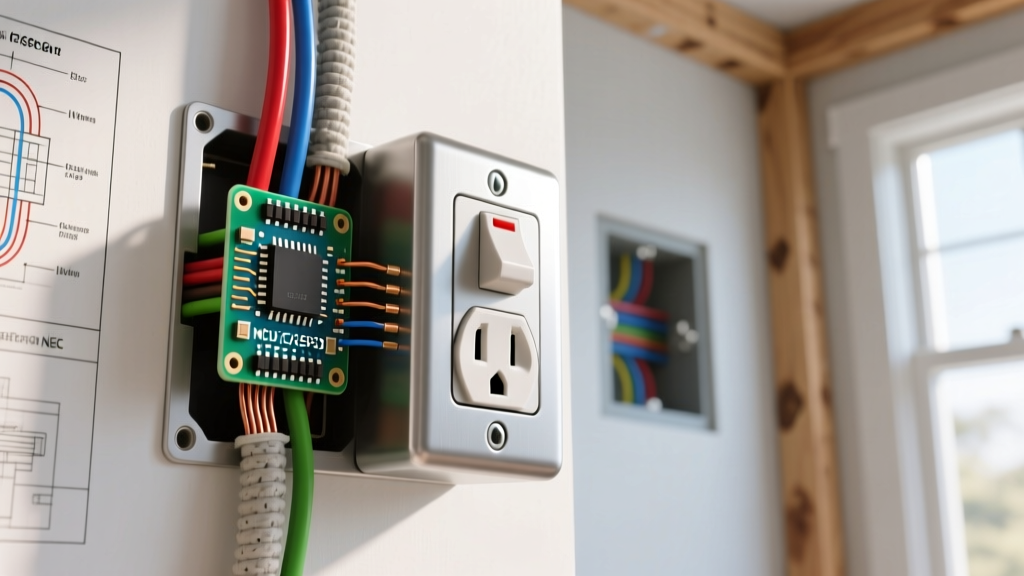

The Foundation: NEMA Standards and US Electric Outlet Types
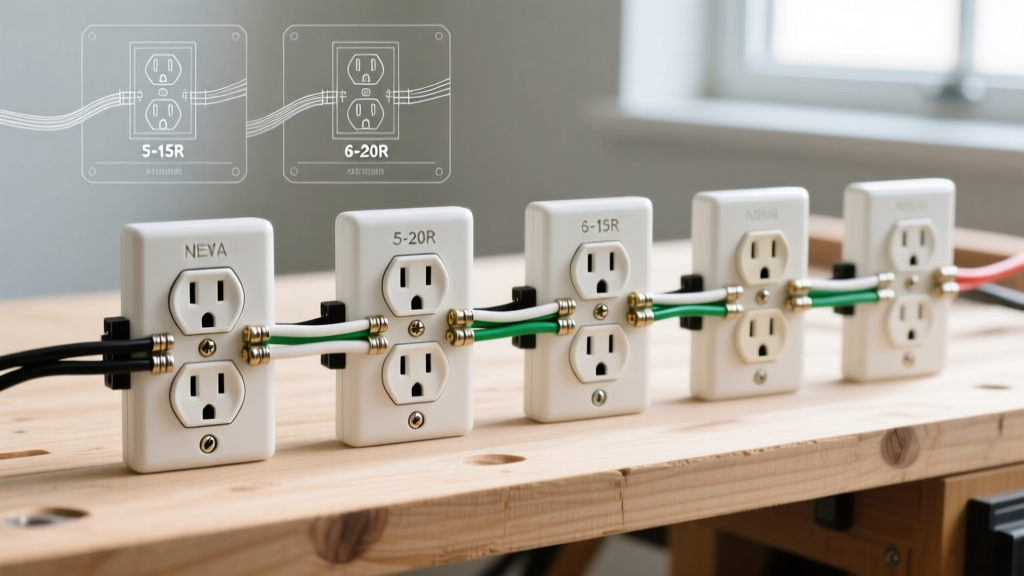
When navigating US electric outlet types, electricians and DIYers must adhere to the National Electrical Manufacturers Association (NEMA) standards. The NEMA WD 6 standard dictates the physical dimensions, voltage, and amperage ratings of non-locking and locking wiring devices. Misidentifying these configurations in common wiring scenarios leads to overloaded circuits, breaker nuisance tripping, or catastrophic arc faults.
Common NEMA Configurations Reference Matrix
| NEMA Config | Voltage | Amperage | Poles/Wires | Primary Wiring Scenario |
|---|---|---|---|---|
| 1-15R | 125V | 15A | 2P / 2W | Obsolete ungrounded (replacement only) |
| 5-15R | 125V | 15A | 2P / 3W | Standard residential living spaces |
| 5-20R | 125V | 20A | 2P / 3W | Kitchen/Bath small-appliance circuits |
| 6-15R | 250V | 15A | 2P / 3W | Heavy window AC units, baseboard heaters |
| 14-50R | 125/250V | 50A | 3P / 4W | EV Level 2 charging, electric ranges |
Scenario 1: Upgrading to 20A Kitchen Receptacles (NEMA 5-20R)
Under NEC Article 210.11(C)(1), kitchens require at least two 20-ampere small-appliance branch circuits. The standard outlet for this scenario is the NEMA 5-20R, identifiable by its T-shaped neutral slot. While a 15A plug will fit into a 20A receptacle, a 20A plug cannot fit into a 15A receptacle, preventing overloads.
Wiring Execution and Torque Specifications
For a commercial-grade upgrade, we recommend the Leviton 5262-SW (approx. $3.50). Unlike residential spec-grade outlets that rely on push-in back-wire clamps, commercial grades use internal pressure plates for side-wiring.
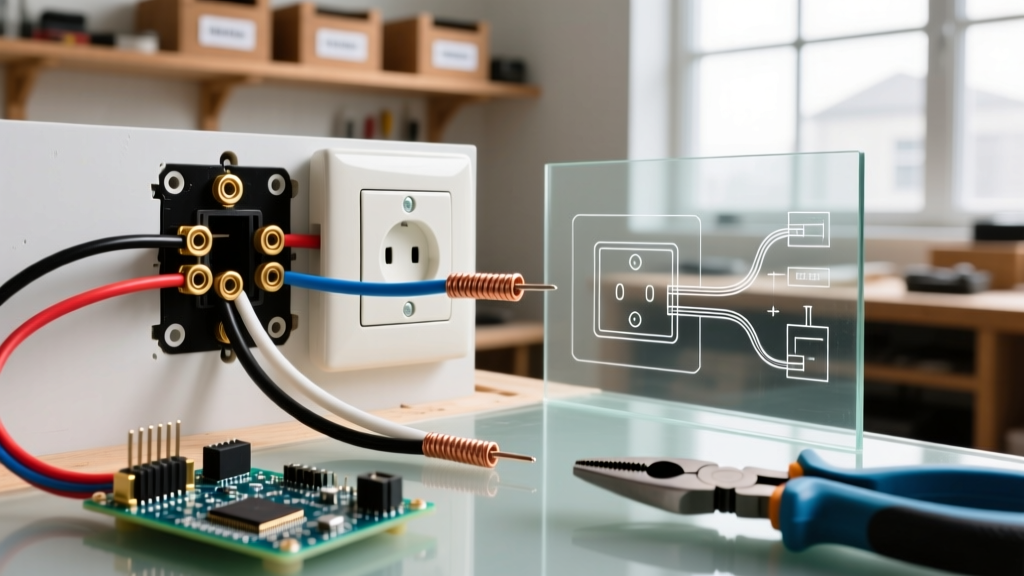
- Wire Prep: Strip 12 AWG solid copper wire to exactly 5/8 inch using the gauge on your wire strippers. Exposed copper beyond the terminal plate invites short circuits.
- Termination: Loop the wire clockwise around the terminal screw. This ensures the screw pulls the wire tighter as it is torqued.
- Torque: Use a calibrated torque screwdriver (e.g., Klein Tools 32500) set to 14 in-lbs. UL 498 testing proves that under-torqued terminals loosen under thermal cycling, leading to high-resistance connections and melting.
Scenario 2: Installing a 240V NEMA 14-50R for EV Charging
With the surge in EV adoption, wiring a NEMA 14-50R for Level 2 charging is one of the most requested residential scenarios. A common and dangerous failure mode is reusing an old 3-wire NEMA 10-50R (which lacks a dedicated equipment grounding conductor). The NEC strictly prohibits using the neutral as a ground for new installations (NEC 250.140).
The 4-Wire 14-50R Wiring Protocol
- Breaker & Wire Sizing: Install a 50A double-pole breaker. Run 6 AWG copper THHN in 3/4-inch EMT conduit, or 4 AWG aluminum SER cable. The 2026 NEC Table 310.16 ampacity charts mandate these sizes for 50A continuous loads when applying the 125% continuous load multiplier (effectively sizing for 62.5A, though 50A breakers are standard for 40A continuous EVSE draws).
- Receptacle Selection: Avoid $15 residential 14-50R outlets. EV charging draws continuous maximum current for hours, melting cheap internal contacts. Use an industrial-grade receptacle like the Hubbell HBL9450A (approx. $45.00), designed for high-heat continuous loads.
- Termination Order: Connect the bare copper ground to the green screw first. Connect the white neutral to the silver screw (center blade). Connect the black and red hots to the brass screws (outer blades). Polarity on the hots does not matter for 240V resistive/EV loads, but maintaining black-to-brass and white-to-silver is best practice.
Expert Warning: Never install a 14-50R receptacle on a 60A breaker. If the EVSE fails and pulls 55A, the 50A receptacle will melt before the 60A breaker trips. The breaker must match the receptacle rating (NEC 210.21).
Scenario 3: GFCI Protection in Wet Locations
Bathrooms, garages, and outdoor patios require Ground Fault Circuit Interrupter (GFCI) protection per NEC 210.8. In outdoor scenarios, standard GFCIs fail prematurely due to UV degradation and moisture ingress.
Weather-Resistant (WR) Mandates
For outdoor wiring scenarios, you must use a Tamper-Resistant, Weather-Resistant (TR/WR) GFCI, such as the Leviton GFWT2 (approx. $28.00). These feature UV-stabilized thermoplastic faces and stainless-steel internal components that resist corrosion.
- Feed-Through Wiring: To protect downstream outlets, connect the incoming power to the LINE terminals and the downstream cables to the LOAD terminals. Wrap electrical tape around the exposed LOAD terminals to prevent ground faults inside a crowded weatherproof box.
- Box Selection: Pair the WR GFCI with an extra-duty while-in-use weatherproof cover (e.g., TayMac MX850S). Standard bubble covers violate NEC 406.9(B)(1) if they do not allow the cover to close while a cord is plugged in.
Scenario 4: Multi-Wire Branch Circuits (MWBC) and Split Receptacles
In living rooms and bedrooms, electricians often use Multi-Wire Branch Circuits to maximize efficiency. An MWBC shares a single neutral wire between two hot legs (Phase A and Phase B) on a 240V double-pole breaker. This allows a single 14/3 or 12/3 NM-B cable to feed multiple 15A or 20A NEMA 5-15R or 5-20R outlets while cancelling out neutral current.
The Split-Tab Technique
A common wiring scenario involves splitting a duplex receptacle so the top half is switched (for a lamp) and the bottom half is always hot.
- Break the Hot Tab: Using needle-nose pliers, snap off the small brass connecting tab on the hot (black screw) side of the receptacle. Never break the silver neutral tab on an MWBC; doing so will immediately cause 240V to dead-short across the shared neutral, resulting in an explosive arc and destroyed electronics.
- Pigtailing: NEC 300.13(B) requires that the continuity of the neutral conductor in an MWBC must not depend on a receptacle device. You must use a wire nut and a 6-inch pigtail to connect the neutral to the receptacle, ensuring that removing the outlet does not sever the neutral return path for the other hot leg.
Frequently Asked Questions: US Outlet Wiring
Can I install a 20A outlet on a 15A breaker?
Yes. NEC 210.21(B)(3) permits a 20A NEMA 5-20R receptacle on a 15A circuit, provided it is not a single-receptacle installation. However, you will only ever draw a maximum of 15A before the breaker trips, making the upgrade purely cosmetic unless you plan to upgrade the breaker and wire later.
Why are push-in back-wired outlets discouraged?
Push-in (stab-in) connections on 15A spec-grade outlets rely on a small brass spring clip to grip 14 AWG wire. Over years of thermal expansion and contraction, these clips lose tension, leading to high-resistance arcing. For reliable scenarios, always use side-wiring with terminal screws or commercial-grade screw-clamp back-wiring.
Summary of Best Practices for US Outlet Wiring
Mastering US electric outlet types requires more than just matching plug shapes. It demands strict adherence to wire gauge, torque specifications, and continuous load calculations. Always verify your local jurisdiction's adoption of the latest NEC cycle before beginning any wiring scenario.
For further reading on electrical safety standards and wiring device classifications, consult the National Fire Protection Association (NFPA) and the National Electrical Manufacturers Association (NEMA). For specific guidance on EV charging infrastructure, refer to the U.S. Department of Energy.