
The Hidden Code Violations in Your Outlet Box
When wiring a standard 15-amp or 20-amp receptacle, most DIYers and even some apprentice electricians focus entirely on wire stripping lengths, line/load orientation, and proper grounding. However, one of the most frequently cited electrical inspection failures involves a component often treated as an afterthought: the screws. Understanding the exact size of electrical outlet screws is not merely a matter of mechanical convenience; it is a strict requirement under the National Electrical Code (NEC). Using the wrong thread pitch, diameter, or length can lead to catastrophic failures, including arcing, thermal expansion loosening, and electrical fires.
This guide breaks down the NEC mandates for both mounting screws (which secure the device to the box) and terminal screws (which secure the wires to the device), providing the exact specifications you need to pass inspection and ensure long-term safety in 2026.
NEC 110.3(B) Installation and Use: Listed or labeled equipment shall be installed and used in accordance with any instructions included in the listing or labeling. This means you cannot substitute standard wood screws or drywall screws for factory-specified electrical hardware.Standard Mounting Screw Sizes: The 6-32 UNC Standard
The screws used to mount the outlet yoke (the metal strap) to the electrical box are universally standardized in North America. For standard single-gang and multi-gang device boxes, the required size is a #6-32 UNC (Unified National Coarse) machine screw.
Why 6-32 UNC?
The 6-32 thread pitch provides the optimal balance of shear strength and threading ease for the thin-gauge steel, aluminum, or PVC used in modern electrical boxes. The tapped holes in standard metallic boxes (like those from Raco or Steel City) are precisely machined for this thread. Forcing a metric screw (like an M3.5) or a fine-thread screw (like a 6-40) will strip the box's internal threads, ruining the enclosure and creating a code violation.
Length Requirements and the 'Bottoming Out' Hazard
While the diameter and thread pitch are fixed at 6-32, the length of the mounting screw varies based on the box depth and the physical profile of the outlet. Standard lengths range from 1/2 inch to 1 inch. However, the NEC and UL listing requirements dictate two critical failure modes you must avoid:
- Bottoming Out: If a screw is too long for a shallow box (e.g., using a 1-inch screw in a 1.5-inch deep pancake box), the screw will hit the back of the box before the outlet yoke is pulled tight against the plaster ears. This leaves the receptacle loose, which can cause the internal contacts to shift when a plug is inserted, leading to arcing.
- Piercing and Conductor Damage: In shallow boxes, an over-long screw can physically pierce the insulation of the Romex (NM-B) cable resting against the back of the box, creating a direct ground fault or short circuit.
Expert Rule of Thumb: The screw must fully engage the box threads (at least 3 to 4 full rotations) without bottoming out. If you are installing a GFCI or AFCI receptacle in a standard-depth box, you will typically need to upgrade from the standard 1/2-inch screws to 3/4-inch or 1-inch 6-32 screws to accommodate the deeper electronic housing.
Terminal Screw Specifications: Where the Wires Connect
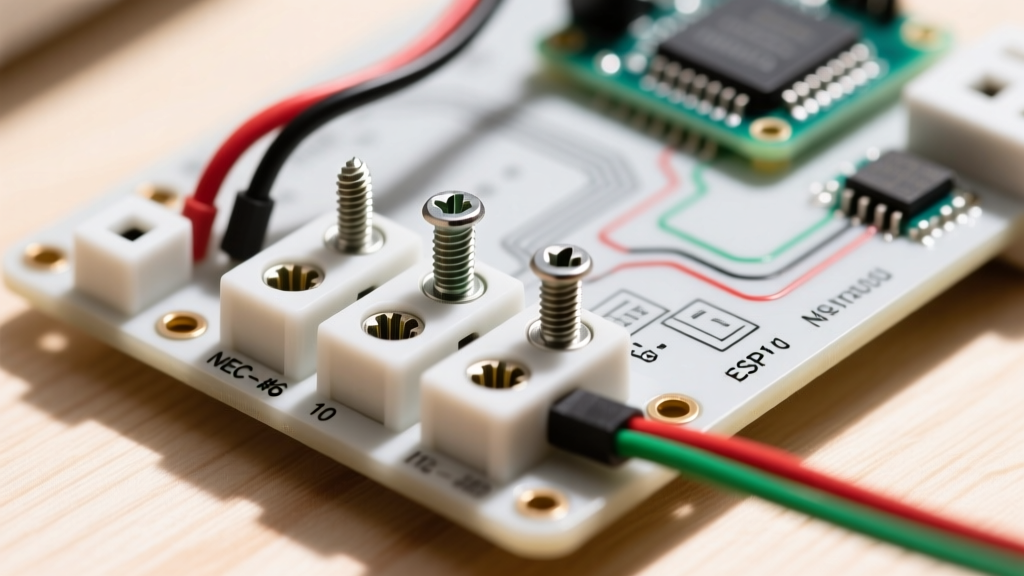
The terminal screws are where the electrical current actually transfers from the branch circuit wire to the receptacle. The size of these screws is strictly governed by the wire gauge they are rated to accept and the physical constraints of the UL listing.
Sizing by Amperage and Wire Gauge
| Receptacle Type | Standard Terminal Screw Size | Accepted Wire Gauges | Screw Head Type |
|---|---|---|---|
| 15A Standard (e.g., Leviton 5320) | #10-32 or #8-32 | 14 AWG and 12 AWG | Slotted / Phillips (Combo) |
| 20A Standard (e.g., Hubbell 5362) | #10-32 | 12 AWG (and sometimes 10 AWG) | Slotted / Phillips (Combo) |
| 30A/50A Specialty (Dryer/Range) | #10-32 to 1/4-20 | 10 AWG to 4 AWG | Hex / Square Drive |
Most standard 15A and 20A commercial and residential receptacles utilize #10-32 terminal screws. The larger head diameter and heavier shank are required to withstand the clamping force necessary to hold a stiff 12 AWG solid copper wire securely against the brass or steel terminal plate.
Material and Color Coding
The NEC requires terminal screws to be made of specific materials to prevent galvanic corrosion and ensure proper conductivity:
- Brass (Hot): Used for the ungrounded (hot) conductor. Brass provides excellent conductivity and resists corrosion.
- Silver/Steel (Neutral): Used for the grounded (neutral) conductor. Often silver-plated steel for cost-efficiency and high tensile strength.
- Green (Ground): Must be green (or sometimes marked with a green washer) per NEC 250.8(A) to clearly identify the equipment grounding conductor connection.
NEC 110.14(D): The Torque Requirement You Cannot Ignore
Knowing the correct size of electrical outlet screws is only half the battle. Since the 2017 NEC cycle (and heavily enforced by inspectors in 2026), NEC 110.14(D) mandates that all electrical connections must be tightened to the manufacturer's specified torque using a calibrated torque tool.
'Connections shall be torqued to the values specified by the manufacturer using a calibrated torque tool.' — NEC 110.14(D)
For a standard 15A or 20A receptacle, the manufacturer (such as Leviton, Eaton, or Hubbell) typically specifies a torque value between 12 in-lbs and 16 in-lbs for the terminal screws. Hand-tightening with a standard #2 Phillips screwdriver is no longer code-compliant for commercial work and is highly discouraged for residential work. Under-torqued screws lead to thermal cycling loosening, while over-torqued screws can strip the 10-32 threads or crush the copper wire, reducing its cross-sectional area and creating a hot spot.
Tool Recommendation: The CDI 401SM (approx. $135) or the Wiha 64501 (approx. $120) are industry-standard, calibrated torque screwdrivers that allow you to dial in the exact 14 in-lbs required for most modern 20A receptacles.
Common Code Violations and How to Fix Them
Electrical inspectors frequently flag the following screw-related issues during rough-in and final inspections:
- Using Drywall or Wood Screws for Mounting: These screws have a tapered point and aggressive threads that do not match the 6-32 tapped hole. They will strip the box and fail the UL listing requirement. Fix: Only use blunt-tipped 6-32 UNC machine screws.
- Missing Ground Screws: Installing a receptacle in a metallic box without a green #10-32 ground screw bonding the box to the equipment grounding conductor. Fix: Use a listed green grounding screw (like the Ideal Industries 33-090) to bond the bare copper wire to the back of the metal box.
- Back-Stabbing (Push-In) Connections on 20A Circuits: While not a screw issue directly, relying on push-in terminals instead of wrapping the wire around the 10-32 terminal screw is a violation if the wire is 12 AWG (most push-in terminals are only UL listed for 14 AWG). Fix: Always use the terminal screws and wrap the wire clockwise.
Expert Sourcing: Where to Buy Code-Compliant Hardware
Do not rely on the random assortment of screws found in a general hardware store bin. For electrical work, source your hardware from dedicated electrical suppliers or manufacturer-specific packs. A 100-count box of standard 6-32 x 1/2-inch slotted machine screws from Gardner Bender or Ideal Industries typically costs between $4.50 and $7.00. For longer screws needed for GFCI/AFCI devices or mud-ring extensions, keep a supply of 6-32 x 1-inch and 1.5-inch screws on hand. According to the National Fire Protection Association (NFPA), adhering strictly to listed hardware is the first line of defense against electrical fires.
Frequently Asked Questions
Can I use metric screws for electrical outlets?
No. North American electrical boxes and UL-listed receptacles are manufactured to Imperial (UNC) standards. Using an M3 or M4 metric screw will cross-thread the 6-32 hole, destroying the box and violating NEC 110.3(B).
What size is the ground screw on a metal electrical box?
The standard ground screw used to bond a grounding wire to a metal electrical box is a #10-32 screw, typically painted green with a hex head for easy driving. Never use a drywall screw for grounding, as its coarse threads and lack of proper surface area violate OSHA and NEC grounding standards.
Why are the terminal screws on my 20A outlet so hard to turn?
20A receptacles (like the Hubbell 5362) use heavy-duty 10-32 terminal screws with deep, square-shaped pressure plates designed to clamp 12 AWG wire securely. They require higher torque (up to 16 in-lbs) to seat properly. Ensure you are using a high-quality #2 Phillips or square-drive bit to prevent cam-out.