
The Anatomy and Global Footprint of the Type I Electrical Outlet
The Type I electrical outlet is the dominant receptacle standard across Australia, New Zealand, Papua New Guinea, Argentina, and China. Characterized by two flat, angled pins set at 30 degrees to the vertical and a straight vertical grounding pin, this configuration is engineered for robust mechanical retention and high-current safety. For electrical professionals, DIY enthusiasts working on travel rigs, and procurement specialists, understanding the precise material requirements and tooling for Type I systems is critical.
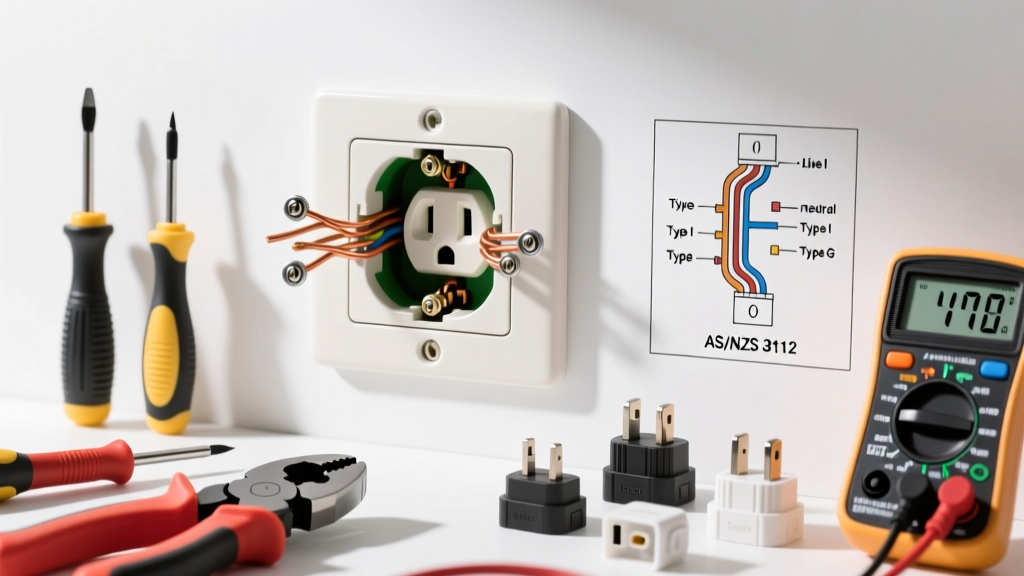
While the physical geometry appears uniform to the untrained eye, the underlying standards diverge significantly by region. Australia and New Zealand operate under the AS/NZS 3112 standard, which mandates strict insulating sleeves on the active and neutral pins to prevent shock hazards during partial insertion. Conversely, Argentina’s IRAM 2073 standard shares the geometry but historically lacks these mandatory insulating sleeves, creating a vital safety distinction for material sourcing. China utilizes the GB 1002 / GB 2099 standard, which frequently integrates Type I configurations into multi-standard wall panels alongside Type A and C sockets.
Regional Specifications & Tolerances
| Region | Governing Standard | Standard Voltage / Frequency | Common Amperage Ratings | Pin Insulation Sleeves |
|---|---|---|---|---|
| Australia / NZ | AS/NZS 3112 | 230V / 50Hz | 10A, 15A, 20A, 25A, 32A | Mandatory (Active & Neutral) |
| China | GB 1002 / GB 2099 | 220V / 50Hz | 10A, 16A | Optional / Varies |
| Argentina | IRAM 2073 | 220V / 50Hz | 10A, 20A | Not Mandatory |
Essential Tools for Type I Wiring & Installation
Working with Type I receptacles requires precision tools capable of handling the specific metric wire gauges and terminal screw sizes prevalent in these regions. In 2026, the shift toward larger cross-sectional earth wires and stricter torque requirements means standard generic toolkits often fall short.
Precision Stripping & Termination
- Wire Strippers: The Knipex MultiStrip 10 (12 62 180) is the industry benchmark. Type I circuits in AU/NZ typically utilize 2.5mm² dual-insulated copper for standard 10A/16A circuits and 4.0mm² for 20A air-conditioning or heavy appliance circuits. The Knipex auto-adjusts to these exact metric diameters without nicking the copper strands, which is vital for maintaining the mechanical integrity of the terminal connection.
- Insulated Screwdrivers: Type I GPO (General Power Outlet) terminals predominantly use M3.5 or M4 slotted/Phillips captive screws. The Wera VDE 1160i series (rated to IEC 60900 for 1000V) provides the exact tip geometry required to prevent cam-out, which can damage the soft brass terminal blocks found in budget receptacles.
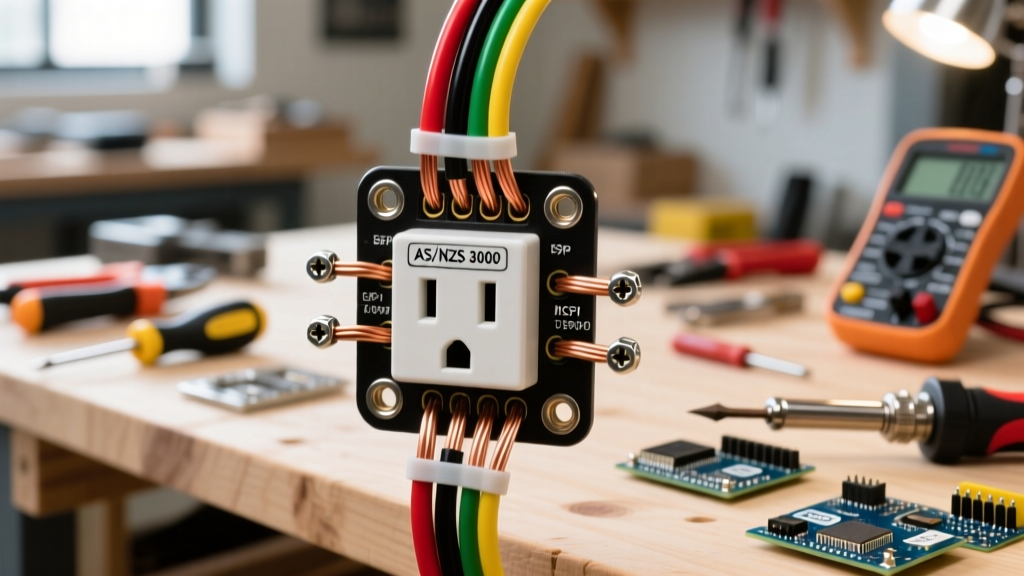
- Torque Screwdriver: Modern AS/NZS 3000 Wiring Rules increasingly emphasize correct terminal torque to prevent thermal runaway. A calibrated torque screwdriver set to 1.2 Nm to 1.5 Nm (depending on the manufacturer's spec, such as Clipsal or Schneider) ensures the wire is clamped securely without stripping the brass threads.
Testing & Verification
Before energizing any Type I circuit, verification is non-negotiable. The Fluke T6-1000 Electrical Tester utilizes FieldSense technology to measure AC voltage and current without metal-to-metal contact. For final compliance testing in Australia and New Zealand, a dedicated PAT (Portable Appliance Tester) or installation tester like the Megger MFT1845 is required to measure earth loop impedance and verify the RCD (Residual Current Device) trip times, which must be under 300ms for standard 30mA Type I safety switches.
Material Selection: Receptacles & Smart Enclosures
The material landscape for Type I outlets has evolved rapidly. In 2026, the integration of smart home protocols directly into the wall plate has shifted purchasing decisions from purely mechanical durability to digital interoperability.
Premium Mechanical & Modular Systems
For high-end residential and commercial builds in Oceania, the Clipsal Iconic (Schneider Electric) range remains the gold standard. Its modular skin-plate design allows electricians to install the Type I GPO mechanism (such as the 4025XA base) and let the homeowner snap on matte black, timber, or stainless steel fascias post-painting. The internal terminals feature a unique 'push-in' and screw-clamp hybrid that accepts both solid and stranded 2.5mm² wires seamlessly.
Smart Type I Outlets (Matter & Thread)
In the Chinese and global smart-home markets, dedicated Type I smart wall sockets have moved beyond cloud-dependent Wi-Fi. The 2026 generation of Xiaomi Smart Wall Sockets (Zigbee/Matter) and Aqara T1 Type I GPOs utilize the Matter over Thread protocol. These require a deep wall cavity (at least 50mm depth) to accommodate the internal solid-state relays and RF antennas. When procuring these materials, ensure the backbox is rated for the thermal dissipation of the internal 16A relay, which can generate up to 1.5W of heat under continuous load.
CRITICAL SAFETY & LEGAL WARNING: In Australia and New Zealand, it is strictly illegal for unlicensed individuals to perform fixed electrical wiring, including the installation or replacement of hardwired Type I GPOs. According to WorkSafe Victoria and equivalent national regulators, only licensed electricians can legally alter fixed wiring. This guide is intended for material procurement, licensed professional reference, and safe travel adaptation.
Harmonized vs. Legacy Wiring Color Codes
One of the most dangerous pitfalls when repairing or upgrading older Type I installations is encountering legacy wiring colors. Australia and New Zealand transitioned to the IEC harmonized color codes in the early 2000s, but millions of older Type I outlets still contain the legacy AS/NZS 3000 colors. Misidentifying these can result in catastrophic short circuits or electrocution.
| Function | Current Harmonized (IEC / AU/NZ Post-2000) | Legacy AU/NZ (Pre-2000) | China (GB 50258) | Argentina (IRAM) |
|---|---|---|---|---|
| Active / Phase | Brown (or Red/Grey for 3-phase) | Red | Yellow / Green / Red | Brown |
| Neutral | Light Blue (or Black/White for 3-phase) | Black | Light Blue | Light Blue |
| Earth / Ground | Green & Yellow Stripe | Green | Green & Yellow Stripe | Green & Yellow Stripe |
Pro-Tip for Electricians: When upgrading a legacy red/black Type I circuit to a modern smart GPO, always sleeve the legacy black neutral wire with light blue heat-shrink tubing at the termination point to maintain visual consistency for future maintenance, as recommended by Standards Australia guidelines.
Travel Adaptation & Step-Down Materials
For travelers and expatriates bringing 110V/120V North American or Japanese appliances into Type I regions (220V-240V), a simple plug adapter is insufficient and will destroy the appliance. You must source high-quality step-down transformers.
- Plug Adapters: The Skross World Adapter Pro remains the most reliable mechanical adapter, featuring spring-loaded pins that maintain tight tension in worn Type I hotel receptacles, preventing the dangerous 'arcing' that causes melted faceplates.
- Step-Down Transformers: For high-draw appliances (like US 120V hair dryers or power tools), a minimum 2000W toroidal step-down transformer (e.g., LiteFuze LT-2000) is required. Toroidal cores are preferred in 2026 for their 40% reduction in standby magnetic hum and lower weight compared to traditional E-I laminated cores.
- Surge Protection: Type I regions, particularly in parts of Australia and Argentina, experience frequent grid switching surges. Utilizing a Type I compatible surge-protected power board (like the Belkin SurgeMaster 8-Outlet with a 3940 Joule rating) is essential for protecting sensitive laptop power bricks and camera equipment.
Frequently Asked Questions (FAQ)
Can I use a Chinese Type I plug in an Australian Type I outlet?
Physically, yes. The pin geometry defined by China's GB 1002 is nearly identical to Australia's AS/NZS 3112. However, Chinese plugs often lack the insulating sleeves on the active and neutral pins. While they will fit and function, the lack of sleeves means the metal pins are exposed up to the faceplate, posing a minor shock risk if touched while partially inserted. Furthermore, Chinese plugs are rated for 220V, which is perfectly compatible with the 230V nominal supply in Australia.
What wire gauge is required for a 15A Type I outlet?
In Australia and New Zealand, a standard 10A GPO is wired with 2.5mm² copper cable on a 16A or 20A circuit breaker. However, a dedicated 15A Type I outlet (commonly used for caravans, RVs, and heavy workshop equipment) must be wired with a minimum of 2.5mm² cable, but is frequently upgraded to 4.0mm² depending on the length of the cable run to mitigate voltage drop. The circuit must be protected by a 16A or 20A MCB (Miniature Circuit Breaker) and a 30mA RCD.
Why are Type I pins angled at 30 degrees?
The 30-degree inverted 'V' angle of the active and neutral pins was originally designed to provide superior mechanical grip within the socket's internal brass wipers. This angled geometry prevents the plug from being easily pulled out by the weight of heavy power supply bricks, a common failure point in vertically aligned standards like the North American Type A/B. For deeper technical histories on global plug configurations, the International Electrotechnical Commission (IEC) maintains comprehensive archives on plug evolution and safety standardization.