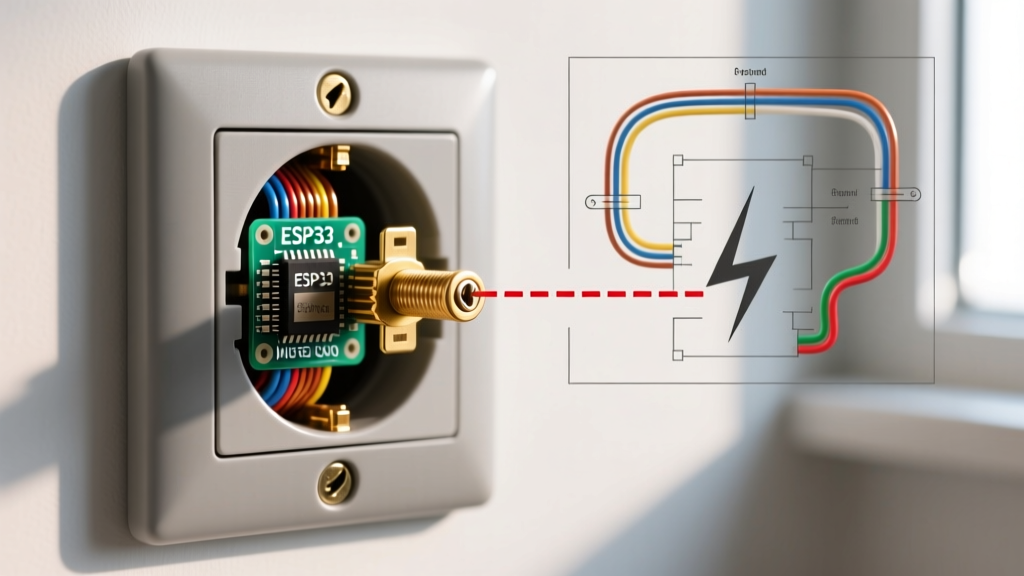

Understanding the Open Ground Fault
An open ground electrical outlet occurs when the equipment grounding conductor (EGC) is disconnected, broken, or improperly terminated between the receptacle and the main service panel. While the outlet will still power a 120V appliance (since current flows on the hot and neutral wires), the lack of a continuous ground path creates a severe shock hazard and renders surge protectors useless.
According to the U.S. Consumer Product Safety Commission (CPSC), faulty grounding and wiring anomalies are leading contributors to residential electrical fires and electrocution incidents. In this comprehensive diagnostic guide, we will walk through the exact steps to identify the root cause of an open ground, differentiate it from dangerous 'bootleg' wiring, and apply National Electrical Code (NEC) compliant repairs.
Initial Diagnosis: Reading the Receptacle Tester
The first step in troubleshooting is using a standard 3-prong receptacle tester. For this guide, we reference the industry-standard Klein Tools RT210 (approx. $15) or the advanced RT250 (approx. $55), which includes a GFCI trip test and an open ground indicator light.
Standard Tester Light Matrix
| Indicator Lights (Left-Center-Right) | Condition | Action Required |
|---|---|---|
| Yellow - Yellow - OFF | Open Ground | Verify ground wire termination at receptacle and upstream splices. |
| OFF - Yellow - Yellow | Open Neutral | Check neutral (white) wire connections; high fire risk. |
| Yellow - OFF - Yellow | Hot/Neutral Reversed | Swap black and white wires on the duplex receptacle terminals. |
| Yellow - OFF - OFF | Hot/Ground Reversed | Immediate danger; panel or junction box miswiring. |
Note: Always test a known-good outlet first to verify your tester's batteries and functionality before diagnosing the suspect circuit.
The 'Bootleg Ground' Danger: A Lethal Code Violation
Before tearing into the drywall to trace a broken wire, you must rule out a 'bootleg ground.' This is an illegal and highly dangerous workaround where a previous installer placed a jumper wire between the neutral (silver) terminal and the ground (green) terminal on the receptacle.
WARNING: A bootleg ground tricks a standard receptacle tester into showing a 'Correct' wiring status. However, if the neutral wire ever becomes disconnected upstream, the metal chassis of any plugged-in appliance (like a refrigerator or microwave) will become energized at 120V, posing a lethal shock hazard. This violates NFPA 70 (NEC) Article 250.148, which strictly forbids connecting the equipment grounding conductor to the grounded circuit conductor on the load side of the service disconnect.
How to Test for a Bootleg Ground
- Turn off the circuit breaker and verify zero voltage using a non-contact voltage tester (e.g., Klein NCVT-1) and a multimeter (e.g., Fluke 117).
- Remove the receptacle from the electrical box.
- Inspect the green ground screw. If you see a bare copper or green wire connecting directly to the silver neutral screw, you have a bootleg ground.
- Remove the jumper immediately. The outlet will now correctly read as an 'Open Ground' on your tester.
Root Cause Analysis: Why is the Ground Open?
Once you have confirmed a true open ground (and ruled out a bootleg), you must identify where the physical break in the equipment grounding conductor (EGC) has occurred.
| Failure Mode | Typical Scenario | Diagnostic Approach |
|---|---|---|
| Loose Terminal Screw | Receptacle was replaced hastily; ground wire slipped out from under the green screw. | Visual inspection of the receptacle's ground terminal. |
| Failed Wire Nut Splice | Vibrations or thermal expansion/contraction caused the ground pigtail splice in the back of the box to loosen. | Inspect wire nuts; gently tug on the bare copper ground wires. |
| Broken EGC in Cable | A drywall screw or nail pierced the NM-B (Romex) cable upstream, severing the bare ground wire while leaving insulated hot/neutral intact. | Test the previous outlet on the same circuit. If it also reads 'Open Ground', the break is upstream. |
| True Ungrounded System | Home built before 1965 using 2-wire NM or Knob & Tube. There is no EGC in the walls. | Remove receptacle; only one black and one white wire enter the box. No bare copper exists. |
Step-by-Step Repair Solutions
Scenario A: Localized Termination Failure
If the ground wire is present in the box but disconnected:
- Strip 3/4 inch of insulation from the bare copper wire using a Klein 11055 wire stripper.
- Form a J-hook using needle-nose pliers and loop it clockwise around the green ground screw on the receptacle. This ensures the wire tightens as the screw turns right.
- Tighten the screw to the manufacturer's torque specification (typically 12-14 in-lbs for standard 15A/20A duplex receptacles like the Hubbell 5362).
- If splicing a pigtail, use an Ideal 341 (Red) or Ideal 33 (Orange) wire nut, rated securely for 14 AWG and 12 AWG solid copper combinations.
Scenario B: The Upstream Break
If the outlet is wired correctly but still shows an open ground, the fault lies upstream. Electrical circuits are typically daisy-chained. Go to the nearest receptacle between the suspect outlet and the main breaker panel. Test it. If it shows an open ground, move to the next one toward the panel. The break is located between the last 'Good' outlet and the first 'Open Ground' outlet. You will need to open the junction boxes or receptacles in that zone to find the disconnected wire nut splice.
Scenario C: The Ungrounded System (NEC 406.4(D)(2) Solution)
If your home has legacy 2-wire cabling (no bare ground wire exists in the wall cavity), you cannot legally or safely run a single ground wire to a nearby water pipe or metal duct. Doing so violates NEC grounding electrode rules and creates dangerous potential differences.
Instead, the National Electrical Code provides a specific retrofit solution under NEC 406.4(D)(2):
- Replace the standard duplex receptacle with a GFCI (Ground Fault Circuit Interrupter) receptacle, such as the Leviton 8599-W (approx. $18-$22).
- A GFCI does not require an equipment ground to function. It monitors the current imbalance between the hot and neutral conductors, tripping in milliseconds if a ground fault (current leaking through a human) is detected.
- You must apply the included 'No Equipment Ground' sticker to the faceplate. This is a mandatory code requirement to inform users that while they are protected from shock, surge protectors plugged into this outlet will not function correctly.
Essential Tool & Material Cost Matrix (2026 Estimates)
| Item | Model / Specification | Estimated Cost | Purpose |
|---|---|---|---|
| Receptacle Tester | Klein Tools RT250 | $55.00 | Identifies open ground, tests GFCI trip. |
| Multimeter | Fluke 117 True-RMS | $195.00 | Verifies zero voltage before touching wires. |
| GFCI Receptacle | Leviton 8599-W (20A) | $21.50 | NEC 406.4(D)(2) compliant retrofit. |
| Wire Connectors | Ideal 341 (Red, 50-pack) | $8.00 | Secure pigtailing of 14/12 AWG ground wires. |
| Torque Screwdriver | Klein Tools 69060 | $85.00 | Ensures terminal screws meet UL/NEC torque specs. |
Frequently Asked Questions
Will a surge protector work on an open ground outlet?
No. Standard surge protectors use Metal Oxide Varistors (MOVs) to divert excess voltage spikes away from your electronics. The MOVs dump this excess energy directly into the equipment grounding conductor. Without a ground path, the surge protector cannot divert the spike, leaving your expensive electronics vulnerable to damage, and potentially causing the MOV to catch fire.
Is an open ground a code violation for a home sale?
Yes. During a home inspection, open grounds are flagged as safety defects. While a GFCI replacement is a legal retrofit for ungrounded systems under the current NEC cycle, an open ground on a modern 3-wire NM-B system must be physically repaired to pass inspection and satisfy most home insurance underwriters.
Can I just connect the ground wire to the metal electrical box?
Only if the metal box is part of a continuous, code-approved grounding path (such as EMT metal conduit with proper fittings, or older BX/AC cable with a dedicated internal bonding strip). If you are using standard plastic (PVC) junction boxes, or if the metal conduit lacks a separate EGC and relies on loose locknuts, connecting to the box will not provide a reliable fault-current path. Always use a dedicated bare copper or green insulated EGC.