
The Legal and Technical Anatomy of the 3 Prong Electrical Outlet
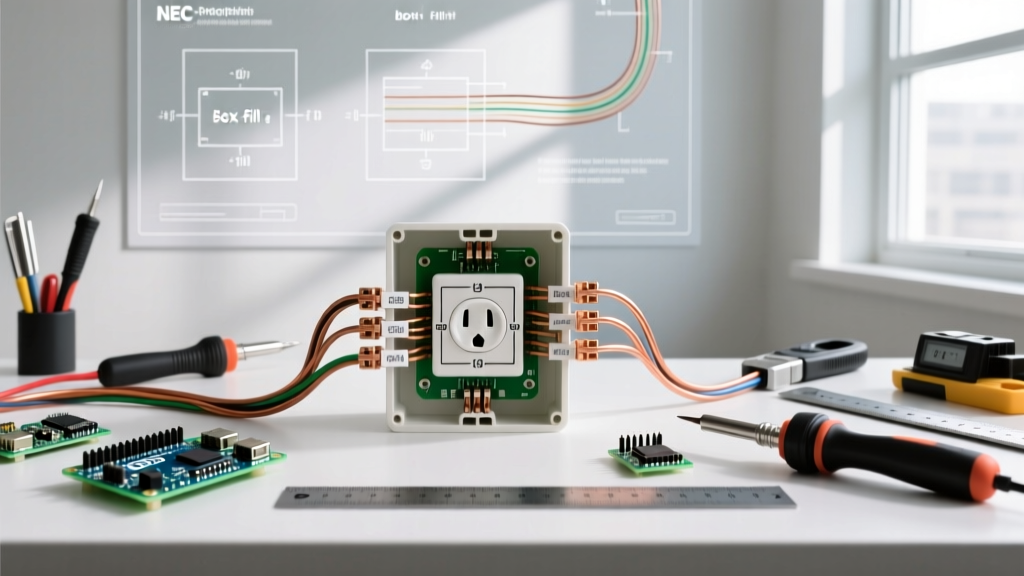
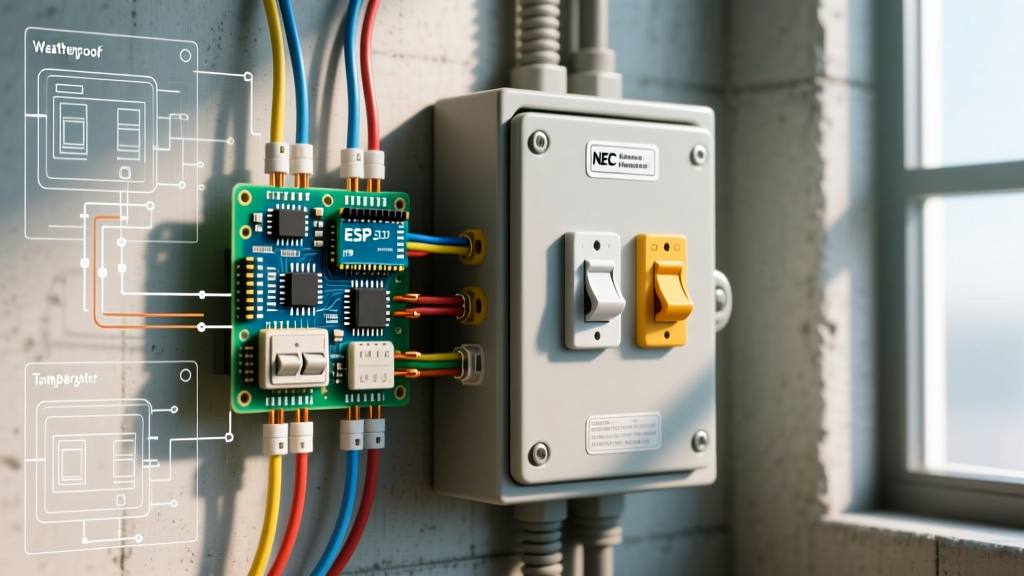
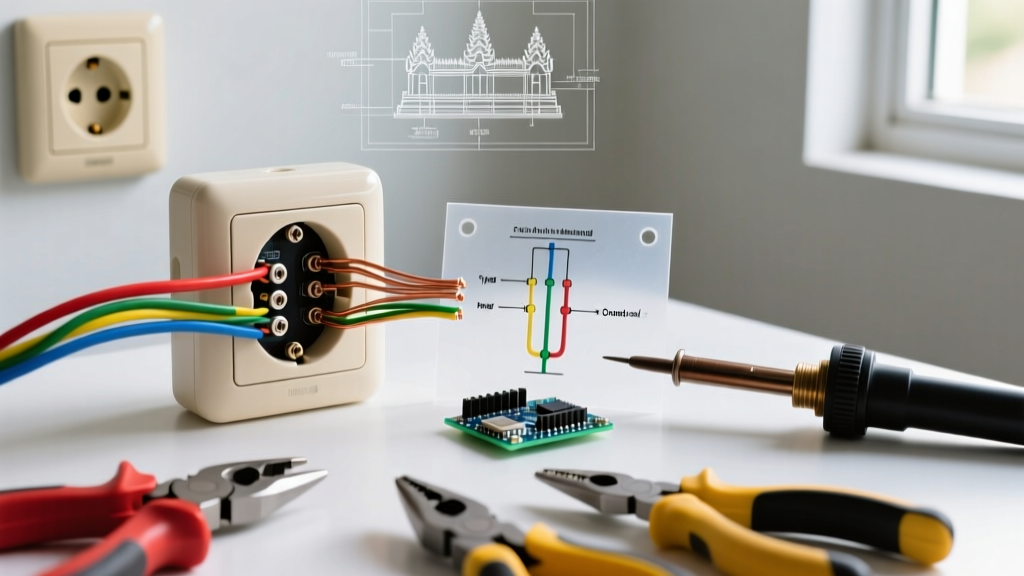
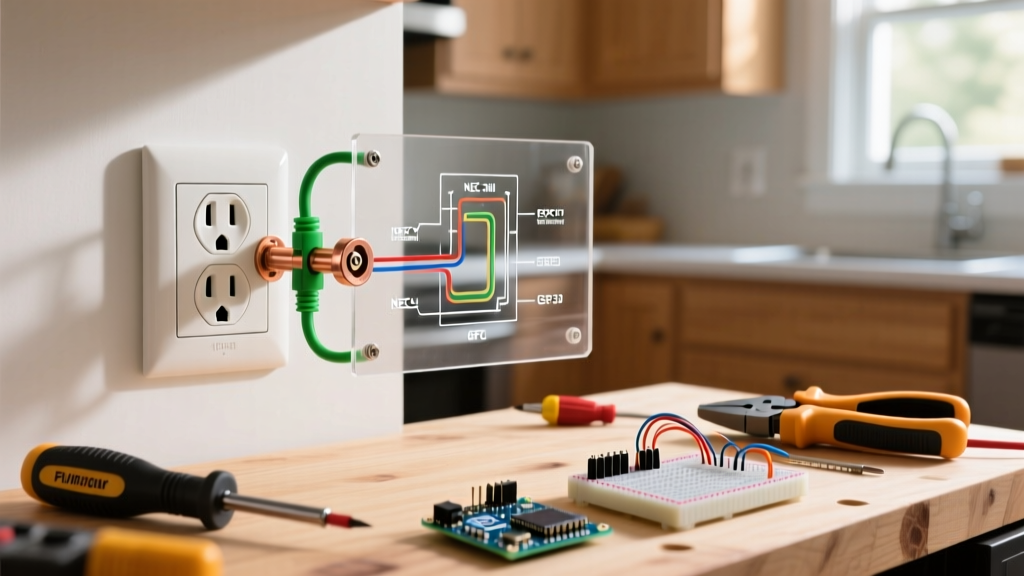
The standard 3 prong electrical outlet, technically designated as a NEMA 5-15R receptacle, is the backbone of residential power distribution in North America. While it appears simple, installing or replacing one involves strict adherence to the National Electrical Code (NEC). A code-compliant installation is not just about making the device fit into the wall box; it requires precise wire stripping, correct torque application, and strict observance of grounding mandates.
Physical Specifications and Slot Tolerances
Every UL-listed 3 prong electrical outlet must conform to precise dimensional standards to ensure safe mating with NEMA 1-15P and 5-15P plugs. The three slots serve distinct purposes:
- Hot Slot (Right): Measures 11/32 inch wide by 9/32 inch tall. Connects to the black (or red) ungrounded conductor carrying 120V AC.
- Neutral Slot (Left): Slightly larger at 13/32 inch wide by 9/32 inch tall. Connects to the white grounded conductor to complete the 120V circuit.
- Ground Slot (Bottom): A U-shaped or D-shaped aperture measuring roughly 1/4 inch wide. Connects to the bare copper or green insulated Equipment Grounding Conductor (EGC).
Modern commercial-grade receptacles, such as the Hubbell 5262-I or Pass & Seymour 2095-TR, feature brass and silver-plated terminal screws designed to handle continuous 15-amp loads without thermal degradation.
NEC Article 250: The Grounding Mandate
The defining feature of the 3 prong electrical outlet is the ground pin. Under NEC Article 250.148, the Equipment Grounding Conductor (EGC) must be securely connected to the receptacle's green grounding screw. This connection provides a low-impedance fault path back to the main service panel, ensuring that a short circuit will trip the breaker instantly rather than energizing the appliance chassis.
Wire Sizing and Torque Requirements
Code compliance extends to how the wires are terminated. For a standard 15-amp circuit utilizing 14 AWG copper wire, or a 20-amp circuit utilizing 12 AWG copper wire, the NEC and manufacturer instructions dictate specific termination practices:
- Strip Length: Exactly 3/4 inch of insulation must be removed. Exposed copper beyond the terminal yoke creates an arc-flash hazard.
- Loop Direction: The wire loop must be formed clockwise around the terminal screw. Tightening the screw pulls the loop tighter; a counter-clockwise loop will be pushed out.
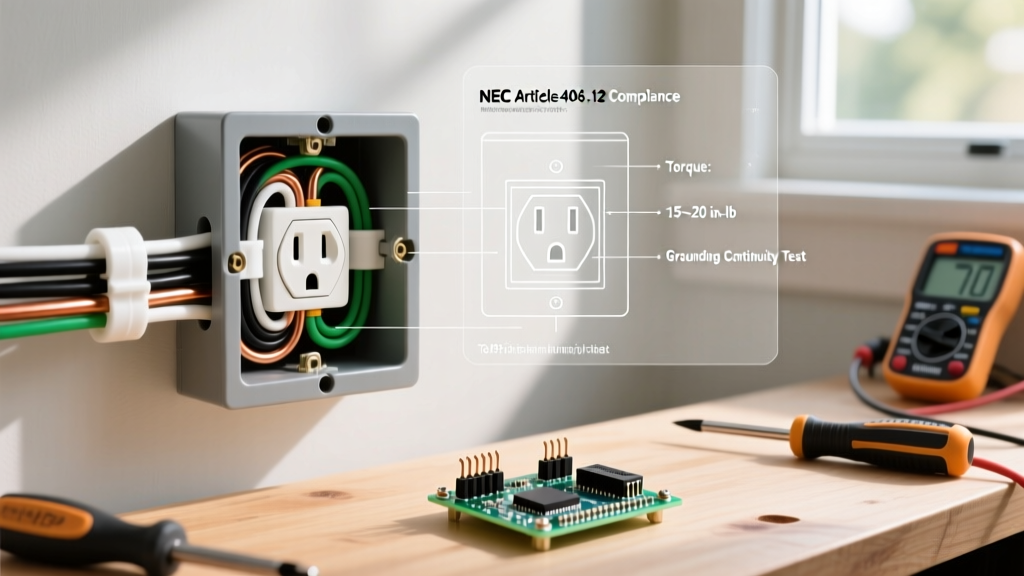
- Torque Specifications: The 2017 NEC (and subsequent 2023/2026 editions) introduced NEC 110.14(D), requiring terminations to be torqued to manufacturer specifications. For most Leviton and Eaton 15A receptacles, this requires exactly 14 in-lbs of torque. Using a calibrated torque screwdriver prevents terminal loosening over time, which is a leading cause of residential electrical fires.
The 'Ungrounded' Exception: Retrofitting Older Homes
Millions of homes built before 1962 feature Knob & Tube or early Romex wiring that lacks an equipment grounding conductor. Homeowners frequently want to upgrade their obsolete 2-prong receptacles to modern 3 prong electrical outlets to accommodate grounded appliance plugs.
The NEC strictly prohibits installing a standard 3-prong receptacle on an ungrounded circuit. Doing so creates a lethal shock hazard, as the user assumes the device is grounded when it is not. However, NEC 406.4(D)(2) provides a legal pathway for replacement when an EGC cannot be easily pulled through the walls.
Legal vs. Illegal Ungrounded Retrofits
If you are replacing a 2-prong outlet on a circuit with no ground wire, you must choose one of the following code-compliant methods:
| Retrofit Method | NEC Reference | Code Status | Required Action |
|---|---|---|---|
| GFCI Protected 3-Prong | 406.4(D)(2)(b) | Legal | Install a GFCI receptacle or protect it with an upstream GFCI breaker. Must apply 'No Equipment Ground' and 'GFCI Protected' stickers. |
| Standard 3-Prong (No Ground) | N/A | Illegal | Violates code. Creates a false sense of security. Fails home inspection. |
| Bootleg Ground (Jumper) | 250.148 / 406.4 | Highly Illegal | Connecting a jumper wire from the neutral terminal to the ground screw. Lethal if the neutral wire breaks upstream. |
| Pull New EGC Wire | 250.130(C) | Legal | Run a new bare copper ground wire back to the panel's grounding bar or any accessible point on the grounding electrode system. |
CRITICAL SAFETY WARNING: Never install a 'bootleg ground' (a jumper wire between the neutral silver screw and the green ground screw) to trick a receptacle tester into showing a correct 3-prong wiring configuration. If the neutral connection fails anywhere upstream, the metal chassis of any plugged-in appliance will become energized at 120 volts. According to the Electrical Safety Foundation International (ESFI), improper grounding and missing GFCI protection are leading contributors to residential electrocutions.
Tamper-Resistant (TR) Mandates
Since the 2008 NEC cycle, and reinforced in all modern code updates, NEC 406.12 requires all 15-amp and 20-amp 3 prong electrical outlets installed in dwelling units to be Tamper-Resistant (TR).
How TR Mechanisms Work
TR receptacles, such as the Leviton T5320-W, feature internal spring-loaded shutter plates. These shutters only open when equal, simultaneous pressure is applied to both the hot and neutral slots—exactly what happens when a 2-prong or 3-prong plug is inserted. A child attempting to insert a single object, like a paperclip or a hairpin, into one slot will be blocked by the shutters.
Note: The TR requirement applies to nearly all interior and exterior residential locations, including guest rooms in hotels and motels, but exempts receptacles located more than 5.5 feet above the floor or dedicated to specific stationary appliances.
GFCI and AFCI Integration Rules
A standard 3 prong electrical outlet is not always sufficient on its own; location dictates whether it must incorporate advanced fault protection. The National Fire Protection Association (NFPA) continually updates the NEC to expand these protection zones.
Where GFCI 3-Prong Outlets are Required
Ground Fault Circuit Interrupter (GFCI) receptacles monitor the current balance between the hot and neutral wires. If an imbalance of just 4 to 6 milliamps is detected (indicating current is leaking to ground, possibly through a human body), the device trips in under 25 milliseconds. Code requires GFCI 3-prong outlets in:
- Bathrooms and kitchens (within 6 feet of the sink edge)
- Garages, accessory buildings, and crawl spaces
- Outdoor receptacles (must also be rated WR - Weather Resistant with in-use covers)
- Laundry areas and dishwashing zones
- Basements and unfinished areas
Dual-Function (AFCI/GFCI) Receptacles
For circuits requiring both Arc-Fault and Ground-Fault protection (such as a kitchen circuit where the breaker is an AFCI, but the receptacle near the sink needs GFCI), electricians increasingly use Dual-Function receptacles like the Eaton GFCA15W. Priced around $38 to $45, these devices combine both microprocessors into a single 3-prong yoke, eliminating nuisance tripping caused by long wire runs between an AFCI breaker and a downstream GFCI receptacle.
Testing and Verification Tools
Visual inspection is not enough to verify code compliance. Every 3 prong electrical outlet must be tested under load. Professional electricians rely on advanced solenoid testers and digital circuit analyzers rather than cheap plug-in neon testers, which can provide false readings on high-impedance bootleg grounds.
- Klein Tools RT250: A premium GFCI receptacle tester ($45-$55) that features a digital LCD screen. It not only identifies wiring faults (open ground, reversed polarity, open neutral) but also displays the exact trip time of the GFCI mechanism in milliseconds, ensuring it meets the UL 943 standard of under 300ms at 6mA.
- Sperry Instruments GFI-3500: A rugged, heavy-duty tester that applies the necessary current to trip the GFCI without relying on the receptacle's internal test button, verifying the actual circuit protection rather than just the mechanical button function.
Summary of Compliance Costs
When budgeting for a residential rewire or outlet upgrade, factor in the cost of code-compliant materials. As of 2026, standard commercial-grade TR 3-prong receptacles cost between $2.50 and $4.00 each. Upgrading to GFCI models raises the material cost to $16.00 - $25.00 per device. While the material cost difference is marginal, the labor cost to pull a new Equipment Grounding Conductor through finished drywall to avoid the GFCI retrofit exception can range from $150 to $300 per drop. Understanding these NEC mandates allows homeowners and electricians to choose the safest, most cost-effective path to compliance.