
The Critical Importance of Hot-to-Brass Polarity
When inspecting residential and commercial 120V AC receptacles, one of the most common and dangerous wiring faults is reversed polarity. In the electrical trade, the fundamental rule of thumb is that the electrical outlet black wire to gold (brass) screw connection must be strictly maintained. While DIYers often refer to the hot terminal as 'gold,' the National Electrical Code (NEC) and manufacturers technically classify this terminal as brass. The white neutral wire terminates on the silver screw, and the bare or green ground wire terminates on the green screw.
Failure to correctly route the black hot wire to the brass terminal creates a reversed polarity condition. While a lamp or appliance plugged into a reversed outlet will typically still function, the internal safety mechanisms of those devices are compromised. According to the Electrical Safety Foundation International (ESFI), reversed polarity is a leading cause of localized electrical shocks in older homes, particularly when interacting with metal-chassis appliances or Edison-base lamp sockets.
Anatomy of a Standard 15A/20A Receptacle
Before testing, you must visually identify the terminal architecture on standard spec-grade receptacles, such as the ubiquitous Leviton T5262-W or Hubbell 5262. These devices feature distinct metallurgical and physical identifiers:
- Brass (Gold) Terminal: Connected to the internal hot bus bar. It features a shorter internal prong slot on the face of the receptacle.
- Silver Terminal: Connected to the neutral bus bar. It aligns with the longer neutral slot on the receptacle face.
- Green Terminal: Connected directly to the device mounting yoke and the U-ground pin.
Under NEC Article 200.10, the identification of wiring device terminals is strictly regulated to ensure uniformity across all installations. The National Fire Protection Association (NFPA) 70 explicitly requires that the grounded (neutral) conductor be connected to the terminal clearly identified by a white or silver color.
Required Inspection & Testing Tooling
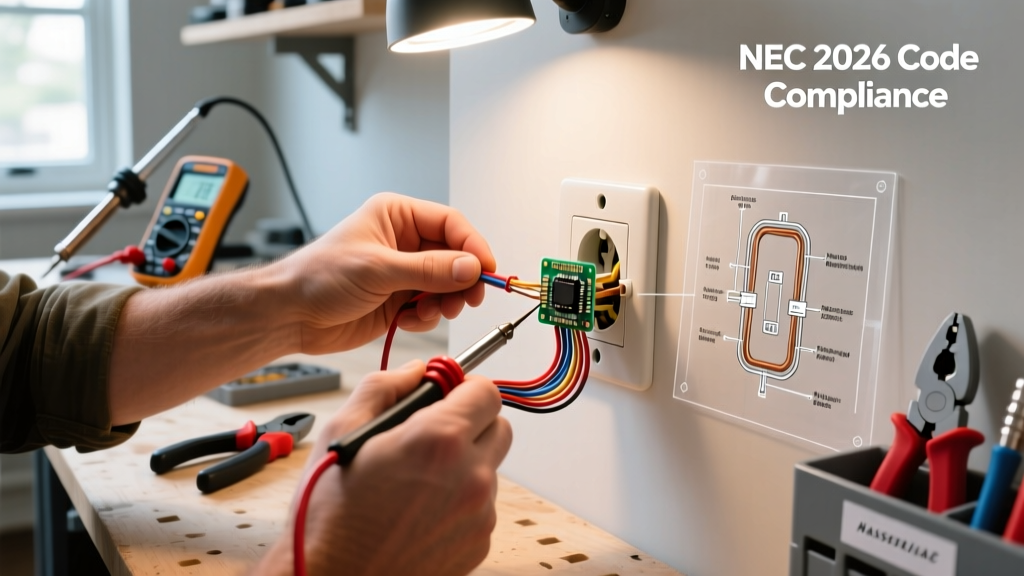
To properly verify the electrical outlet black wire to gold connection, you must move beyond simple plug-in receptacle testers. While a $10 plug-in tester can flag reversed polarity, it cannot verify connection integrity, torque, or open-bootleg grounds. A professional inspection requires the following tools:
- Digital Multimeter (DMM): Fluke T6-1000 or Klein Tools MM400. Must support True-RMS AC Voltage and Continuity testing.
- Non-Contact Voltage Tester (NCVT): Klein NCVT-3 for initial dead-front verification.
- Torque Screwdriver: Ideal Industries 1.5 in-lb to 40 in-lb torque screwdriver to verify NEC 110.14(D) compliance.
Phase 1: Dead Testing (Continuity & Mechanical Inspection)
Never begin an inspection on a live circuit. Shut off the branch circuit breaker and verify the absence of voltage using your NCVT and DMM.
Step 1: Visual and Mechanical Verification
Pull the receptacle from the junction box. Inspect the side-wire terminal screws. If the black wire is terminated on the silver screw and the white wire on the brass screw, you have confirmed reversed polarity. Additionally, check for 'back-stabbed' push-in connections. Back-stabbed connections on the brass terminal are notorious for high-resistance failures and arcing over time. Best practice dictates moving all black hot wires to the side-wire brass screw terminals or using the screw-clamp plates found on premium commercial-grade receptacles.
Step 2: Continuity Testing
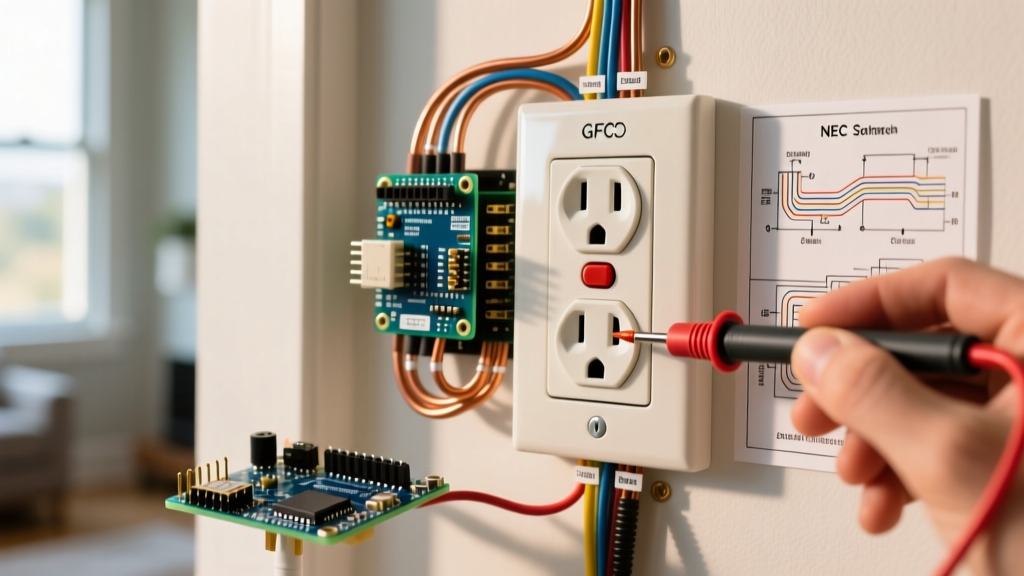
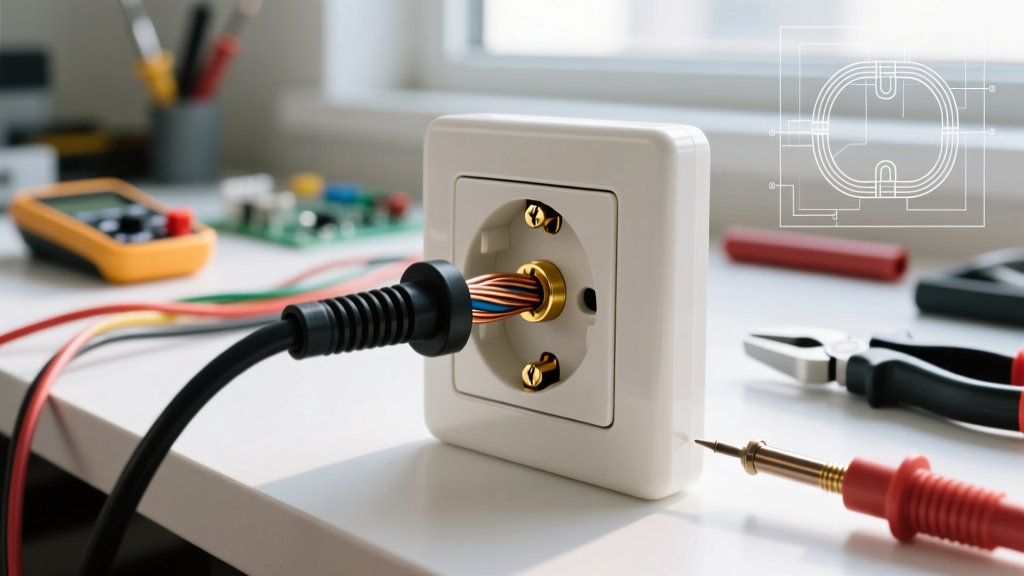
Set your Fluke or Klein DMM to the Ohms/Continuity setting. Place one probe on the exposed copper of the black hot wire and the other probe on the brass (gold) screw head. A properly terminated connection will yield a resistance reading of less than 0.5 ohms and trigger the continuity beep. If the reading is infinite (OL), the wire is broken, back-stabbed poorly, or terminated on the wrong terminal.
Phase 2: Live Voltage Testing Matrix
Once mechanical integrity is confirmed and the device is pushed back into the box, restore power at the breaker. Use your DMM set to AC Voltage (V~) to perform the live testing protocol. Insert the red probe into the V/Ohm jack and the black probe into the COM jack.
| Probe 1 (Red) | Probe 2 (Black) | Expected Reading (120V System) | Fault Indication |
|---|---|---|---|
| Brass (Gold) Slot | Ground U-Pin | ~120V (114V - 126V) | Open Ground if 0V; Reversed Polarity if 0V here but 120V on Silver |
| Silver Slot | Ground U-Pin | ~0V (Under 2V) | Reversed Polarity if ~120V is detected |
| Brass (Gold) Slot | Silver Slot | ~120V | Open Neutral if 120V to ground exists, but 0V across Hot/Neutral |
Expert Insight: If you measure 120V from the Silver slot to Ground, and 0V from the Brass slot to Ground, the black hot wire has been incorrectly terminated to the silver terminal. This confirms a failure in the electrical outlet black wire to gold rule.
The Hidden Danger of Reversed Polarity
Why does it matter if the black wire goes to the silver screw? Consider a standard table lamp with an Edison-base socket. In a correctly wired circuit, the hot (black) wire travels to the center tab at the very bottom of the socket, while the neutral (white) wire connects to the outer threaded sleeve. If a user touches the outer threads while changing a bulb, they are safe because the threads are tied to neutral.
If the electrical outlet black wire to gold connection is reversed, the outer threaded sleeve of the lamp socket becomes energized at 120V. A user changing a bulb who accidentally brushes the metal threads completes the circuit to ground, resulting in a severe or potentially fatal shock. This is precisely why Occupational Safety and Health Administration (OSHA) electrical guidelines mandate strict adherence to polarity in all workplace and residential environments.
Verifying Terminal Torque (NEC 110.14 Compliance)
Inspection is not complete without verifying mechanical torque. Since the 2017 NEC cycle, Article 110.14(D) requires that terminals identified with a torque specification must be tightened using a calibrated torque tool. For a standard Leviton 15A/20A spec-grade receptacle, the manufacturer specifies a torque of 12 in-lbs for both 14 AWG and 12 AWG solid copper wire.
Under-torquing the brass terminal screw can lead to thermal expansion and contraction cycles that loosen the wire over time, increasing resistance and creating a fire hazard. Over-torquing can strip the brass threads or snap the screw head entirely. During your inspection, use a torque screwdriver set to 12 in-lbs to click-off on the brass terminal screw, ensuring a permanent, low-resistance mechanical bond.
Final Inspection Sign-Off
A receptacle passes the polarity and mechanical inspection only when: (1) The black hot wire is physically terminated to the brass/gold screw, (2) Live voltage testing confirms 120V from Brass-to-Ground and 0V from Silver-to-Ground, and (3) The terminal torque meets the manufacturer's printed specification. By adhering to this rigorous testing protocol, you eliminate the risk of reversed polarity shocks and ensure long-term circuit reliability.