
The Chilean Electrical Landscape: Navigating Type L and Type N Standards
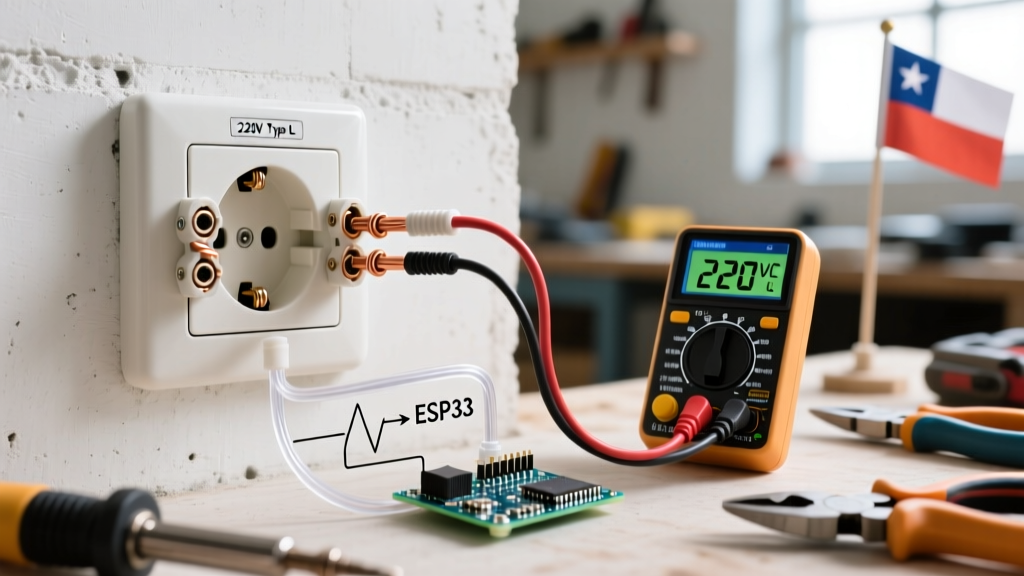
When evaluating an electric outlet in Chile, electrical inspectors and DIY enthusiasts must navigate a unique transitional landscape. Chile operates on a 220V, 50Hz alternating current (AC) grid. Historically, the country has relied almost exclusively on the Type L socket (based on the Italian CEI 23-50 standard). However, as of 2026, there is a sustained, code-driven push toward the Type N standard (IEC 60906-1) to improve grounding reliability and harmonize with broader South American safety frameworks.
Before connecting a multimeter or receptacle tester, you must visually identify the outlet variant. Misidentifying a 10A Type L socket for a 16A variant is a leading cause of terminal overheating and melted faceplates in older Chilean residential builds.
Chilean Outlet Specifications Matrix
| Feature | Type L (10A Variant) | Type L (16A Variant) | Type N (IEC 60906-1) |
|---|---|---|---|
| Pin Diameter | 4.0 mm | 4.8 mm | 4.0 mm (10A) / 4.8 mm (20A) |
| Pin Spacing | 5.5 mm | 8.0 mm | 19.0 mm (Line to Neutral) |
| Grounding Pin | Inline (Center) | Inline (Center) | Offset Triangle |
| Child Safety Shutters | Rare in legacy installs | Occasional | Mandated by modern code |
Source: International Electrotechnical Commission (IEC World Plugs Guide)
Essential Diagnostic Equipment for 220V Systems
Standard North American 120V receptacle testers (like the Gardner Bender GRT-501) are useless and potentially dangerous when plugged into a Chilean 220V circuit. To properly inspect an electric outlet in Chile, you must assemble a specialized diagnostic kit:
- True-RMS Digital Multimeter: The Fluke 117 or Klein Tools MM400 is required for accurate voltage readings, especially in circuits with non-linear loads like LED drivers or variable-frequency appliance motors.
- Non-Contact Voltage Tester (NCVT): A dual-range NCVT (e.g., Fluke 2AC-II) capable of detecting 220V through insulated walls to verify dead-front conditions before removing the faceplate.
- Type L / Type N Adapter Pigtails: Because commercial plug-in circuit analyzers are rarely manufactured natively for Type L, inspectors use a heavy-duty 14 AWG adapter pigtail terminating in bare spade lugs to safely interface with standard testers.
- Torque Screwdriver: For verifying terminal tightness. Type L outlets are notorious for loose screw terminals; the 16A variant requires a minimum torque of 1.2 Nm to prevent arcing faults.
Step-by-Step Inspection and Testing Protocol
Follow this rigorous sequence to verify the safety, polarity, and grounding integrity of a 220V Chilean receptacle. For comprehensive safety practices, always reference established electrical testing guidelines, such as those outlined by Fluke's voltage testing protocols.
Phase 1: Visual and Mechanical Inspection
- Shutter Mechanism Test: Insert a single non-conductive probe into the Line or Neutral slot. Modern Type N and updated Type L outlets feature interlocking shutters that will block entry unless both pins are inserted simultaneously. If a single probe opens the shutter, the outlet is defective and must be replaced.
- Faceplate and Terminal Check: Remove the faceplate. Inspect the backstab (push-in) connections. The Chilean electrical code heavily favors screw-terminal or screw-clamp connections over push-in backstabs for 220V circuits due to thermal expansion risks.
- Scorch and Ozone Inspection: Look for brown discoloration around the center ground pin on Type L outlets. This indicates high-resistance grounding or chronic overloading of the 10A variant by 16A appliances.
Phase 2: Multimeter Voltage Verification
Set your True-RMS multimeter to AC Voltage (V~). Insert the probes into the appropriate slots and record the following measurements:
- Line to Neutral (L-N): Expected reading is 220V to 230V. The Superintendencia de Electricidad y Combustibles (SEC) permits a ±10% tolerance (198V to 242V). Readings outside this band indicate a utility-side transformer tap issue or severe voltage drop.
- Line to Ground (L-G): Expected reading is 220V to 230V. This confirms the ground wire is bonded back to the main panel's grounding bus.
- Neutral to Ground (N-G): Expected reading is 0V to 2V. A reading above 3V under load indicates a shared neutral fault, an undersized neutral conductor, or a loose neutral bus connection in the sub-panel.
Identifying Common Failure Modes in Chilean Wiring
When troubleshooting an electric outlet in Chile, be on high alert for these specific regional failure modes:
1. The "Puente Ilegal" (Bootleg Ground)
In older Chilean homes built before the widespread enforcement of mandatory grounding, electricians often installed a jumper wire (puente) between the Neutral terminal and the Ground terminal inside the socket box. This is a lethal hazard. If the upstream neutral wire breaks or polarity is reversed at the panel, the metal chassis of any plugged-in appliance will become energized at 220V. You can detect a bootleg ground by measuring N-G voltage; if it reads exactly 0.0V under a heavy 15A load, or if a ground-loop impedance tester shows zero resistance, suspect a bootleg. You must open the outlet box to visually verify that the ground wire traces back to a dedicated grounding conductor.
2. 110V/220V Split-Phase Confusion
While Chile is strictly 220V single-phase, some legacy industrial or high-end residential properties imported US appliances and installed step-down transformers. Occasionally, a 110V receptacle (Type A or B) is wired into a multi-wire branch circuit (MWBC) sharing a neutral. Testing these requires verifying that the Line-to-Line voltage reads 220V, while Line-to-Neutral reads 110V. Miswiring here leads to immediate catastrophic failure of 110V electronics.
3. Type L Pin Splay and Contact Resistance
The inline pin design of the Type L plug is mechanically weaker than the triangular Type N or Schuko designs. Over time, repeated insertion of heavy 16A plugs into 10A sockets causes the internal brass contacts to splay outward. This increases contact resistance, leading to localized melting. During inspection, insert a standard 10A plug; if it slides in without firm mechanical detent resistance, the internal leaf springs have fatigued, and the receptacle must be discarded.
Regulatory Compliance: SEC and NCh Elec. 4/2003
All electrical installations in Chile are governed by the Superintendencia de Electricidad y Combustibles (SEC) and must comply with the NCh Elec. 4/2003 standard (and its subsequent 2020s updates). The SEC strictly mandates that all new residential circuits must feature a dedicated equipment grounding conductor (EGC) sized proportionally to the circuit breaker (e.g., 2.5 mm² copper for a 16A breaker).
SEC Compliance Warning: According to the Superintendencia de Electricidad y Combustibles, utilizing the metallic conduit or water piping as a substitute for a dedicated copper grounding conductor is strictly prohibited. Any outlet found relying on structural grounding during a SEC audit will result in an immediate failure of the installation's TE1 certification.
Frequently Asked Questions
Can I use a standard US 120V receptacle tester in Chile?
No. Standard US testers are rated for 110-125V. Plugging a 120V tester into a 220V Chilean outlet will cause the internal neon lamps or LEDs to explode, potentially causing arc flash burns. You must use a 220V-rated European/International circuit analyzer or a multimeter.
Why is my Type N outlet rejecting my Type L plug?
Type N (IEC 60906-1) features a recessed hexagonal or circular cavity with a triangular pin layout. Type L plugs feature three inline pins. They are physically incompatible. You must use a high-quality, fused travel adapter (rated for at least 10A at 250V) or, preferably, replace the appliance's power cord with a molded Type N plug.
What is the acceptable ground resistance for a Chilean home?
For standard residential installations, the SEC recommends a ground electrode resistance of less than 25 Ohms. However, for sensitive electronics or homes with integrated solar inverters, an impedance of under 5 Ohms is highly recommended to ensure rapid tripping of 30mA GFCI/RCD (Residual Current Device) breakers.