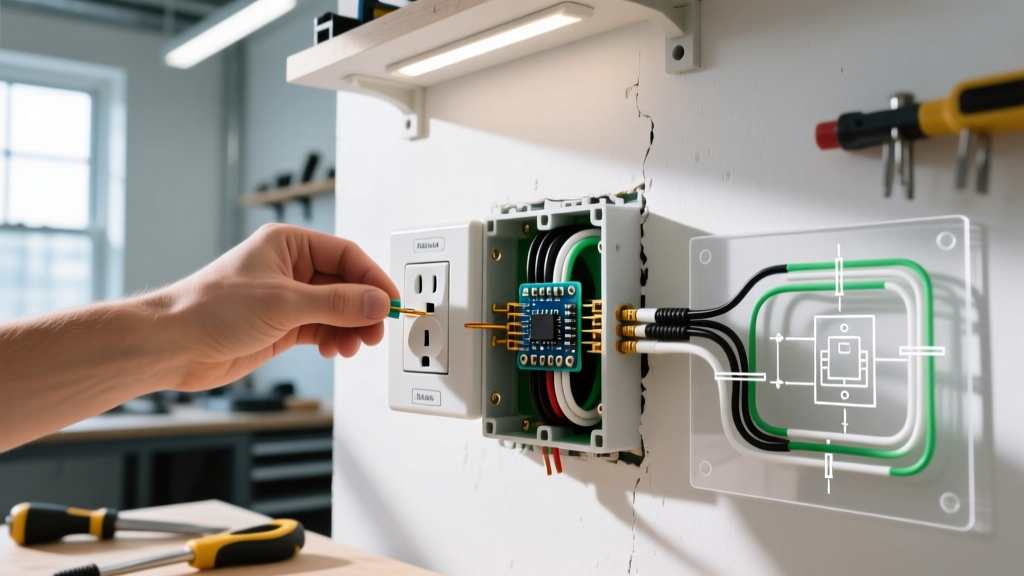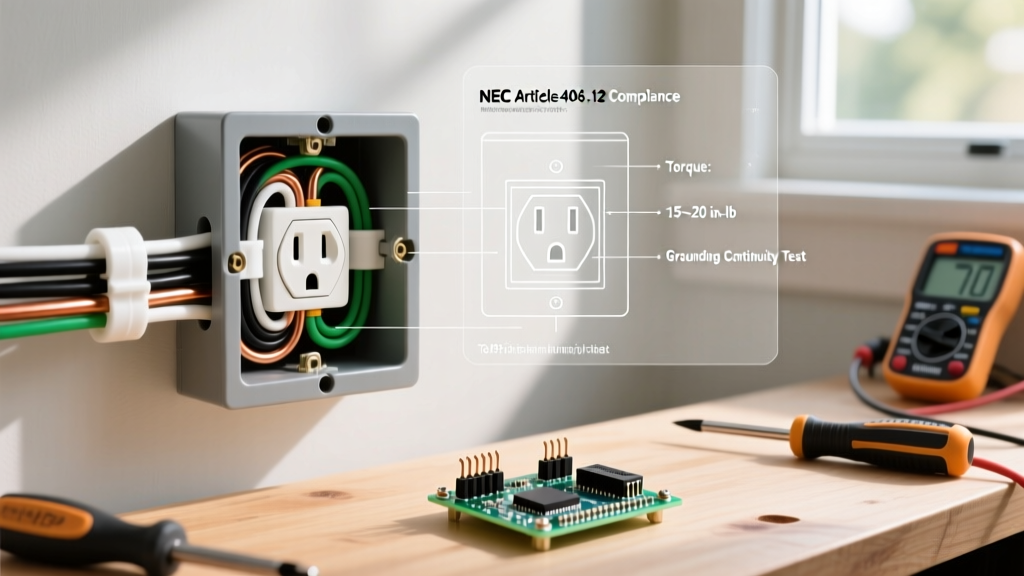

The Evolution of the Safety Electrical Outlet
For decades, standard duplex receptacles posed a severe, hidden hazard in residential environments. According to the Consumer Product Safety Commission (CPSC), thousands of children suffer electrical shocks and burns annually from inserting foreign objects into unshielded outlet slots. The introduction and subsequent mandate of the tamper-resistant safety electrical outlet (commonly known as a TR receptacle) has fundamentally changed residential wiring. Unlike plastic outlet caps—which children can easily remove and choke on—TR outlets feature built-in, spring-loaded shutter mechanisms that permanently block access to the live electrical contacts unless a standard, two- or three-prong plug is inserted with equal, simultaneous pressure.
As a homeowner, electrician, or DIY enthusiast working in 2026, understanding the nuances of TR technology, National Electrical Code (NEC) compliance, and proper installation torque specifications is no longer optional. This guide provides an exhaustive look at the code requirements, internal mechanics, and precise wiring procedures for safety electrical outlets.
The NEC Mandate: Why TR Outlets Are No Longer Optional
The shift toward mandatory tamper-resistant technology began in the 2008 NEC cycle and has been expanded in every subsequent revision, including the 2023 and 2026 NEC updates. Under NEC Article 406.12, all 15-ampere and 20-ampere, 125-volt and 250-volt receptacles installed in dwelling units must be listed as tamper-resistant.
The National Fire Protection Association (NFPA) enforces this code to ensure that safety electrical outlets are installed in all areas of a home, including:
- General living areas and bedrooms
- Kitchens and dining rooms
- Bathrooms and laundry rooms
- Garages and unfinished basements
- Outdoor patio and deck areas (requiring TR/WR combinations)
Are There Any Code Exemptions?
While the mandate is broad, NEC 406.12 does outline a few specific exemptions where a standard (non-TR) receptacle is still legally permissible:
- Height Exemption: Receptacles located more than 5.5 feet above the floor.
- Dedicated Appliance Receptacles: Outlets installed for a specific, dedicated appliance that is not easily moved (e.g., a hardwired-style plug for a built-in microwave or a sump pump in a crawlspace), provided the receptacle is not easily accessible to children.
- Non-Dwelling Units: Commercial and industrial spaces are governed by different articles, though many commercial builders now spec TR outlets universally for liability reduction.
Anatomy of a Tamper-Resistant Safety Electrical Outlet
To troubleshoot or install these devices effectively, you must understand their internal mechanics. A TR receptacle utilizes a dual-shutter system made of high-impact, flame-retardant nylon. When a plug is inserted, the prongs must push both shutters inward at the exact same time. If a child inserts a single object (like a hairpin or a key) into one slot, the opposite shutter locks the mechanism in place, preventing contact with the brass and nickel terminal blades inside.
Receptacle Type Comparison Matrix
| Feature | Standard (Non-TR) | Tamper-Resistant (TR) | Weather-Resistant (WR) | Hospital Grade (HG) |
|---|---|---|---|---|
| Child Safety Shutters | No | Yes | Varies (Usually No) | Yes |
| UV & Corrosion Resistance | No | No | Yes | No |
| Terminal Grip Strength | Standard | Standard | Standard | Enhanced (Medical Grade) |
| NEC Residential Compliance | Violates Code | Compliant | Compliant (Outdoors) | Compliant (Overkill) |
| Average Unit Cost (2026) | $0.65 | $1.85 - $3.20 | $4.50 - $6.00 | $8.00 - $12.00 |
Note: For outdoor residential installations, the NEC requires both Tamper-Resistant (TR) and Weather-Resistant (WR) ratings. Look for the 'TR' and 'WR' stamps on the device yoke.
Step-by-Step Wiring Guide for TR Receptacles
Wiring a safety electrical outlet requires precision. The internal shutters add slight mechanical resistance, meaning the outlet body is marginally deeper than older models. Ensure your electrical boxes have adequate cubic-inch capacity (a standard single-gang box must be at least 18 cubic inches for a single TR duplex receptacle with 14/2 or 12/2 NM cable).
1. Preparation and Verification
Shut off the circuit breaker. Do not rely solely on the breaker label. Use a non-contact voltage tester, such as the Klein Tools NCVT-3, to verify that the wires are completely de-energized. Test the tester on a known live source before and after checking the target wires to ensure the tool's battery is functioning.
2. Wire Stripping and Preparation
Strip exactly 5/8-inch of insulation from the 14 AWG or 12 AWG copper conductors. Do not nick the copper wire, as scoring the metal creates a weak point that can snap under the torque of the terminal screw.
3. Termination: Side-Wiring vs. Back-Stabbing
Never use the push-in (back-stab) connections on the rear of a TR receptacle. While UL-listed, push-in connections rely on a small internal spring clip that can loosen over time due to thermal expansion and contraction, leading to arcing. Always use the side-terminal screws.
CRITICAL CODE WARNING (NEC 110.14(D)): The NEC now requires that terminal screws be tightened to the manufacturer's specified torque. For most 15A and 20A TR receptacles (like the Leviton T5320), the required torque is 14 inch-pounds for 14 AWG wire and 16 inch-pounds for 12 AWG wire. Use a calibrated torque screwdriver, such as the Wiha 645P, to ensure compliance and prevent overheating.
4. Securing the Device
Wrap the wires neatly behind the device. Push the TR receptacle into the box. Because the TR mechanism makes the back of the outlet slightly bulkier, use 1/4-inch spacers or 'caterpillar' shims if the outlet sits recessed more than 1/8-inch from the finished wall surface, per NEC 314.20.
Troubleshooting Common TR Outlet Failures
Homeowners frequently complain that 'the safety electrical outlet is broken' because a plug won't go in. In 90% of cases, the outlet is functioning exactly as designed. Here is how to diagnose and resolve common issues:
- Issue: Plug refuses to insert.
Diagnosis: The plug's prongs are bent, folded, or of unequal length. The TR shutters require perfectly parallel prongs to disengage the locking mechanism.
Solution: Inspect the plug cap. If the prongs are bent, straighten them with pliers or, preferably, cut the cord and install a replacement plug cap (e.g., Leviton R50-00101). - Issue: Shutter is visibly jammed open or stuck closed.
Diagnosis: Drywall dust, paint overspray, or debris has infiltrated the shutter track during construction.
Solution: Turn off the breaker. Use a can of compressed air to blow out the slots. Never use WD-40 or lubricants, as these attract more dust and can degrade the nylon shutters over time. - Issue: Outlet feels excessively warm to the touch.
Diagnosis: Loose terminal connection or daisy-chaining too many high-draw devices.
Solution: Remove the faceplate, check for melted plastic around the brass screws, and re-terminate using a torque screwdriver. If the yoke shows heat damage, replace the outlet immediately.
2026 Market Analysis: Top TR Receptacle Models
When sourcing safety electrical outlets, buying in bulk (10-packs or 50-packs) drastically reduces the per-unit cost. Here are the top-performing, code-compliant models for residential use in 2026:
- Leviton T5320-W (15A, 125V): The industry standard. Features a shallow profile that makes box-fitting easier. Price: ~$2.15 per unit in a 10-pack.
- Eaton TR20W (15A, 125V): Excellent shutter sensitivity; slightly easier to insert stiff plugs compared to competitors. Price: ~$1.85 per unit in a 10-pack.
- Hubbell 5262-TR (15A, 125V): Commercial-spec grade built for high-traffic residential areas (like kitchens). Heavier gauge steel yoke. Price: ~$3.10 per unit.
For further reading on child-proofing your home's electrical system, the Electrical Safety Foundation International (ESFI) provides excellent visual guides and statistical data on TR receptacle efficacy.
Frequently Asked Questions (FAQ)
Do I need to replace my existing non-TR outlets if I am not renovating?
No. The NEC is generally not retroactive. If your home was built before the TR mandate and you are not adding new circuits or altering existing ones, your current outlets are 'grandfathered' in. However, from a safety perspective, upgrading high-risk areas (playrooms, nurseries) is highly recommended and costs less than $50 for a whole room.
Can I use a TR outlet on a 20-amp circuit?
Yes, but you must match the amperage rating. A 15-amp TR receptacle (like the Leviton T5320) can be installed on a 20-amp circuit only if there is more than one receptacle on that circuit (per NEC 210.21(B)(3)). If it is a single, dedicated receptacle on a 20-amp circuit, you must use a 20-amp TR receptacle (which features one T-shaped neutral slot).
Are TR outlets required in the garage and outdoors?
Yes. The 2023 and 2026 NEC cycles require all 125V and 250V receptacles in garages, accessory buildings, and outdoor locations to be tamper-resistant. Outdoor outlets must carry both the TR and WR (Weather-Resistant) listings and be paired with an 'in-use' bubble cover.