
The Anatomy of a Spanish Electrical Outlet: Beyond the Basics
Working with a spanish electrical outlet requires a fundamental shift in perspective for electricians and DIYers accustomed to North American NEMA standards. Spain operates on a 230V ±10% / 50Hz electrical grid, governed by the stringent Reglamento Electrotécnico para Baja Tensión (REBT). The standard receptacle is the Type F (Schuko / CEE 7/4), characterized by two round pins and lateral grounding clips.
Unlike the 120V/15A systems common in the US, Spanish socket circuits are typically protected by 16A miniature circuit breakers (MCBs) and require specialized metric cabling, specific VDE-insulated hand tools, and strict adherence to IEC color codes. This comprehensive tool and material guide details the exact equipment, components, and regulatory frameworks required to safely install, replace, or troubleshoot Spanish Type F receptacles in 2026.
Understanding the Type F (Schuko) Standard & REBT Regulations
Before purchasing materials, it is critical to understand the regulatory environment. According to the Spanish REBT (specifically instruction ITC-BT-19 for indoor wiring), all standard power outlet circuits must be protected by a 30mA residual current device (RCD / interruptor diferencial) to prevent lethal electric shocks. Furthermore, the physical dimensions of the wall boxes and receptacles follow specific European and national UNE standards.
| Feature | Spanish Type F (Schuko) | NEMA 5-15R (US/Canada) |
|---|---|---|
| Voltage / Frequency | 230V / 50Hz | 120V / 60Hz |
| Max Continuous Current | 16A (3680W max load) | 15A (1800W max load) |
| Grounding Mechanism | Lateral metal clips (CEE 7/4) | Third round pin (NEMA) |
| Standard Wire Size | 2.5 mm² (Solid Copper) | 14 AWG (Solid Copper) |
| Wall Box Diameter | 65mm - 72mm (Flush) | Standard Single Gang (Rectangular) |
Essential VDE-Insulated Hand Tools for 230V Systems
When working on live or potentially live 230V circuits, standard hardware store tools are insufficient and dangerous. You must use tools certified to IEC 60900 standards, rated for 1000V. Below is the exact toolkit required for Spanish outlet installations.
1. Voltage Testing & Verification
- Fluke T6-1000 Electrical Tester ($220 - $250): Essential for non-contact and contact voltage verification up to 1000V AC. The 'FieldSense' technology allows you to measure 230V without metal-to-metal contact, drastically reducing arc flash risks when probing Spanish Schuko terminals.
- Wera VDE Spannungsprüfer (Voltage Tester Screwdriver) ($12): A simple but mandatory secondary check tool to verify the absence of voltage at the terminal screws before touching the conductors.
2. Wire Stripping & Preparation
- Jokari No. 20 Automatic Wire Stripper ($35 - $40): Spanish installations use 2.5 mm² H07V-U (solid) or H07V-K (stranded) cables. The Jokari No. 20 cleanly strips the PVC insulation without nicking the copper core, which is critical; a nicked 2.5 mm² wire can create a high-resistance hot spot under a 16A load.
- Knipex 13 26 200 Electrician's Pliers ($55): Combines cutting, gripping, and stripping. The precision tips are necessary for looping 2.5 mm² solid wire if you are terminating on screw-post Schuko receptacles rather than push-in terminals.
3. Fastening & Termination
- Wiha 320P VDE SoftFinish Phillips #2 ($14): Spanish receptacle faceplates and terminal screws require a high-torque PH2 driver. Wiha's 1000V rated insulation ensures safety if the tool slips and bridges a live 230V terminal to the grounded metal backbox.
- Wera Kraftform Kompakt VDE 14 ($65): An interchangeable insulated set that includes the slim-blade Pozidriv (PZ1/PZ2) bits often required for European terminal blocks and mounting brackets.
Sourcing the Right Materials: Receptacles & Cables
Sourcing materials for a spanish electrical outlet project means navigating the European metric system and specific regional brands. Do not attempt to import US 14 AWG wire or NEMA receptacles; they will not fit standard Spanish 65mm backboxes (cajas de mecanismos) and violate REBT codes.
Receptacle Selection (Type F Schuko)
In Spain, three major brands dominate the high-quality residential and commercial market. Expect to pay between €8 and €22 per receptacle depending on the series.
- Simon 82 or Simon 100 Series: Simon is a premier Spanish manufacturer. The Simon 82 series features robust polycarbonate housings and screwless push-in terminals that accept 2.5 mm² solid wire directly, cutting installation time by 40%.
- Legrand Valena Next: Widely available across Europe, featuring a patented 'Grip' mounting frame that self-levels in slightly warped plaster walls, a common issue in older Spanish properties.
- Schneider Electric Odace: Offers excellent thermal resistance and deep terminal chambers, ensuring no exposed copper remains visible after tightening.
Cabling & Conductors
Per IEC 60227 and Spanish REBT guidelines, you must use harmonized European cables. For a standard 16A socket circuit, the mandatory specification is 2.5 mm² cross-sectional area copper.
Expert Note: Never substitute 1.5 mm² wire for a socket circuit. While 1.5 mm² is permissible for lighting circuits (protected at 10A), using it for a 16A Schuko outlet circuit is a severe fire hazard and an automatic failure during an official Boletín Eléctrico (electrical certification) inspection.
Step-by-Step Wiring Sequence & IEC Color Codes
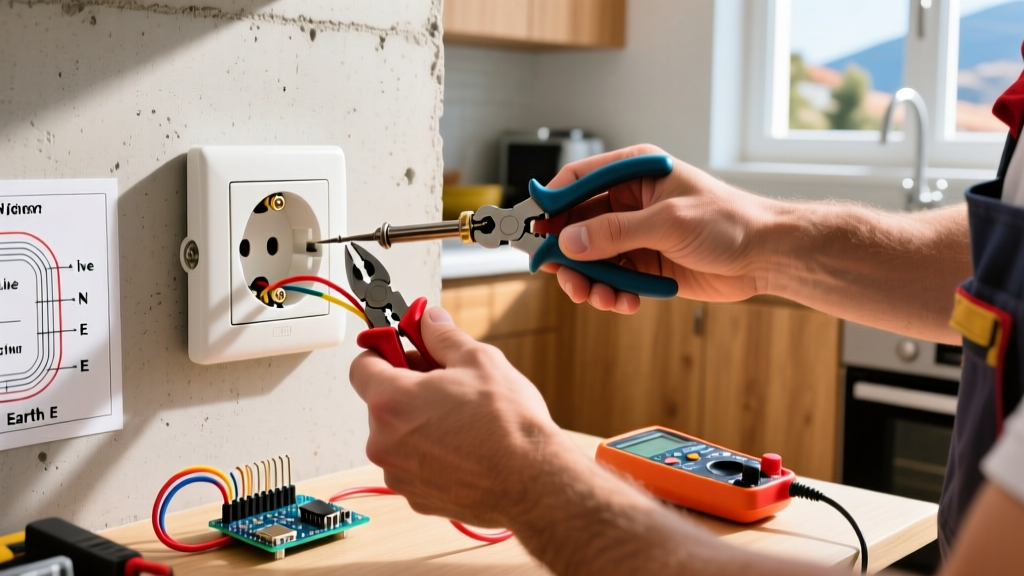
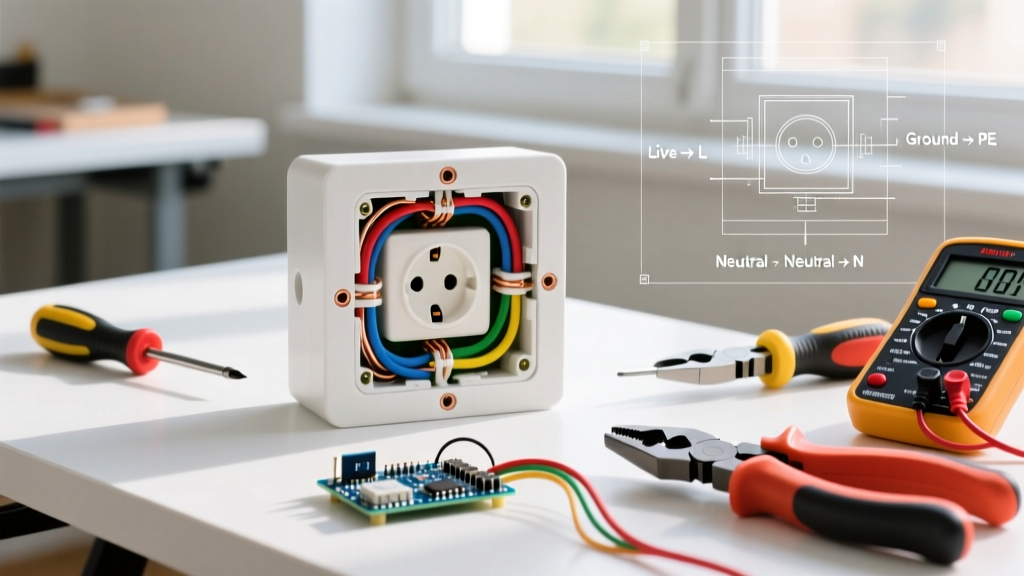
European wiring color codes differ vastly from the US NEC black/white/bare standard. According to international harmonization standards, you must strictly adhere to the following IEC 60446 color codes when terminating your spanish electrical outlet:
- Identify the Conductors:
- Brown: Phase / Line (L) - Carries the 230V.
- Blue: Neutral (N) - The return path.
- Green/Yellow Bicolor: Protective Earth (PE) - Mandatory for Schuko grounding clips.
- Strip the Insulation: Use the Jokari stripper to remove exactly 12mm of insulation. Spanish push-in terminals (like those on the Simon 82) have a strict depth gauge; stripping too little causes a loose connection, while stripping too much leaves live copper exposed.
- Terminate the Earth (PE) First: Always connect the Green/Yellow wire to the central earth terminal (marked with the ⏚ symbol). This ensures the lateral grounding clips are bonded before the circuit is energized.
- Connect Phase and Neutral: Insert the Brown (L) and Blue (N) wires into the designated push-in terminals. While Schuko plugs are reversible and technically non-polarized, Spanish best practice dictates placing the Phase (Brown) on the right terminal and Neutral (Blue) on the left when facing the receptacle.
- Secure the Chassis: Use M3.5 x 25mm machine screws to secure the receptacle's metal chassis to the 65mm wall box, followed by the faceplate.
Safety Gear & Final Circuit Testing
Once the physical installation is complete, you must verify the integrity of the wiring before energizing the 16A MCB at the main distribution board (cuadro eléctrico).
Required Testing Equipment
For professional validation, a simple plug-in tester is not enough. You need an installation tester like the Fluke 1653B ($1,100+) or the more budget-friendly Brennenstuhl PM 231 E ($45) for basic DIY verification.
- Earth Loop Impedance Test: Verifies that the grounding path has low enough resistance to trip the 16A breaker instantly in the event of a short circuit.
- RCD Trip Test: Injects a simulated fault current to ensure the 30mA differential breaker trips within the mandated 300 milliseconds, a strict requirement under REBT ITC-BT-24.
- Polarity Check: Confirms the Phase and Neutral have not been swapped at the distribution board.
Frequently Asked Questions (FAQ)
Can I install a US NEMA 5-15R outlet in my Spanish home?
No. Beyond the physical incompatibility with standard 65mm European backboxes, a US 15A/125V receptacle connected to a 230V Spanish grid will instantly destroy any 120V appliance plugged into it and poses a severe arc flash and fire hazard. If you need to power US appliances, use a high-quality step-down transformer (230V to 120V) rated for the appliance's wattage, or install a dedicated 120V circuit fed by a whole-home step-down transformer.
What is the difference between Type C and Type F outlets in Spain?
As detailed by the International Electrotechnical Commission (IEC), Type C (Europlug) is an ungrounded, 2.5A receptacle typically used only for shavers or low-power bathroom fixtures. Type F (Schuko) is the 16A grounded standard used for all general-purpose room outlets, kitchens, and heavy appliances. Never install an ungrounded Type C outlet in place of a required Type F Schuko.
Do I need a permit to replace a Spanish electrical outlet?
Replacing a damaged like-for-like Type F receptacle does not require a permit or a new Boletín Eléctrico. However, if you are adding new circuits, moving the main panel, or upgrading the overall capacity of the home, Spanish law requires a certified instalador autorizado to perform the work and issue updated certification to the regional industry ministry.