
The Critical Importance of NEC Compliance in Outlet Wiring
When undertaking any residential electrical project, understanding the National Electrical Code (NEC) is not just a matter of passing an inspection—it is the baseline for preventing electrical fires and fatal shocks. The NEC, published by the National Fire Protection Association (NFPA), is updated every three years, with the 2023 and upcoming 2026 cycles introducing stricter safety mandates. For DIYers and professionals alike, mastering the code requirements for wiring for electrical outlet installations ensures your home remains safe, legal, and insurable.
This guide breaks down the exact NEC articles governing receptacle placement, protection, wire sizing, and termination torque, providing actionable frameworks for your next wiring project.
The 6/12 Rule: Receptacle Spacing and Placement (NEC 210.52)
One of the most frequently cited violations during rough-in inspections is improper outlet spacing. NEC Article 210.52 dictates the minimum number and placement of receptacles in dwelling units to prevent the hazardous use of extension cords.
How the 6/12 Rule Works
- The 12-Foot Rule: In any habitable room (living rooms, bedrooms, family rooms), no point along the floor line of any wall space can be more than 6 feet from a receptacle. This effectively means outlets must be spaced no more than 12 feet apart.
- The 6-Foot Wall Rule: Any continuous wall space that is 2 feet or wider (including space measured around corners) requires at least one receptacle.
- Floor Receptacles: Floor-mounted receptacles can count toward the wall space requirement only if they are located within 18 inches of the wall.
Pro-Tip for Kitchen Islands: The 2023 NEC revised rules for kitchen islands and peninsulas. While previously mandated, receptacles are no longer strictly required on islands unless specifically requested by the homeowner, though if installed, they must be GFCI protected and cannot be the sole source of countertop power.
Mandatory Protection: GFCI, AFCI, and TR Requirements
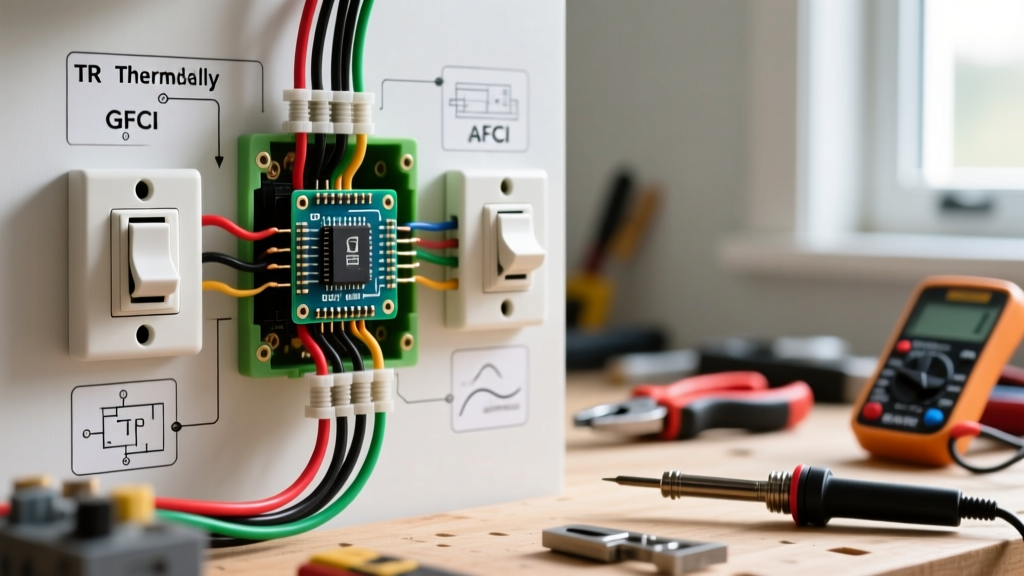
Modern electrical safety relies on three distinct layers of protection. Failing to install the correct type of receptacle in the correct location is an automatic inspection failure.
Tamper-Resistant (TR) Receptacles (NEC 406.12)
All 15-amp and 20-amp, 125-volt and 250-volt non-locking receptacles in dwelling units must be listed as Tamper-Resistant. TR receptacles feature internal shutter mechanisms that block foreign objects from being inserted into a single slot. This applies to nearly every room in the house, including guest rooms in hotels and motels.
Ground-Fault Circuit Interrupter (GFCI) (NEC 210.8)
GFCI protection monitors the current balance between the hot and neutral wires, tripping in milliseconds if a leakage to ground (as low as 4-6 milliamps) is detected. According to the Electrical Safety Foundation International (ESFI), GFCIs prevent thousands of electrocutions annually.
Required Locations: Bathrooms, garages, outdoors, crawlspaces, unfinished basements, kitchens (countertops), laundry areas, boathouses, and any receptacle within 6 feet of a sink, bathtub, or shower.
Arc-Fault Circuit Interrupter (AFCI) (NEC 210.12)
AFCI protection detects dangerous electrical arcs (sparks) that can ignite surrounding combustible materials. While GFCIs protect people, AFCIs protect property from fire.
Required Locations: All 120-volt, single-phase, 15- and 20-amp branch circuits supplying outlets in family rooms, dining rooms, living rooms, parlors, libraries, dens, bedrooms, sunrooms, recreation rooms, closets, hallways, and laundry areas.
Wire Sizing, Ampacity, and Receptacle Ratings
Mismatching wire gauge, breaker size, and receptacle rating is a severe fire hazard. NEC Article 210.21 and Article 240 strictly govern these pairings.
| Circuit Breaker Size | Minimum Copper Wire Gauge (NM-B) | Permitted Receptacle Rating | Common Application |
|---|---|---|---|
| 15 Amp | 14 AWG | 15 Amp | General lighting, bedrooms, living rooms |
| 20 Amp | 12 AWG | 15 Amp or 20 Amp | Kitchen countertops, bathrooms, garages |
| 30 Amp | 10 AWG | 30 Amp (Locking/Specialty) | Dryers, RV hookups, heavy machinery |
Crucial Code Nuance: Under NEC 210.21(B)(3), you are legally permitted to install standard 15-amp duplex receptacles (like the Leviton R52-05320-00W) on a 20-amp circuit, provided there is more than one receptacle on the circuit. This is why most modern kitchens use 12 AWG wire on a 20-amp breaker, but feature standard 15-amp duplex GFCI outlets.
Advanced Code Requirements: Torque and Box Fill
Many DIYers overlook the mechanical requirements of the NEC, focusing solely on the electrical routing. However, two specific articles frequently cause failed inspections in 2026.
Termination Torque (NEC 110.14(D))
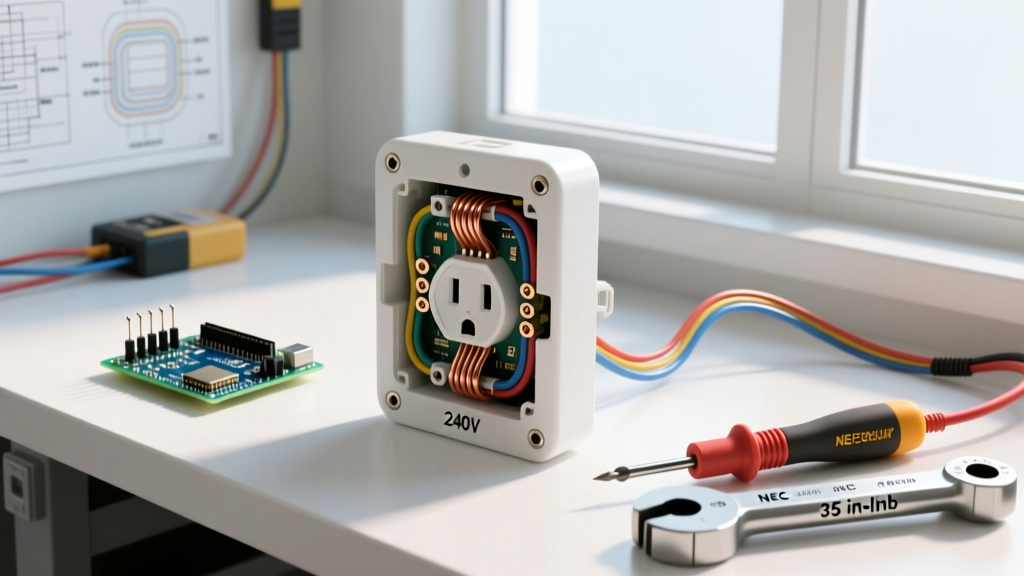
Introduced in recent NEC cycles and heavily enforced today, Article 110.14(D) requires that all screw terminal connections be tightened to the manufacturer's specified torque using a calibrated torque screwdriver.
- Standard 15A/20A Receptacles: Typically require 9 to 14 inch-pounds of torque.
- Failure Mode: Under-torqued screws cause high-resistance connections, leading to thermal expansion, arcing, and eventual melting of the outlet yoke. Over-torquing strips the brass threads or shears the screw head.
Box Fill Calculations (NEC 314.16)
You cannot endlessly cram wires into a single-gang electrical box. Box fill is calculated based on the volume of the box (measured in cubic inches) versus the size and number of conductors, clamps, and devices.
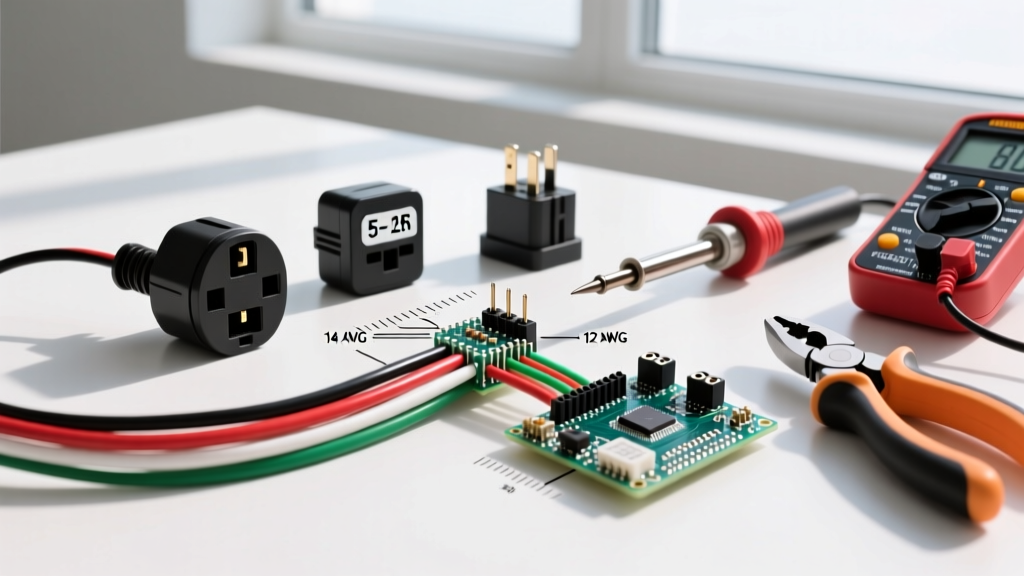
- 14 AWG Wire: Counts as 2.0 cubic inches per conductor.
- 12 AWG Wire: Counts as 2.25 cubic inches per conductor.
- The Device (Outlet): Counts as 2x the wire volume (e.g., a 15A outlet on 14 AWG wire takes up 4.0 cubic inches).
Example: A standard Carlon B618R single-gang nail-on box has a volume of 18 cubic inches. If you are wiring a pass-through outlet (power in, power out) using 12/2 NM-B cable, you have 4 current-carrying conductors (9 cu in), 2 ground wires (1.125 cu in), and the device itself (4.5 cu in). Total fill: 14.625 cubic inches. This fits safely within the 18 cu in box.
Grounding and Pigtailing Best Practices
NEC 250.148 requires an equipment grounding conductor to be connected to the receptacle's green grounding screw. While the code allows the metal yoke of the receptacle to serve as the grounding path in metal boxes, this is highly discouraged in modern DIY and professional work.
The Pigtailing Method
Always use a "pigtail"—a short 6-inch piece of bare copper wire—connected via a wire nut or WAGO lever connector to join the incoming ground, outgoing ground, and the receptacle's ground screw. Why? If you daisy-chain the ground wire through the outlet's green screw and later remove the outlet to replace it, you break the ground path for all downstream outlets, creating a hidden shock hazard.
Common Code Violations to Avoid
- Backstabbing (Push-in Terminals): While UL-listed for 14 AWG solid wire only, push-in terminals rely on a weak internal spring grip. Over time, thermal cycling loosens the grip, causing arcing. Always use the side-screw terminals or a torque screwdriver for termination.
- Reverse Polarity: Connecting the black (hot) wire to the silver screw and the white (neutral) to the brass screw. The hot wire must always connect to the smaller slot (brass screw) to ensure the internal switch of an appliance breaks the hot leg.
- Missing AFCI/GFCI in Transitional Spaces: Forgetting that hallways, closets, and areas within 6 feet of a wet bar sink require specific arc-fault or ground-fault protection.
Frequently Asked Questions
Can I mix 14 AWG and 12 AWG wire on the same circuit?
Technically, the NEC does not explicitly forbid it, provided the breaker is sized for the smallest wire (15 Amp for 14 AWG). However, it is a massive red flag for inspectors and future electricians, who may assume the 12 AWG wire allows for a 20-amp breaker, leading to a future fire hazard. Keep wire gauges uniform per circuit.
Do I need a permit for wiring for electrical outlet additions?
Yes. In almost all municipalities, adding new circuits or extending existing wiring requires an electrical permit and a rough-in/final inspection by the local Authority Having Jurisdiction (AHJ). Replacing an existing outlet with a new one of the same rating typically does not require a permit.
Where can I find the exact NEC codes for my area?
While the NFPA publishes the base NEC, your state or county may adopt specific amendments. Always check with your local building department. For general safety guidelines and explanations, the ESFI's AFCI and GFCI resources are excellent starting points.