
Navigating the Electric Plug Outlet in South Korea: Standards and Safety
South Korea boasts one of the most advanced and reliable electrical grids in the world, managed primarily by the Korea Electric Power Corporation (KEPCO). However, for electricians, expats, and DIY enthusiasts, understanding the specific code requirements for an electric plug outlet in South Korea is critical. The country has undergone a massive electrical transition over the last few decades, moving from a split 110V/220V system to a unified 220V standard. This guide breaks down the Korean Industrial Standards (KS), wiring color codes, and mandatory safety protocols you need to know for compliant installations in 2026.
Core Specifications: Voltage, Frequency, and Plug Types
Before pulling any wire, it is essential to understand the baseline electrical parameters. South Korea operates on a 220V supply voltage and a 60Hz frequency. This 60Hz frequency is a crucial differentiator from European countries, which use 220-240V at 50Hz. While the physical plug may look European, the frequency difference can affect the operational speed and thermal performance of imported AC motors and timing circuits.
Approved Receptacle Types
According to the International Electrotechnical Commission (IEC), South Korea officially utilizes Type C and Type F configurations. However, modern building codes heavily favor Type F for all new permanent installations.
| Feature | Type C (Europlug Socket) | Type F (Schuko / KS Standard) |
|---|---|---|
| Grounding | Ungrounded (2-pin) | Grounded (2 earth clips) |
| Current Rating | Up to 2.5A (Receptacle limit) | 16A to 20A |
| Code Compliance | Restricted to low-power lighting/specific fixtures | Mandatory for general purpose and appliance outlets |
| Child Safety Shutters | Not always required | Mandatory for residential (KS C 8305) |
Korean Electrical Code (KEC) and KS Standards Explained
The installation of any electric plug outlet in South Korea is governed by the Korean Electrical Safety Act and enforced through the Korean Industrial Standards (KS), overseen by the Korean Agency for Technology and Standards (KATS). The primary standard for household receptacles is KS C 8305, which is heavily harmonized with the international IEC 60884-1 standard but includes specific national deviations for thermal endurance and shutter mechanisms.
Mandatory Grounding and Earth Leakage Protection
Historically, many older Korean apartments built in the 1980s and early 1990s lacked proper equipment grounding, relying instead on neutral-ground bonding at the panel—a practice now strictly prohibited. Today, the Korean Electrical Code mandates a dedicated equipment grounding conductor (EGC) for all 16A and 20A receptacle circuits.
- Residual Current Devices (RCDs): Under KS C 8471, RCDs (Ground Fault Circuit Interrupters) are mandatory for all outlets located in wet areas (bathrooms, kitchens, laundry rooms) and outdoor spaces. The required sensitivity is 30mA for personal shock protection, with a maximum trip time of 30 milliseconds at 5x the rated residual current (150mA).
- Arc Fault Protection (AFDD): While not yet universally mandated for every residential bedroom as it is in the US NEC, AFDDs are increasingly specified in high-end residential builds and commercial dormitories in Seoul and Busan to mitigate electrical fire risks.
Wiring Color Codes and Installation Practices
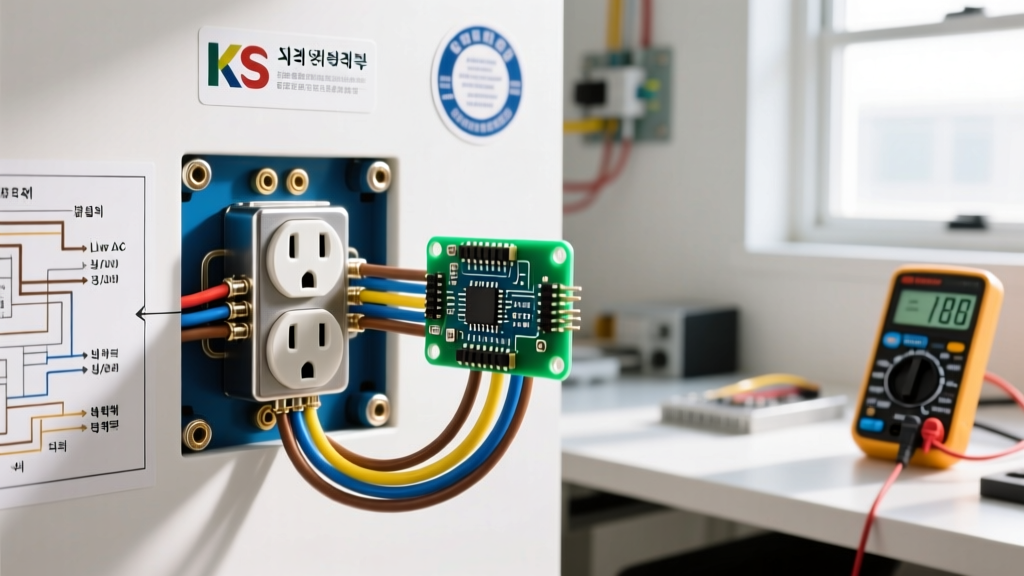
When wiring a Type F Schuko outlet, electricians must adhere to the harmonized KS C IEC 60446 color codes. Miswiring the line and neutral can bypass the internal switching mechanisms of imported appliances, creating a severe shock hazard during maintenance.
Standard Color Assignments
- Line (Phase): Brown (Modern) or Black/Red (Legacy installations pre-2010)
- Neutral: Blue (Modern) or White (Legacy)
- Earth/Ground: Green-and-Yellow striped (Strictly enforced, no legacy alternatives permitted)
Wire Sizing and Termination Torque
For standard 20A receptacle circuits, the minimum wire gauge is 2.5 mm² (roughly equivalent to 13 AWG, sitting between US 14 AWG and 12 AWG). When terminating 2.5 mm² solid copper wire into the screw terminals of a KS-certified Type F outlet, the manufacturer-specified torque is typically 0.8 Nm to 1.2 Nm. Under-torquing leads to high-resistance connections, which thermal imaging often reveals as hotspots exceeding 60°C under continuous 16A loads (such as running a Kimchi refrigerator or induction cooktop).
Expert Insight: Always verify the 'KC' (Korea Certification) mark on the back of the receptacle. Outlets imported directly from European or Chinese markets without the KC mark may not have the exact dimensional tolerances required for Korean standard faceplates, and they will fail the final KEPCO safety inspection.
Common Edge Cases and Troubleshooting
The 110V Legacy Problem
If you are renovating an older apartment (particularly in districts like Gangnam or Mapo built before 1995), you may encounter 110V Type A/B outlets. The South Korean government completed its 220V conversion mandate years ago, but some hidden, abandoned 110V wiring remains behind walls. Do not simply swap the receptacle to 220V without tracing the circuit back to the breaker panel. The old wiring may be 1.5 mm², which is insufficient for modern 20A 220V loads, and the breaker will likely be an obsolete 110V model. The code-compliant solution is a complete circuit replacement with 2.5 mm² wire and a modern 220V MCB (Miniature Circuit Breaker).
High-Draw Appliance Receptacles
For appliances exceeding 3.5 kW (such as large commercial air conditioning units or heavy-duty workshop equipment), a standard 16A/20A Type F electric plug outlet in South Korea is insufficient. The code requires dedicated hardwired connections or specialized KS C 8305 industrial plugs (often 30A or 50A configurations) with isolated circuits and dedicated 30mA RCD protection.
Frequently Asked Questions (FAQ)
Can I use US-standard 120V appliances in South Korea?
Physically, a US Type A/B plug will not fit into a Korean Type F outlet. Even with a physical adapter, plugging a 120V appliance directly into a 220V outlet will destroy the device and pose a fire hazard. You must use a heavy-duty step-down transformer (220V to 110V) rated for at least 150% of the appliance's maximum wattage to handle startup surges.
Are Type C ungrounded outlets legal in new homes?
Under current KS standards, Type C ungrounded sockets are largely phased out for general-purpose wall receptacles in new residential construction. Type F (grounded) is the mandatory baseline for all 16A/20A wall outlets to ensure equipment grounding for modern electronics and surge protectors.
What is the standard height for outlet installation?
While the Korean Electrical Code does not strictly mandate a universal height for all residential outlets, standard construction practice places general-purpose receptacles at 30 cm to 40 cm (12 to 16 inches) above the finished floor. Kitchen counter outlets are typically installed at 110 cm (43 inches), and bathroom outlets are positioned away from direct water splash zones, integrated with IP44-rated waterproof covers.
Conclusion
Installing or upgrading an electric plug outlet in South Korea requires strict adherence to KS C 8305 standards, proper 2.5 mm² wire sizing, and mandatory grounding protocols. Whether you are dealing with a modern smart-home build in Seoul or retrofitting a legacy 1980s apartment, respecting the 220V/60Hz parameters and integrating 30mA RCD protection will ensure a safe, code-compliant, and highly functional electrical system.