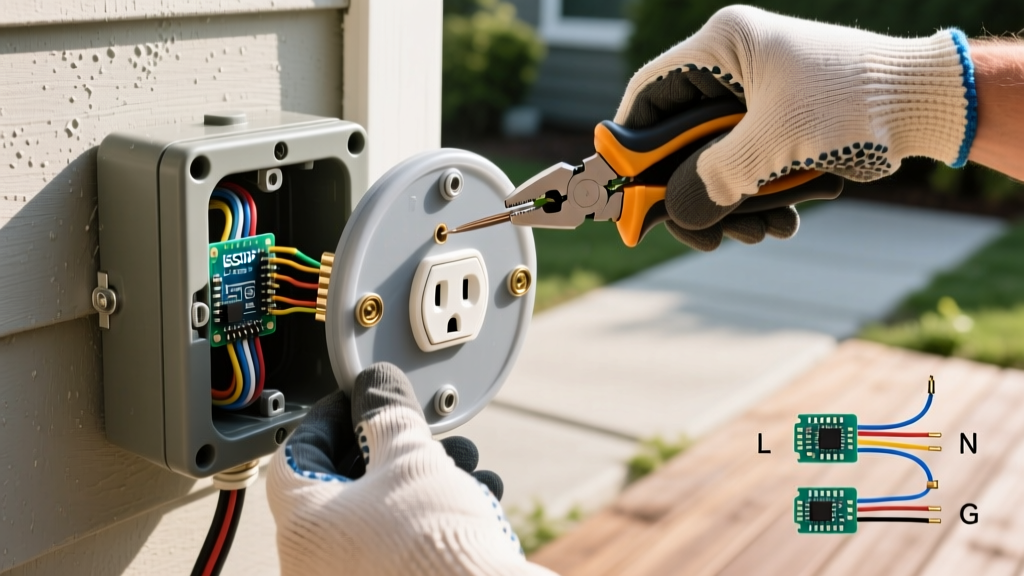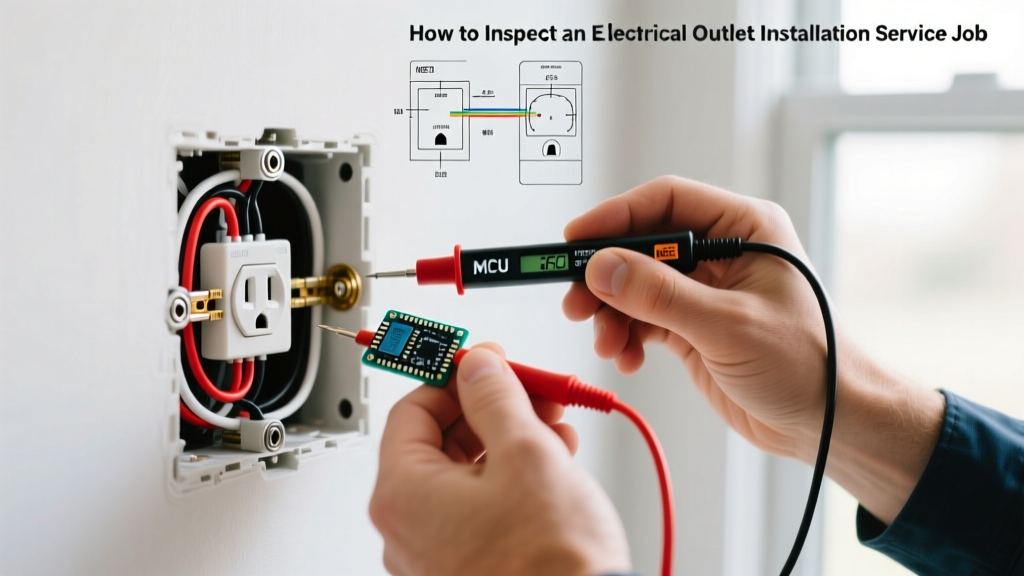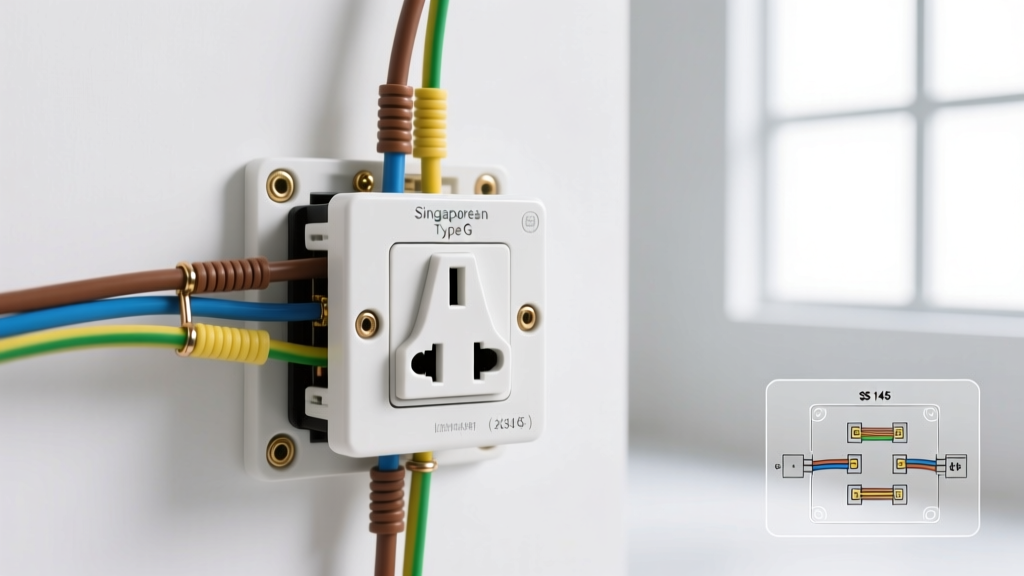

Decoding the Singapore Electrical Outlet Type: Standards and Safety
When planning an electrical installation, retrofit, or renovation in Singapore, understanding the precise regulatory landscape is non-negotiable. The standard Singapore electrical outlet type is the Type G (3-pin rectangular), operating on a 230V supply voltage and 50Hz frequency. However, simply buying a Type G socket is not enough to pass inspection. Every installation must strictly adhere to the Singapore Standard SS 638 (Code of Practice for Electrical Installations) and SS 145 (Plugs and Socket-Outlets).
As of 2026, the Energy Market Authority (EMA) and the Consumer Product Safety Office (CPSO) enforce rigorous safety frameworks, including the Controlled Goods Scheme. This guide breaks down the exact code requirements, wiring specifications, and mandatory protection devices required for compliant outlet installations in Singapore.
Physical Specifications and the SS 145 Standard
The Singapore electrical outlet type is physically identical to the UK’s BS 1363 standard, but locally it is governed by SS 145. Under this standard, all domestic and commercial socket-outlets must meet specific mechanical and electrical safety criteria:
- Rating: Standard sockets are rated at 13 Amps. While the circuit breaker may be rated higher (e.g., 20A or 32A for radial circuits), the individual socket faceplate is strictly limited to 13A continuous draw.
- Shutter Mechanism: SS 145 mandates that all socket-outlets must have interlocking safety shutters. The earth pin (the longest pin) must mechanically open the shutters for the live and neutral pins to prevent foreign object insertion.
- Fusing: Unlike some international standards, fuses are not located in the Singapore wall socket. Overcurrent protection for the appliance is handled by the fuse inside the plug top (typically 3A or 13A BS 1362), while the branch circuit is protected by an MCB/RCD at the distribution board (DB).
⚠️ Compliance Warning: All plugs and adapters imported or sold in Singapore must carry the SAFETY Mark under the Controlled Goods Scheme (CGS). Installing unmarked, non-compliant imported sockets (e.g., direct unmodified purchases from overseas e-commerce sites) is a violation of the Consumer Protection (Safety Requirements) Regulations.
SS 638 Code Requirements for Outlet Circuits
Wiring the Singapore electrical outlet type requires adherence to SS 638 circuit design principles. Historically, Singapore relied heavily on UK-style 32A Ring Final Circuits. However, modern HDB BTO (Build-To-Order) flats and private condominiums predominantly utilize Radial Circuits due to their superior fault-finding characteristics and reduced risk of undetected neutral discontinuity.
Circuit Breaker Sizing and Cable Selection
The sizing of the Miniature Circuit Breaker (MCB) and the corresponding copper conductor cross-sectional area must be perfectly matched to the installation method (e.g., clipped direct, conduit, or trunking).
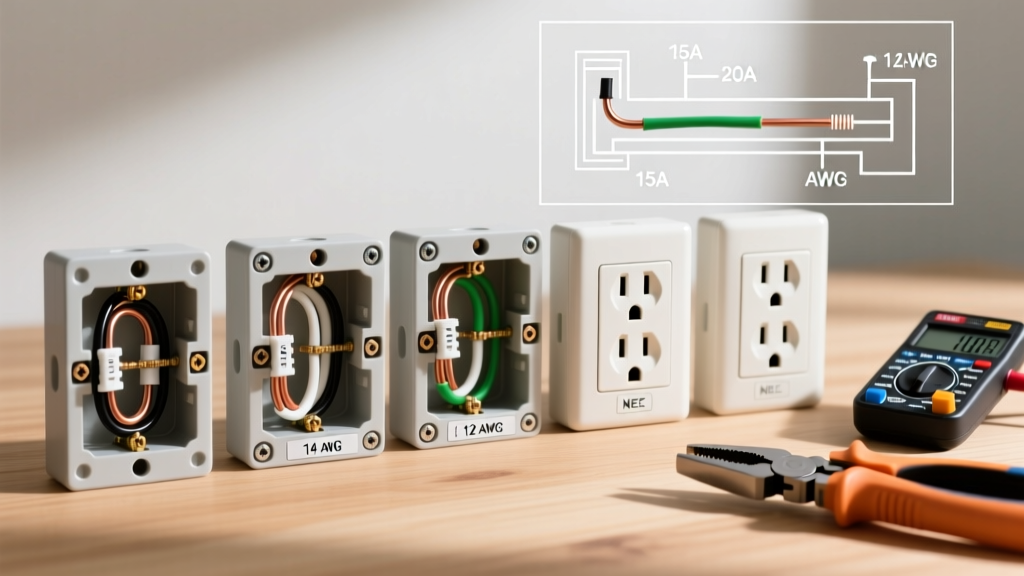
| Circuit Type | MCB Rating | Min. Cable Size (PVC/PVC) | Min. Cable Size (LSZH) | Max Floor Area Served |
|---|---|---|---|---|
| Standard Radial | 20A (Type C) | 2.5 mm² | 2.5 mm² | 50 m² |
| Heavy Duty Radial | 32A (Type C) | 4.0 mm² | 4.0 mm² | 75 m² |
| Legacy Ring Final | 32A (Type B/C) | 2.5 mm² | 2.5 mm² | 100 m² |
| Dedicated Appliance | 16A / 20A | 2.5 mm² | 2.5 mm² | N/A (Single Point) |
Note: In 2026, Low Smoke Zero Halogen (LSZH) cables are strictly mandated for all new concealed wiring in HDB flats and commercial escape routes to prevent toxic smoke emission during a fire.
Mandatory RCD Protection and Earthing
One of the most critical updates in recent revisions of SS 638 is the mandate for Residual Current Device (RCD) protection. According to the Energy Market Authority's electrical safety guidelines, all socket-outlets rated up to 32A that may be used by ordinary persons must be protected by an RCD with a residual operating current not exceeding 30mA.
Type A vs. Type AC RCDs
For decades, Type AC RCDs (which only detect alternating residual currents) were the norm. However, modern Singaporean households are filled with inverter-driven appliances (washing machines, variable-speed air conditioners, EV chargers) that can produce pulsating DC fault currents. These DC components can saturate and blind a standard Type AC RCD.
2026 Code Requirement: For circuits supplying modern inverter appliances, Type A RCDs (or Type F/B where applicable) are now strongly specified by licensed electrical workers (LEWs) to ensure the RCD trips reliably under mixed AC/DC fault conditions.
Earthing Systems (TN-C-S)
Singapore’s national grid primarily utilizes a TN-C-S (Protective Multiple Earthing) system. The earth and neutral are combined at the service intake (PME) and separated at the main distribution board. The earth electrode at the premises acts as a backup. The earth continuity conductor (ECC) to every socket must be continuous and strictly terminated at the socket’s earth terminal—never daisy-chained via the faceplate screws alone.
Harmonized Wiring Color Codes
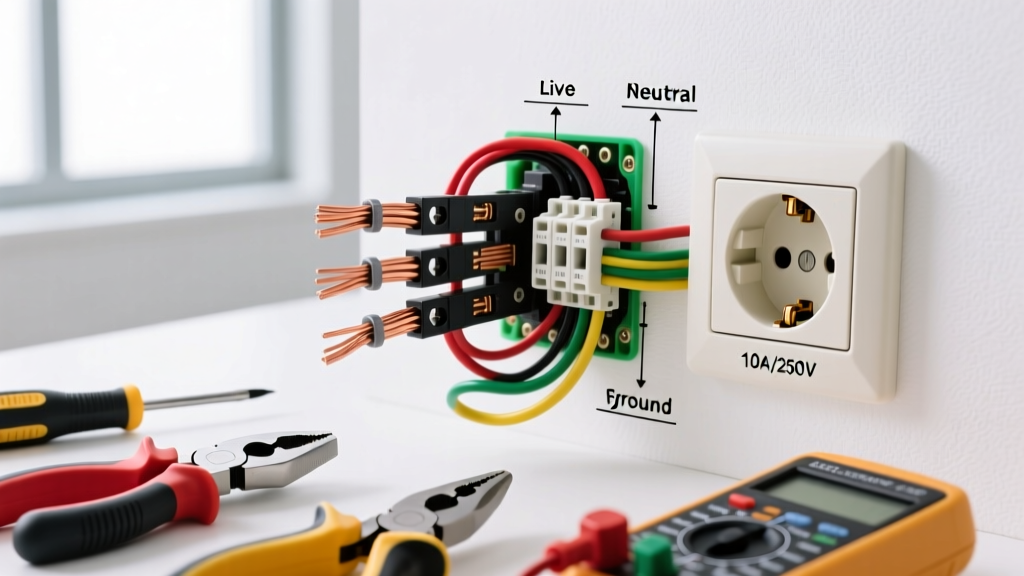
Singapore fully adopted the IEC harmonized color codes for fixed wiring. If you are troubleshooting an older installation (pre-2009), you may encounter the legacy colors. When extending or modifying circuits, the new colors must be used, and clear warning labels must be applied at the DB if both color schemes coexist in the same conduit.
| Function | Current IEC Harmonized Color | Legacy Color (Pre-2009) |
|---|---|---|
| Live (Line) | Brown | Red |
| Neutral | Blue | Black |
| Earth (Protective) | Green/Yellow Stripe | Green (or bare copper) |
Installation Heights, Spacing, and Zoning
The physical placement of the Singapore electrical outlet type is governed by both the Building and Construction Authority (BCA) accessibility guidelines and SS 638 zoning rules for wet areas.
- Standard Living/Bedrooms: Sockets are typically installed at 300mm to 450mm from the finished floor level. For aging-in-place (universal design) HDB flats, sockets are raised to 600mm - 800mm to prevent bending.
- Kitchen Countertops: Switched socket-outlets must be installed at least 100mm above the work surface and horizontally distanced from the sink bowl to prevent water splash ingress.
- Bathrooms (Zoning): Standard 230V socket-outlets are strictly prohibited in Zones 0, 1, and 2 of a bathroom. A shaver supply unit (isolated transformer to BS EN 61558-2-5) is the only permissible outlet, and it must be located outside Zone 2 (typically at least 600mm from the edge of the bath or shower tray).
Common Code Violations in Singapore Renovations
During HDB BTO key collections and private condo resale inspections in 2026, Licensed Electrical Workers (LEWs) frequently flag the following violations committed by unlicensed handymen or interior designers:
- Spurring off Lighting Circuits: Tapping a 13A socket from a 1.5mm² / 10A lighting circuit. This is a severe fire hazard as the 1.5mm² cable will melt before the 10A MCB trips under a heavy socket load.
- Missing Earth Sleeving: Leaving the green/yellow earth wire bare inside the backbox. SS 638 requires proper insulation sleeving right up to the terminal.
- Overloading Radial Spurs: Adding an unfused spur to an already fully loaded 20A radial circuit, causing the main cable to carry more current than its thermal rating allows.
Cost Expectations for Compliant Installations (2026)
If you are hiring an EMA-licensed electrical contractor to install new Singapore electrical outlet types, expect the following market rates for concealed PVC conduit rewiring:
- New Socket Point (Radial Circuit Extension): SGD 120 – SGD 160 per point (includes hacking, 2.5mm² LSZH cable, backbox, and making good).
- DB Upgrade (Adding 30mA Type A RCD): SGD 250 – SGD 400 depending on the brand (e.g., Schneider Electric Acti9 or ABB System Pro M).
- Earth Impedance Testing & Certification: SGD 150 – SGD 250 (Mandatory for commercial spaces or whole-house rewiring to receive the CS3 certificate).
Frequently Asked Questions (FAQ)
Can I install a US or European socket in my Singapore home?
Technically, you can install a universal socket faceplate, but it must be wired to the local 230V/50Hz supply. Plugging a 110V US appliance directly into a universal socket wired to 230V will destroy the appliance and cause a fire. Furthermore, non-SS 145 compliant faceplates may lack the mandatory safety shutters required by Singapore law, making them illegal to install in domestic environments.
Do I need a permit from HDB to add new electrical outlets?
Yes. Any electrical rewiring or addition of new socket points in an HDB flat must be carried out by an EMA-Licensed Electrical Worker (LEW). The contractor must submit a permit application via the HDB e-Service portal before hacking walls or pulling new cables through the structural concrete slabs.
Why does my Type G plug have a plastic earth pin?
Many modern double-insulated (Class II) appliances, such as phone chargers or table lamps, do not require an earth connection. However, to comply with SS 145 and open the socket's safety shutters, the plug is manufactured with a non-conductive plastic or insulated dummy earth pin. Never replace this with a metal pin, and never use a 'cheater' adapter to bypass the earth pin requirement.