
The Hidden Complexities of Moving a Receptacle
Relocating an electrical outlet seems like a straightforward weekend project: cut a new hole in the drywall, fish a wire, and swap the device. However, the National Electrical Code (NEC) strictly governs where, how, and with what level of protection receptacles can be placed. Whether you are moving a plug behind a wall-mounted television, shifting a kitchen counter receptacle to accommodate a new tile backsplash, or dropping an outlet closer to the floor for ADA compliance, ignoring NEC Articles 210, 300, and 406 can result in failed inspections, severe fire hazards, or fatal shock risks.
This guide breaks down the exact code requirements for relocating electrical outlet placements in residential settings, providing the actionable specificity and product-level detail required for a safe, code-compliant installation.
NEC Article 210: The Spacing and Reach Mandates
When you relocate an outlet, you are not just moving a single device; you are altering the spatial coverage of the room's electrical grid. The NEC dictates that receptacles must be placed so that no point along the floor line is left without access to power.
The 6-Foot and 12-Foot Rule (NEC 210.52)
In general living areas (living rooms, bedrooms, hallways), the NEC mandates that no point along the unbroken floor line of any wall space can be more than 6 feet from a receptacle. Furthermore, any wall space wider than 24 inches must have its own dedicated outlet. If you are relocating an outlet to a new stud bay, you must measure the distance to the adjacent outlets. If moving the receptacle creates a gap where a point on the wall is now 7 feet away from the nearest plug, your relocation violates the code.
Kitchen Countertop Relocations (NEC 210.52)
Kitchen countertops have zero tolerance for spacing errors. The code requires that no point along the countertop wall line can be more than 24 inches from a receptacle. Additionally, any countertop space wider than 12 inches requires an outlet. If you are relocating a kitchen outlet, it must remain on a 20-amp Small Appliance Branch Circuit (SABC). You cannot legally relocate a kitchen SABC outlet to feed a living room entertainment center or a dining room light fixture.
Receptacle Spacing Requirements by Zone
Use the following matrix to verify your relocation plans against NEC minimums before cutting into your drywall.
| Room / Zone Type | Maximum Distance Between Outlets | Maximum Reach from Any Wall Point | Circuit Requirement |
|---|---|---|---|
| General Living Areas | 12 feet (unbroken wall) | 6 feet | 15A or 20A General |
| Kitchen Countertops | 4 feet | 24 inches | 20A SABC (Min. 2 circuits) |
| Bathroom Vanities | N/A (Must be within 36" of basin) | 36 inches from basin edge | 20A Dedicated Bathroom |
| Garages & Basements | At least one per vehicle bay | N/A (Specific placement rules apply) | 20A GFCI Protected |
Protection Mandates: GFCI, AFCI, and TR Requirements
A common misconception among DIYers is that if an existing outlet was not previously protected by a Ground Fault Circuit Interrupter (GFCI) or Arc Fault Circuit Interrupter (AFCI), relocating it allows it to remain unprotected. This is false. Under NEC 406.4(D), when you relocate, replace, or extend a receptacle, it must be brought up to current code protection standards for that specific zone.
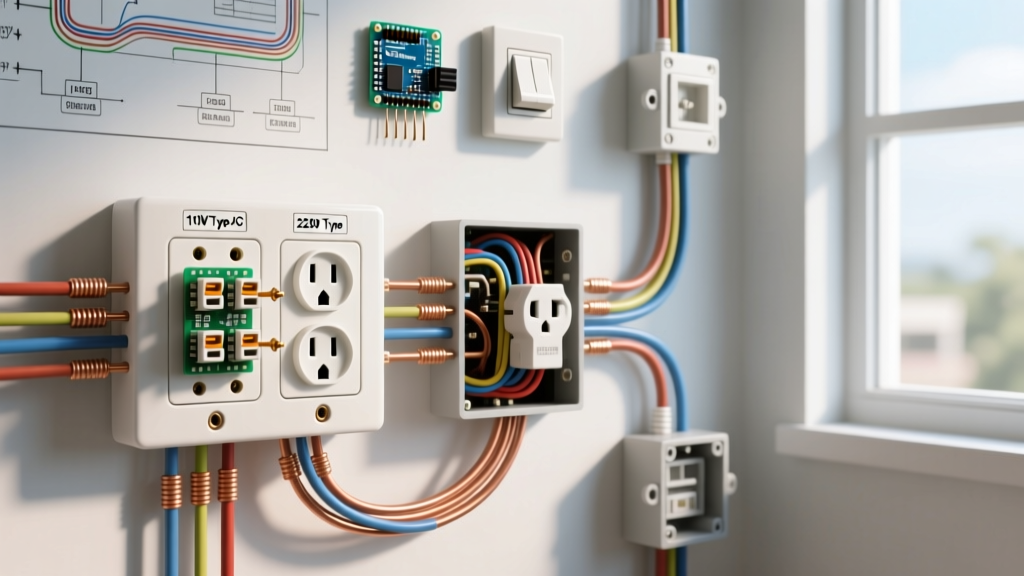
- GFCI Protection (NEC 210.8): If you relocate an outlet in a kitchen, bathroom, garage, unfinished basement, crawl space, or outdoors, the new location must be GFCI protected. For a single-point relocation, using a Tamper-Resistant GFCI receptacle like the Leviton T5280-W is the most cost-effective solution, avoiding the need to upgrade the entire circuit breaker at the panel.
- AFCI Protection (NEC 210.12): If you are extending or relocating an outlet in a bedroom, family room, dining room, or closet, the circuit must be AFCI protected to prevent electrical fires caused by arcing. If the existing breaker is not an AFCI, you must upgrade the breaker or install an OBC (Outlet Branch Circuit) AFCI receptacle at the first outlet in the circuit run.
- Tamper-Resistant (TR) Mandate (NEC 406.12): Every 15-amp and 20-amp, 125-volt and 250-volt non-locking receptacle installed or relocated in a dwelling unit must be TR-rated to prevent children from inserting foreign objects into the slots.
Expert Insight: Never use a standard receptacle in a relocation project. The price difference between a standard $1.50 receptacle and a $3.50 TR/GFCI receptacle is negligible compared to the cost of a failed inspection or a safety hazard. Always default to TR-rated devices for all general relocations.
Box Fill Calculations and Cable Routing (NEC 314 & 300)
When moving an outlet, you will likely use an 'old work' (remodel) electrical box. The NEC strictly regulates how many wires can be crammed into these boxes to prevent overheating and insulation damage.
Calculating Cubic Inches (NEC 314.16)
Every wire, clamp, and device inside the box takes up physical space, measured in cubic inches. For standard 14 AWG wire, each conductor counts as 2.0 cubic inches. For 12 AWG wire, each counts as 2.25 cubic inches. The device (the receptacle itself) counts as two wire volumes. If you are using a standard single-gang old work box like the Carlon B618R (which has a capacity of 18 cubic inches), you can safely accommodate one 12/2 NM-B cable entering (2 conductors + ground), plus the receptacle (2 volumes), totaling 4 wire volumes. 4 x 2.25 = 9 cubic inches. This leaves plenty of room. However, if you attempt to daisy-chain a second cable out of that same 18-cubic-inch box, you will exceed the box fill limit, violating the code and creating a severe fire risk.
Cable Protection (NEC 300.4)
When fishing new NM-B (Romex) cable from the old outlet location to the new one, you must protect the cable from drywall screws and nails. If the cable is routed through a wooden stud and is less than 1.25 inches from the edge of the stud face, NEC 300.4 requires the installation of a steel nail plate (such as the Gardner Bender NP-20) over the stud to prevent fasteners from piercing the wire.
Step-by-Step Code-Compliant Relocation Workflow
Follow this sequence to ensure your relocation meets both safety and inspection standards.
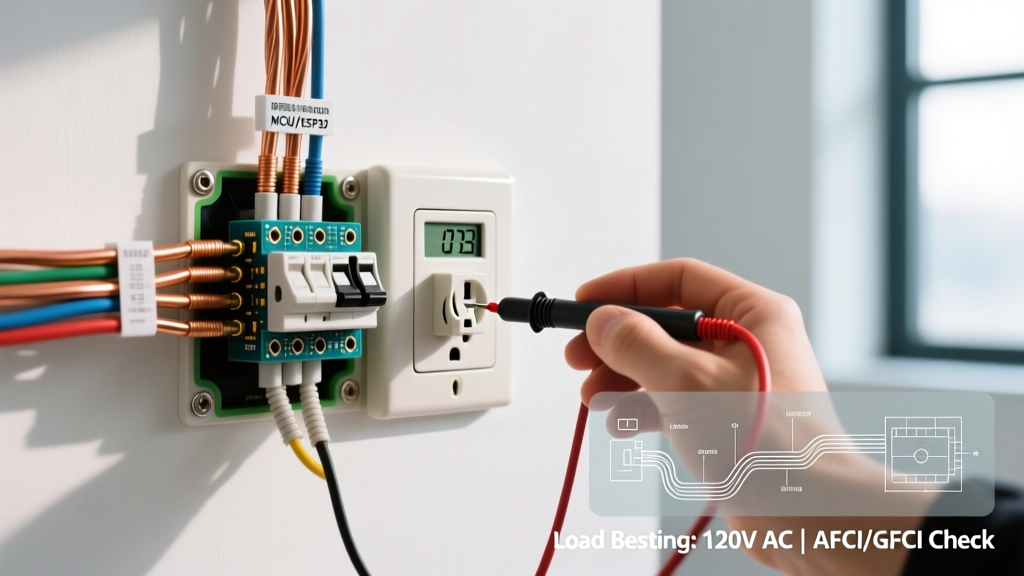
- Circuit Mapping and De-energization: Turn off the breaker and verify zero voltage using a non-contact tester and a multimeter. Never rely solely on a non-contact pen tester.
- Old Box Removal and Fishing: Cut the drywall at the new location. Use a flexible drill bit (e.g., Klein Tools 56207 72-inch flex bit) to drill through the studs between the old and new locations. Fish the new 12/2 or 14/2 NM-B cable, ensuring it matches the amperage of the circuit breaker.
- Box Installation: Insert the remodel box into the wall cavity and tighten the mounting screws until the plaster ears pull flush against the drywall. Do not overtighten, which can crack the drywall or warp the box.
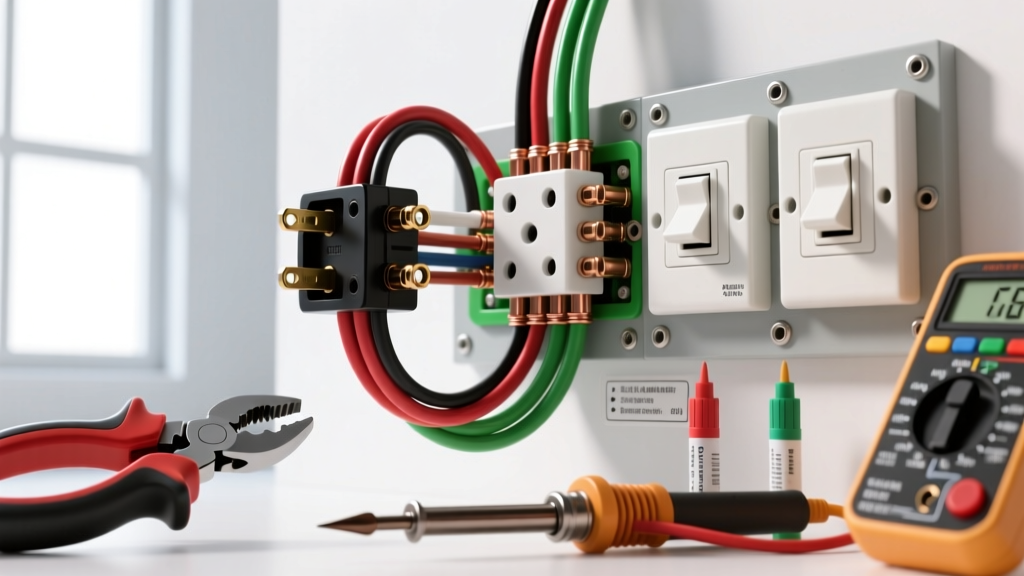
- Pigtailing and Termination: Code requires a continuous equipment grounding conductor. Use a green wire nut to pigtail the bare copper ground wires to the receptacle's grounding screw. Terminate the hot (black) and neutral (white) wires using the side-terminal screws, wrapping the wire clockwise. Never use the back-stab push-in connections, as they are a leading cause of high-resistance arcing failures over time.
- Device Mounting and Testing: Secure the TR or GFCI receptacle, install the faceplate, and restore power. Test GFCI and AFCI functions using the built-in test buttons, not just a plug-in tester.
Real-World Costs and Timeframes
Understanding the financial and temporal investment of relocating electrical outlet placements helps in planning renovations. For a standard single-outlet relocation in drywall (within 6 feet of the original box, no masonry or firebreaks involved), a DIY approach will cost between $25 and $45 in materials (remodel box, NM-B cable, TR receptacle, wire nuts) and take approximately 2 to 3 hours.
If you hire a licensed electrician, expect to pay between $175 and $350 per outlet relocation in 2026. This higher cost accounts for the electrician's minimum service call fee, drywall patching (which many electricians do not perform, requiring a separate drywall contractor), and the guarantee that the work will pass local municipal inspections. Always verify that your local jurisdiction has adopted the latest National Electrical Code standards, as local amendments can sometimes impose stricter rules regarding AFCI protection or kitchen spacing than the baseline NEC.
Final Inspection Considerations
Before closing up your drywall or scheduling a final inspection, double-check that the relocated outlet does not violate the 'face-up' rule in kitchens (NEC 406.5(E)), which prohibits receptacles from being installed in a face-up position in countertop work surfaces due to liquid spill hazards. Ensure all wire insulation extends into the box by at least 1/4 inch, and that no bare copper (other than the ground) is visible outside the terminal screw. By adhering strictly to these NEC articles, your relocated outlet will provide safe, reliable, and legally compliant power for decades.