
Understanding the Poland Electrical Outlet: The Type E Standard
When navigating international electrical installations, the poland electrical outlet presents a unique profile that blends rigorous European safety standards with distinct regional hardware preferences. Poland utilizes the Type E plug and socket system (officially designated as CEE 7/5 for the socket and CEE 7/6 for the plug). Operating on a standardized 230V supply voltage and 50Hz frequency, the Polish electrical grid demands strict adherence to both local regulations and harmonized European norms.
Unlike the German Schuko (Type F) system, which relies on two lateral grounding clips, the Polish Type E socket features a prominent, protruding male earth pin. This design choice fundamentally alters how receptacles are manufactured, installed, and tested. For DIY enthusiasts, electricians, and homeowners upgrading their properties in 2026, understanding the anatomical and regulatory nuances of the Type E outlet is critical for preventing electrical fires, ensuring equipment longevity, and passing municipal inspections.
Anatomical Specifications of the Type E Receptacle
The physical dimensions of the Type E system are governed by precise tolerances to ensure secure mating and reliable grounding. According to the World Standards Type E Guide, the socket must accommodate specific pin geometries:
- Live and Neutral Holes: Spaced 19mm apart, designed to accept 4.8mm diameter pins (older CEE 7/4 plugs used 4.0mm pins, but modern Type E sockets are engineered for the thicker 4.8mm standard to reduce contact resistance and heat generation).
- Earth Pin: A 4.8mm diameter, 24mm long male grounding pin protrudes from the socket face. This pin is offset from the live/neutral axis, forming an equilateral triangle.
- Recess Depth: The socket face is recessed by approximately 15mm to prevent accidental contact with live pins during partial insertion.
When purchasing receptacles in Poland, you will typically encounter 16A rated models. Standard models from manufacturers like Legrand (Celiane series) or Schneider Electric (Asfora series) cost between 18 PLN and 45 PLN ($4.50 to $11.50 USD), depending on the aesthetic finish and integrated shutter mechanisms.
Polish Electrical Code Compliance (PN-HD 60364 & SEP)
Electrical installations in Poland are strictly regulated by the PN-HD 60364 series of standards, which are the Polish adoptions of the IEC 60364 international low-voltage installation codes. Furthermore, practical compliance and electrician certifications are overseen by SEP (Stowarzyszenie Elektryków Polskich), the Polish Association of Electrical Engineers. Any permanent wiring or outlet replacement must align with SEP guidelines to ensure insurance validity and legal compliance.
Mandatory RCD Protection
As of the latest 2026 SEP recommendations, all general-purpose 16A Type E socket outlets must be protected by a 30mA Residual Current Device (RCD). However, the type of RCD matters significantly:
- Type AC RCDs: Now considered obsolete for new installations due to the proliferation of switch-mode power supplies and LED drivers that generate DC fault currents.
- Type A or Type F RCDs: Mandatory for modern Polish homes. These detect both pulsating DC and smooth DC residual currents up to specified thresholds.
- 10mA RCDs: Strictly required for socket outlets located in high-risk wet areas, such as bathrooms (outside restricted zones) or outdoor garden receptacles.
Bathroom Zone Compliance (PN-HD 60364-7-701)
Installing a Poland electrical outlet in a bathroom requires strict adherence to IP (Ingress Protection) zoning:
- Zone 0 (Inside bathtub/shower): No sockets permitted.
- Zone 1 (Directly above Zone 0 up to 2.25m): No sockets permitted.
- Zone 2 (60cm radius outside Zone 1): No standard sockets permitted; only specific shaver supply units (isolated transformers) are allowed.
- Outside Zones (Zone 3 equivalent): Standard Type E sockets are permitted but must be protected by a 30mA RCD and possess a minimum IP44 rating if subject to water splashing.
Step-by-Step Wiring Guide for Type E Outlets
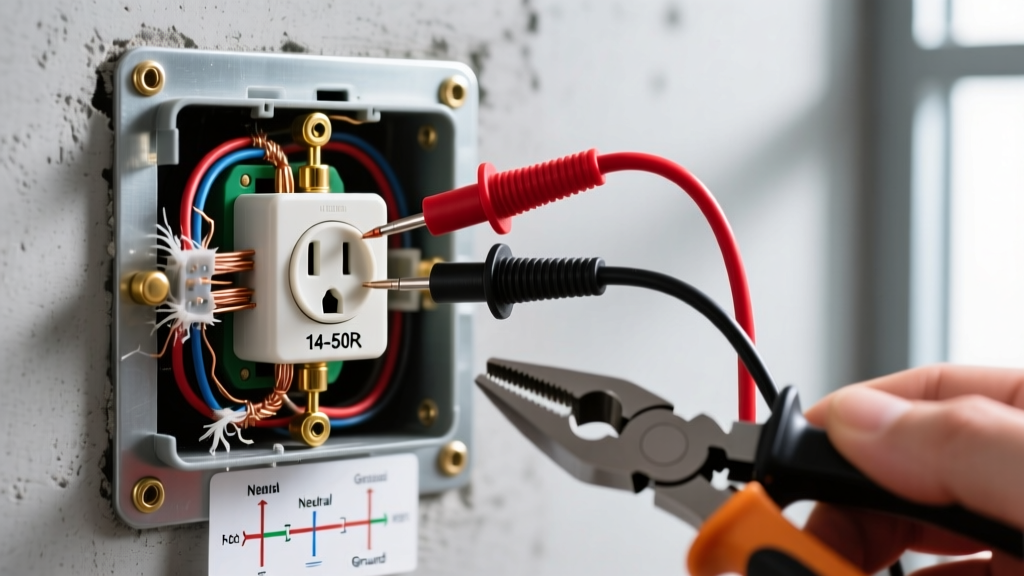
Wiring a Type E receptacle requires attention to the European harmonized color codes (IEC 60446 / HD 308) and precise mechanical termination. Always verify the circuit is de-energized using a CAT III or CAT IV non-contact voltage tester before beginning.
- Wire Preparation: Use a minimum of 2.5 mm² solid copper wire for 16A socket circuits. While 1.5 mm² is permissible for lighting, SEP strongly recommends 2.5 mm² for receptacles to mitigate voltage drop and provide mechanical resilience. Strip exactly 12mm to 14mm of insulation using a precision wire stripper to avoid nicking the copper conductor.
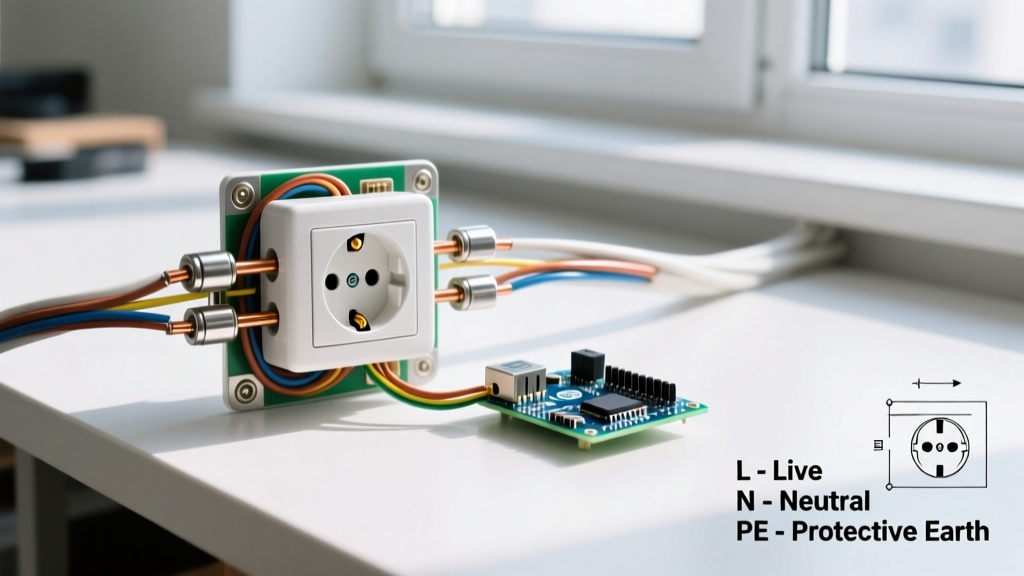
- Identify Terminals: The Type E socket will have three terminals. L (Line/Phase) is typically on the right when facing the socket. N (Neutral) is on the left. PE (Protective Earth) is connected to the protruding male pin.
- Color Code Matching:
- Brown: Connect to the L (Phase) terminal.
- Blue: Connect to the N (Neutral) terminal.
- Green/Yellow: Connect to the PE (Earth) terminal. Never use the green/yellow wire for any purpose other than grounding.
- Termination and Torque: Insert the stripped wires into the screw terminals. Tighten the screws to the manufacturer's specified torque, typically 1.2 Nm to 1.5 Nm for modern Legrand or Berker receptacles. Undertightening causes arcing and thermal runaway; overtightening can shear the copper strand or strip the brass terminal threads.
- Strain Relief: Ensure the outer cable sheath is clamped securely within the rear housing of the socket mechanism, not just the individual insulated wires. This prevents tension from pulling the live conductors out of their terminals.
Comparative Analysis: Type E vs. Type F vs. Type G
Understanding how the Polish standard compares to neighboring regions is vital for cross-border projects or importing appliances.
| Feature | Type E (Poland/France) | Type F (Schuko/Germany) | Type G (United Kingdom) |
|---|---|---|---|
| Grounding Method | Male pin in socket | Female clips on plug edges | Large rectangular top pin |
| Plug Compatibility | Accepts CEE 7/16, CEE 7/17 | Accepts CEE 7/16, CEE 7/17 | Strictly BS 1363 |
| Standard Fuse | Breaker/RCD at panel | Breaker/RCD at panel | Fused plug (3A, 5A, 13A) |
| Pin Diameter | 4.8mm | 4.8mm | Rectangular (varies) |
Note: Modern "hybrid" plugs (CEE 7/17) are designed with both a hole for the Type E earth pin and side contacts for the Type F Schuko clips, making them universally compatible across Poland and Germany.
Common Failure Modes and Edge Cases
The "Schuko" Compatibility Trap
A frequent error in older Polish installations (pre-2000s) is the presence of unmodified Type E sockets paired with older, pure Type F (Schuko) appliances. A pure Type F plug lacks the hole required for the Polish earth pin. If forced, the plug will not seat fully, leaving the live pins partially exposed—a severe shock hazard. Solution: Replace outdated appliances with hybrid CEE 7/17 cords, or upgrade the wall receptacles to modern dual-compatible Type E/F hybrid sockets, which are now standard in the Polish market.
Bootleg Grounding (False Earth)
In older communist-era blocks (Wielka Płyta), grounding infrastructure was sometimes inadequate. A dangerous, non-compliant practice known as "bootleg grounding" involves wiring a jumper between the Neutral terminal and the Earth terminal inside the socket. If the neutral wire breaks upstream or the phase/neutral are swapped at the panel, the metal chassis of any plugged-in appliance becomes energized at 230V. According to the Stowarzyszenie Elektryków Polskich (SEP), this is a critical violation. The only compliant fix is running a dedicated PE conductor back to the main distribution board or utilizing a localized TT grounding system with an RCD.
Thermal Overload from High-Draw Appliances
Polish kitchens frequently utilize high-wattage appliances like induction hobs and electric kettles. Plugging a 2000W kettle and a 2000W toaster into a dual Type E receptacle wired on a standard 16A breaker draws roughly 17.4A, tripping the breaker. However, if the breaker is degraded or the terminal screws are loose, the socket will overheat before the breaker trips. Always use a thermal imaging camera during post-installation inspections to verify that terminal temperatures do not exceed 40°C above ambient under full load.
Smart Home Integration for Type E Outlets
As of 2026, integrating smart monitoring into Type E circuits is highly popular for energy compliance. Devices like the Shelly Plus Plug S (priced around 75 PLN / $19 USD) or the TP-Link Tapo P110 slot directly into Polish Type E sockets. These devices not only allow remote switching but also monitor real-time power consumption, helping homeowners identify phantom loads and ensure they are not exceeding the 3.68kW (16A) limit of the receptacle. When installing smart plugs, ensure the physical shutter of the Type E socket is not obstructing the smart plug's earth pin, which can cause a poor ground connection.
Frequently Asked Questions
Can I use a US appliance in a Poland electrical outlet?
Directly, no. The US operates on 120V/60Hz, while Poland uses 230V/50Hz. Plugging a 120V appliance into a Polish Type E outlet via a simple physical adapter will instantly destroy the appliance and may cause a fire. You must use a step-down voltage transformer rated for the appliance's wattage, or verify that the appliance's power supply is dual-voltage (e.g., "100-240V ~ 50/60Hz" printed on the brick).
Are child-proof shutters mandatory in Poland?
While the International Electrotechnical Commission (IEC) outlines global safety baselines, Polish building codes (PN-HD 60364) strongly mandate or heavily incentivize integrated child-proof shutters for all Type E receptacles installed in residential dwellings, particularly in living rooms and children's bedrooms. Modern Legrand and Schneider models include these as standard.
What is the standard breaker size for a Type E socket circuit?
The standard overcurrent protection for a 2.5 mm² wire feeding 16A Type E sockets in Poland is a 16A Type B or Type C miniature circuit breaker (MCB). Type B is preferred for residential lighting and standard socket circuits to ensure rapid tripping during short circuits, while Type C is reserved for circuits with high inrush currents, such as those feeding workshop tools or large compressors.