
The Code Reality of an Open Ground Receptacle
When you plug a standard receptacle tester (like the Klein Tools RT210) into a wall outlet and the 'Open Ground' indicator illuminates, you are looking at a localized failure in your home's safety infrastructure. An open ground means the equipment grounding conductor (EGC) is either broken, disconnected, or entirely missing between the receptacle and the main service panel.
For homeowners and DIYers trying to figure out how to fix open ground electrical outlet problems, the internet is full of dangerous shortcuts. As a code requirement explainer, this guide bypasses the hacks and focuses strictly on National Electrical Code (NEC) compliant solutions. Whether you are dealing with a 1960s ungrounded circuit or a modern wire that was improperly terminated, the NEC provides specific, legal pathways to restore safety.
Diagnostic Note: Before attempting any repair, verify the open ground with a dedicated tester. A non-contact voltage tester cannot detect grounding faults. If your tester shows 'Open Ground,' turn off the breaker and verify zero voltage before opening the receptacle box.
The Illegal 'Bootleg Ground' Trap
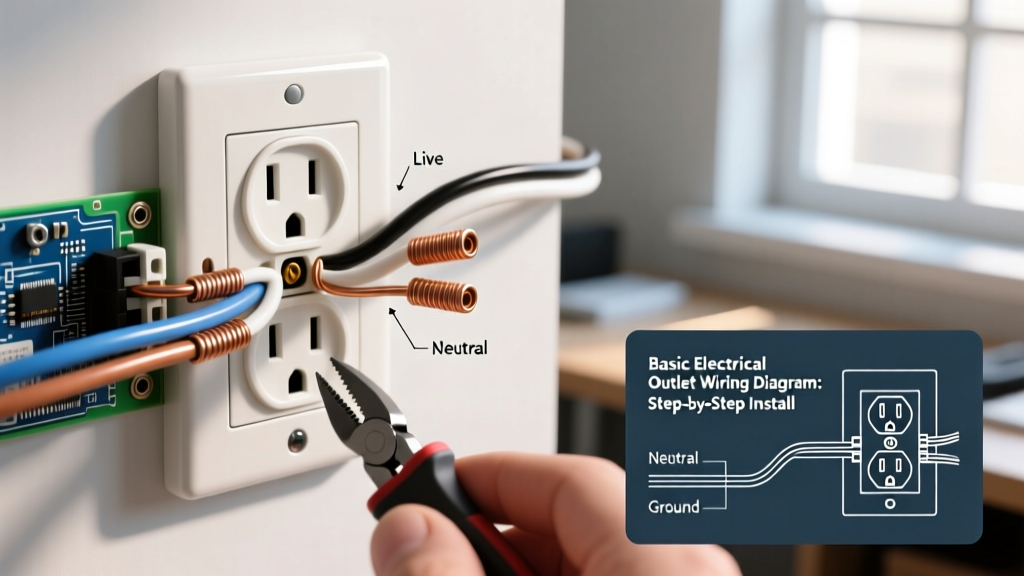
Before exploring legal fixes, we must address the most common and deadly code violation found in older homes: the bootleg ground. This occurs when a previous owner or handyman installs a jumper wire between the neutral (silver) terminal and the ground (green) terminal on a 3-prong receptacle.
This tricks standard plug-in testers into reading a 'Correct' wiring status, but it is exceptionally dangerous. The neutral wire carries return current. If the neutral connection ever breaks upstream, the metal casing of any appliance plugged into that outlet will become fully energized at 120 volts, posing a lethal shock hazard. The Electrical Safety Foundation International (ESFI) strictly warns against modifying neutral paths for grounding purposes. If you find a jumper wire during your inspection, remove it immediately.
NEC Article 406.4(D): The Rulebook for Ungrounded Receptacles
The NEC acknowledges that millions of older homes lack true equipment grounding. Rather than forcing homeowners to tear open every wall to rewire, the code offers specific remediation paths under NEC Article 406.4(D). When replacing a receptacle on an ungrounded or open-ground circuit, you must choose one of three code-compliant methods.
Method 1: GFCI Protection (The Legal 'Fake' Fix)
Under NEC 406.4(D)(2)(b), you are legally permitted to replace an open-ground receptacle with a Ground Fault Circuit Interrupter (GFCI). This is the most common and cost-effective solution.
- How it works: A GFCI does not create a ground. Instead, it monitors the current balance between the hot and neutral wires. If it detects a leakage of as little as 4 to 6 milliamps (indicating current is flowing through a person to the ground), it trips in milliseconds, preventing electrocution.
- Installation Specifics: Use a high-quality GFCI like the Leviton GFNT1-W or Hubbell GF520W. Connect the incoming hot and neutral wires to the 'LINE' terminals. Leave the 'LOAD' terminals empty unless you intend to protect downstream outlets.
- The Catch (Crucial Code Requirement): The NEC mandates that the receptacle faceplate must be labeled with the included sticker reading 'No Equipment Ground'. Furthermore, GFCI protection does not provide a path to ground for surge protectors. Plugging a sensitive PC or home theater system into a GFCI-protected open ground leaves the equipment vulnerable to voltage spikes.
Method 2: Equipment Grounding Conductor Retrofit
If you need a true ground for surge protection or specific appliances, NEC 250.130(C) allows you to retrofit a new Equipment Grounding Conductor (EGC) without replacing the entire cable. You can run a bare copper or green THHN wire from the receptacle box to any of the following:
- The main service panel's grounding busbar.
- A grounding electrode system (like a grounding rod or metal water pipe bonded to the service).
- The service equipment enclosure.
- Any accessible point on the existing grounding electrode conductor.
Wire Sizing: The retrofit ground wire must be sized according to NEC Table 250.122. For a standard 15-amp circuit, use 14 AWG copper. For a 20-amp circuit (kitchen/bathroom), you must use a minimum of 12 AWG copper. This wire can be fished behind drywall or run through surface-mounted conduit (like Legrand Wiremold) if wall access is impossible.
Method 3: Complete Circuit Rewiring
The ultimate, no-compromise fix is to abandon the old ungrounded cable and pull new NM-B (Romex) or Metal-Clad (MC) cable from the panel to the outlet. This provides a dedicated hot, neutral, and bare copper ground enclosed in the same jacket. While this guarantees full code compliance and surge protection, it requires extensive drywall repair and typically costs between $300 and $800+ per room when hiring a licensed electrician.
Comparing Open Ground Remediation Methods
To help you decide which path aligns with your budget and safety needs, review the comparison matrix below.
| Remediation Method | NEC Reference | Avg. DIY Cost | Surge Protection? | Shock Protection? |
|---|---|---|---|---|
| GFCI Receptacle | 406.4(D)(2)(b) | $18 - $28 | No | Yes (Excellent) |
| EGC Retrofit Wire | 250.130(C) | $30 - $60 | Yes | Yes (Excellent) |
| Full NM-B Rewire | 210.8 / 250.118 | $150 - $400+ | Yes | Yes (Excellent) |
| Bootleg Jumper | Code Violation | $0.10 | No | No (Lethal Hazard) |
Advanced Edge Cases: AFCI and Multi-Wire Branch Circuits
When fixing an open ground, you must also consider modern Arc Fault Circuit Interrupter (AFCI) requirements. Under NEC 210.12, if you are replacing an ungrounded receptacle in a bedroom, living room, or hallway, the circuit must now be protected by an AFCI breaker or an AFCI/GFCI dual-function receptacle. Standard GFCIs do not detect arc faults. If your panel lacks AFCI breakers, you must install an AFCI/GFCI combo receptacle (such as the Leviton AGTR1) at the first outlet in the circuit to satisfy current code cycles.
Additionally, if you discover a Multi-Wire Branch Circuit (MWBC) sharing a neutral wire between two hot legs, you cannot simply swap in a standard GFCI receptacle. MWBCs require simultaneous disconnect (a handle-tied 2-pole breaker) and specialized GFCI wiring configurations to prevent neutral overloading and ensure the GFCI coil functions correctly.
Frequently Asked Questions
Can I just use a 2-prong adapter (cheater plug)?
While a 3-to-2 prong adapter is technically legal if you screw the grounding tab into the metal faceplate screw, it relies on the outlet box being grounded via metal conduit (EMT or BX). If your tester shows an open ground, the box is not grounded, rendering the adapter useless and unsafe for high-draw appliances.
Does a GFCI fix the open ground for my refrigerator?
No. While a GFCI protects human life from shock, major appliances with metal chassis (refrigerators, washing machines, microwaves) require a true equipment ground to safely dissipate internal fault currents and static buildup. For these appliances, use Method 2 (Retrofit) or Method 3 (Rewire). Furthermore, the Consumer Product Safety Commission (CPSC) notes that GFCIs on dedicated appliance circuits can lead to nuisance tripping and spoiled food if not strictly required by local amendments.
Where can I find the exact code text for my jurisdiction?
The NEC is updated every three years (2017, 2020, 2023, and the upcoming 2026 cycle). You can review the baseline standards and adoption maps via the National Fire Protection Association (NFPA). Always check with your local Authority Having Jurisdiction (AHJ) or city building department, as local municipalities frequently amend the base NEC text regarding retrofit allowances.