
The Critical Role of Outlet Electrical Wire Sizing
Selecting the correct outlet electrical wire is not merely a matter of making a physical connection; it is the foundational safety mechanism that prevents thermal runaway, insulation melting, and structural fires. According to the U.S. Consumer Product Safety Commission (CPSC), electrical distribution and lighting equipment are involved in tens of thousands of home fires annually, with undersized conductors and loose terminations acting as primary culprits. When wiring a receptacle, the wire gauge must perfectly align with the overcurrent protection device (breaker) and the specific environmental conditions of the installation.
This guide decodes the National Electrical Code (NEC) requirements for branch circuit conductors, moving beyond basic DIY advice into the precise engineering and code mandates that licensed electricians follow. Whether you are installing a standard NEMA 5-15R in a living room or a heavy-duty NEMA 14-50R for an EV charger, understanding ampacity, temperature derating, and termination torque is non-negotiable.
Ampacity Matrix: Wire Gauge, Breakers, and Receptacles
The relationship between wire gauge (AWG), breaker size, and receptacle configuration is strictly governed by NEC Article 240. Below is the definitive matrix for standard residential copper conductors (NM-B / THHN) operating at standard temperatures.
| Wire Gauge (Copper) | Max Overcurrent (Breaker) | Standard Receptacle (NEMA) | Common Application |
|---|---|---|---|
| 14 AWG | 15 Amps | NEMA 5-15R (120V) | Bedrooms, Living Rooms, Hallways |
| 12 AWG | 20 Amps | NEMA 5-20R (120V) | Kitchens, Bathrooms, Laundry, Garages |
| 10 AWG | 30 Amps | NEMA 10-30R / 14-30R (240V) | Electric Clothes Dryers |
| 8 AWG | 40 Amps | NEMA 14-40R (240V) | Older Electric Ranges, Welders |
| 6 AWG | 50 Amps | NEMA 14-50R (240V) | EV Chargers, Modern Electric Ranges |
NEC 240.4(D): The Small Conductor Rule Explained
One of the most common and dangerous mistakes DIYers make is misinterpreting NEC Table 310.16. If you look at the 90°C column for THHN copper wire, 14 AWG appears to handle 25 Amps, and 12 AWG appears to handle 30 Amps. This is a code violation for standard branch circuits.
NEC Article 240.4(D) specifically overrides Table 310.16 for small conductors. It mandates the following maximum overcurrent protection limits regardless of the insulation's high-temperature rating:
- 14 AWG Copper: Maximum 15 Amps
- 12 AWG Copper: Maximum 20 Amps
- 10 AWG Copper: Maximum 30 Amps
This rule exists because the physical mass of smaller wires cannot dissipate heat fast enough during a sustained overload, even if the insulation itself can survive the temperature. Always size your breaker to the 240.4(D) limits, not the 90°C ampacity column.
Temperature Ratings and the 60°C Termination Rule
Under NEC 110.14(C), the ampacity of a circuit is limited by the lowest temperature rating of any connected component. Most standard 15A and 20A residential receptacles (such as the Leviton Decora or Hubbell Commercial lines) are rated for 60°C or 75°C terminations.
Even if you pull 12 AWG THHN wire (rated 90°C) through conduit, the ampacity must be calculated based on the 60°C or 75°C column because the receptacle's brass screw terminals are not tested or listed for 90°C heat dissipation. For standard NM-B (Romex) cable, the insulation is rated at 90°C, but the ampacity is permanently locked to the 60°C column per NEC 334.80. Therefore, 12 AWG NM-B is strictly limited to 20 Amps, and 14 AWG NM-B is limited to 15 Amps.
Voltage Drop: When to Upsize Your Outlet Electrical Wire
While the NEC does not strictly mandate voltage drop limits for standard residential branch circuits in the main text, Informational Note No. 4 in NEC 210.19(A) strongly recommends a maximum 3% voltage drop for branch circuits and 5% overall from the utility transformer to the furthest outlet.
Calculating Long Runs
If you are wiring a detached garage, a large backyard workshop, or an outdoor post light, distance matters. A 120V circuit carrying 16 Amps (a continuous load on a 20A breaker) will experience a voltage drop of approximately 3.2% over 100 feet using 12 AWG copper wire. To maintain code-recommended efficiency and prevent motor burnout on power tools, you must upsize the outlet electrical wire to 10 AWG for runs exceeding 75 feet on a 20A circuit.
Pro Tip: Voltage drop is calculated based on the actual load current, not the breaker size. However, sizing for the maximum continuous load (80% of breaker rating) ensures future-proofing and absolute safety.
Termination Torque: The Hidden Code Requirement
Since the 2017 NEC cycle, and reinforced in the 2023 and upcoming 2026 editions, NEC 110.14(D) requires that all electrical terminations be tightened to the manufacturer's specified torque using a calibrated torque tool. The Occupational Safety and Health Administration (OSHA) also enforces this in commercial environments to prevent arc flashes.
For standard 15A and 20A duplex receptacles, the manufacturer (e.g., Leviton, Eaton, Hubbell) typically specifies a tightening torque of 14 in-lbs (inch-pounds). Note that this is inch-pounds, not foot-pounds. Overtightening strips the brass screw threads or crushes the copper wire, reducing the cross-sectional area and creating a hot spot. Undertightening leads to micro-arcing, oxidation, and eventual thermal failure.
- Strip exactly 3/4 inch of insulation using a precision wire stripper (e.g., Klein 11055).
- Form a shepherd's hook and loop it clockwise around the terminal screw.
- Use a calibrated torque screwdriver (such as the Klein Tools 32500 or Ideal 36-160) set to 14 in-lbs.
- Tighten until the tool clicks or breaks over.
High-Ampacity Outlets: EV Chargers and Ranges (NEMA 14-50)
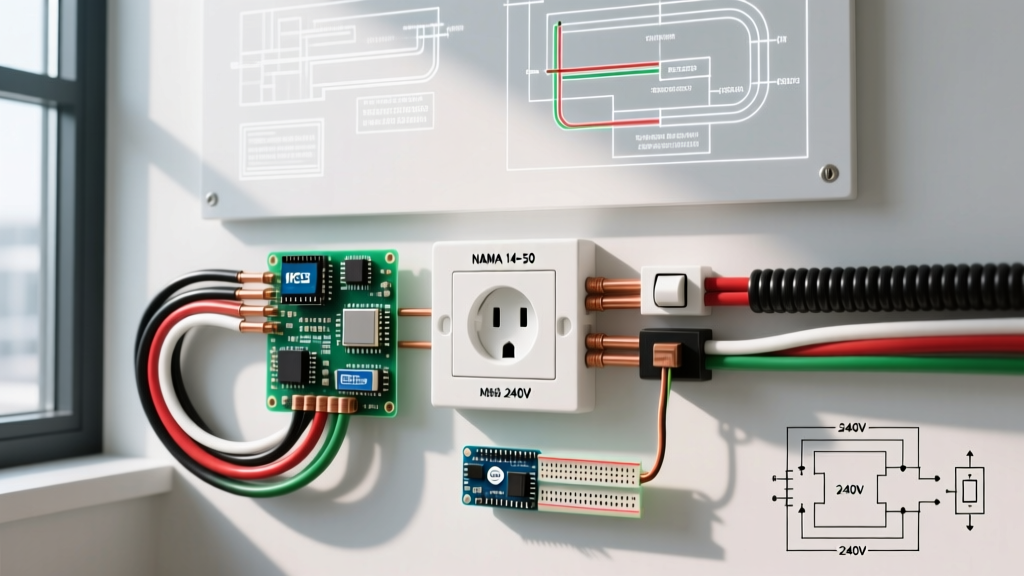
The surge in residential Electric Vehicle (EV) adoption has made the NEMA 14-50R (50A, 125/250V) one of the most common high-amperage outlets installed today. Wiring a 14-50 receptacle requires strict adherence to heavy-gauge protocols:
- Wire Size: Minimum 6 AWG Copper (THHN/THWN-2 in conduit) or 4 AWG Aluminum (XHHW-2).
- Breaker: 50 Amp, 2-pole.
- Neutral Requirement: Unlike older 3-prong dryer outlets, the 14-50 requires a dedicated neutral wire (white) and a dedicated equipment grounding conductor (green/bare). The neutral and ground must never be bonded at the receptacle.
- GFCI Mandate: Recent NEC updates (210.8) require GFCI protection for 14-50 receptacles installed in garages and outdoors. This means you must use a 50A 2-pole GFCI breaker, and the receptacle must be a standard 14-50R, not a GFCI receptacle (which are rarely manufactured for 50A configurations).
Edge Cases and Failure Modes to Avoid
The 'Backstabbing' Hazard
Many cheap receptacles feature push-in 'backstab' terminals that accept 14 AWG solid wire. While technically UL-listed, these spring-loaded connections are notorious for losing tension over time due to thermal cycling. The internal contact area is minuscule compared to a screw terminal. Always use the side screw terminals or a properly torqued screw-clamp plate.
Multi-Wire Branch Circuits (MWBC)
If you are wiring a kitchen using a 12/3 NM-B cable to feed two separate 20A circuits on a shared neutral, you are creating a Multi-Wire Branch Circuit. NEC 210.4 requires that both breakers be tied together with a handle tie or a single 2-pole breaker to ensure simultaneous disconnection. Furthermore, the neutral pigtail must be spliced in the box and run to the receptacle; you cannot daisy-chain the neutral through the receptacle's brass neutral screw, as removing the device would sever the neutral for the opposing phase, sending 240V through your 120V appliances.
Summary of Best Practices
Compliance with the NEC is the bare minimum for safety. To ensure a lifelong, fire-free installation, always match your outlet electrical wire to the breaker, respect the 60°C termination limits, calculate voltage drop for long runs, and use a calibrated torque screwdriver for every termination. When in doubt, upsize the wire and consult a licensed master electrician to verify your local jurisdiction's specific amendments to the national code.