
Wiring an Electrical Outlet in Norway: Navigating the IT-Nett Grid
For international electricians and DIY enthusiasts, installing an electrical outlet in Norway presents a unique challenge that rarely exists elsewhere in Europe. While most of the continent relies on a TN-C-S or TT grounding system with a standard 230V phase-to-neutral supply, approximately 70% of Norway’s power grid operates on an IT-nett (Isolated Terra) system. This fundamental difference dictates everything from wire color codes to the mandatory use of 2-pole residual current devices (RCDs).
This comprehensive wiring diagram reference breaks down the exact procedures, NEK 400 standard requirements, and hardware specifications needed to safely wire a Type F (Schuko) CEE 7/3 receptacle in both Norwegian IT and TN grid environments.
⚠️ CRITICAL SAFETY WARNING: In an IT-nett system, there is no traditional neutral wire. Both current-carrying conductors are live phases (230V phase-to-phase). Treating an IT-nett wire as a neutral will result in severe shock hazards and equipment destruction. Always verify the grid type at the distribution board before beginning work.
Grid Topology Comparison: IT-Nett vs. TN-Nett
Before touching a single terminal screw, you must identify the local grid topology. The Norwegian Directorate for Civil Protection (DSB) mandates strict adherence to local grid parameters. Below is a technical comparison to help you identify your system.
| Parameter | IT-Nett (Isolated Terra) | TN-C-S / TN-Nett |
|---|---|---|
| Voltage | 230V AC (Phase-to-Phase) | 230V AC (Phase-to-Neutral) |
| Conductors to Outlet | L1 (Phase 1), L2 (Phase 2), PE | L (Phase), N (Neutral), PE |
| Neutral Presence | No (L2 acts as return path) | Yes (Blue wire) |
| First Earth Fault | Does not trip breaker (Alarm only) | Trips breaker / RCD immediately |
| RCD Requirement | 2-Pole RCD (Type A or B) Mandatory | 1-Pole or 2-Pole RCD (Type A) |
| Prevalence in Norway | ~70% (Rural, Suburban, Older Urban) | ~30% (New Urban Developments) |
NEK 400 Color Codes & Terminal Mapping
The Norwegian Electrotechnical Committee (NEK) harmonizes with IEC 60446 for color coding, but the application differs based on the grid. For a standard 16A socket circuit, you will typically be pulling 2.5mm² rigid copper cable (e.g., PFSP or PN).
IT-Nett Color Mapping (230V 2-Phase)
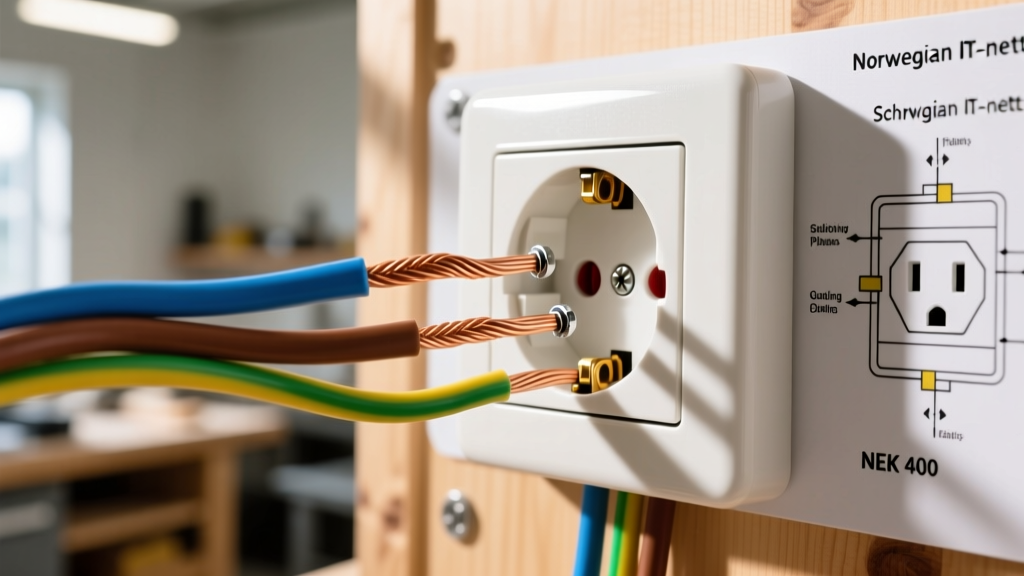
- Phase 1 (L1): Brown (Connected to Left Schuko Pin)
- Phase 2 (L2): Black or Grey (Connected to Right Schuko Pin)
- Protective Earth (PE): Green/Yellow (Connected to Top/Bottom Earth Clips)
TN-Nett Color Mapping (230V Phase-Neutral)
- Phase (L): Brown (Connected to Left Schuko Pin)
- Neutral (N): Blue (Connected to Right Schuko Pin)
- Protective Earth (PE): Green/Yellow (Connected to Top/Bottom Earth Clips)
Step-by-Step Wiring Diagram Reference: Type F (Schuko)
The standard Type F (Schuko) CEE 7/3 outlet features two 4.8mm round pins and two earthing clips on the top and bottom edges. Unlike UK or US outlets, Schuko sockets are generally non-polarized, meaning L1 and L2 (or L and N) can technically be swapped, though maintaining consistent polarity across a dwelling is best practice for single-pole smart switches.
Phase 1: Preparation & Stripping
- Isolate the circuit at the main distribution board (Sikringsskap). Lock out and tag out (LOTO) the MCB.
- Verify zero voltage using a CAT III/IV multimeter. In an IT-nett, test L1 to PE, L2 to PE, and L1 to L2.
- Strip the outer cable sheath to expose 150mm of inner conductors.
- Strip exactly 12mm of insulation from the 2.5mm² copper cores. Do not nick the copper, as this creates a high-resistance hot spot.
Phase 2: Terminal Termination
- Earth First: Insert the Green/Yellow wire into the central PE terminal block. Tighten to the manufacturer's torque specification (typically 1.0 Nm to 1.2 Nm for 2.5mm² wire).
- Live Conductors: Insert Brown (L1) and Black/Grey (L2) into the left and right terminal holes. Ensure no bare copper is visible outside the terminal collar, and no insulation is trapped inside the clamp.
- Tension Test: Apply a firm tug (approx. 30N of force) to each wire to ensure the screw clamps have properly bitten into the copper.
Phase 3: Mounting & Alignment
- Fold the wires into the backbox (standard Norwegian flush-mount boxes are 54mm or 68mm deep; use 68mm for smart sockets with deep electronic modules).
- Secure the outlet chassis to the box using the included M3.5 mounting screws.
- Use a spirit level to ensure the Schuko faceplate is perfectly horizontal before tightening the cover plate.
Recommended Hardware for 2026 Installations
When sourcing materials, avoid cheap imported clones that lack proper earthing mass. The Norwegian market is dominated by high-quality, halogen-free thermoplastic designs that withstand high torque and thermal cycling.
- Elko Plus 1205000 (Schuko Socket): The industry standard in Norway. Features robust screw terminals, integrated child protection shutters, and a depth of just 22mm, making it ideal for shallow 54mm backboxes. Price range: $12 - $18 USD.
- Schneider Electric Exxact CEE 7/3: Premium aesthetic with excellent terminal accessibility. Compatible with the Schneider Wiser Zigbee/Matter ecosystem for smart home upgrades. Price range: $20 - $28 USD.
- Testing Equipment: The Fluke 1664 FC multifunction installer is highly recommended. It features a specific IT-nett testing mode that prevents the tester from falsely tripping the grid's insulation monitoring devices during loop impedance tests.
Mandatory Safety: RCDs (Jordfeilbryter) in IT Grids
A common failure mode for foreign electricians working in Norway is installing a standard 1-pole+N RCD on an IT-nett circuit. Because the IT grid lacks a true neutral referenced to earth, a 1-pole RCD cannot establish a reference voltage and will fail to trip during an earth fault.
The NEK 400 Solution: You must install a 2-pole RCD (Type A or Type B) rated at 30mA for socket outlets. A 2-pole RCD monitors the vector sum of L1 and L2. If current leaks to the PE wire (e.g., a user touches a faulty metal appliance chassis), the magnetic flux in the toroidal core becomes unbalanced, tripping the mechanism in under 40 milliseconds.
FAQ: Troubleshooting Norwegian Outlets
Why does my voltage tester show 230V between Earth and one of the Live pins?
In a TN-nett, Phase-to-Earth is 230V, and Neutral-to-Earth is ~0V. In an IT-nett, if an earth fault exists elsewhere on the grid (which is not uncommon in older rural networks), the phase-to-earth voltages can shift drastically (e.g., L1-PE = 0V, L2-PE = 230V). Always measure Phase-to-Phase (L1 to L2) to confirm your true 230V supply.
Can I use a US/UK 110V-240V travel adapter in a Norwegian Schuko outlet?
Yes, modern switch-mode power supplies (laptops, phone chargers) rated 100-240V will work perfectly. However, the physical adapter must support Type F (Schuko) grounding clips. Using an ungrounded Europlug (Type C) adapter for a Class I appliance (like a desktop PC) removes the protective earth path, violating safety principles and risking shock if the internal PSU fails.
What is the maximum cable run for a 16A socket circuit?
Using 2.5mm² copper cable on a 16A MCB (Type C curve), the maximum run to maintain a voltage drop of less than 3% (approx 7V) and ensure the magnetic trip of the breaker activates during a short circuit is typically around 45 to 55 meters, depending on the specific IT-nett transformer impedance. Always calculate the exact loop impedance (Zs) using a certified tester.